
Series: History of Chamba, Himachal Pradesh, India
Phase 3: Culture & Art — Part 15 of 30
This article belongs to a historical series examining how expanding empires and regional powers reshaped life in the western Himalayan hills. As external influences pressed into the mountains, local rulers navigated diplomacy, resistance, and accommodation. This phase explores how wider political currents intersected with entrenched hill traditions, altering governance without entirely displacing older structures.
In the Valley at Dawn
The first rays of sunlight spill softly across the Ravi valley, touching the sloping rooftops of Chamba’s old town. Even today, villagers gather at the temple steps, wrapped in woolen cholas and vibrant pattu, exchanging greetings in a language both melodic and ancient. For centuries, these hills have been a crossroads—not just of rivers and ridges, but of languages, beliefs, and traditions as enduring as the stones beneath their feet.
Chamba: A Tapestry of Peoples and Tongues
Long before the Rajput chieftains of legend or the chronicles of Persian chroniclers, the region known as Chamba was a mosaic of small settlements. The earliest communities—descendants of indigenous tribes—spoke dialects that echoed across the northern Himalayas. The Doms, Gaddis, and Gujjars, among others, moved through the valleys and high passes, their speech shaped by isolation and exchange. Oral lore, preserved through generations, hints that the Chamba region was already a meeting place by the early centuries CE, when trade routes threaded from Kashmir and Ladakh towards the plains.
By the 6th and 7th centuries, as small hill states began to coalesce, the language that would become Chambeali started to take form. Early travelers and gazetteers noted the distinct intonations and vocabulary, layered with Prakrit roots and later Sanskritic influences. While Persian and Dogri left their imprints during subsequent centuries of political change, the core of Chambeali retained its local flavor—a testament to the region’s stubborn distinctiveness.
Folk Dress: Weaving Identity in Wool and Color
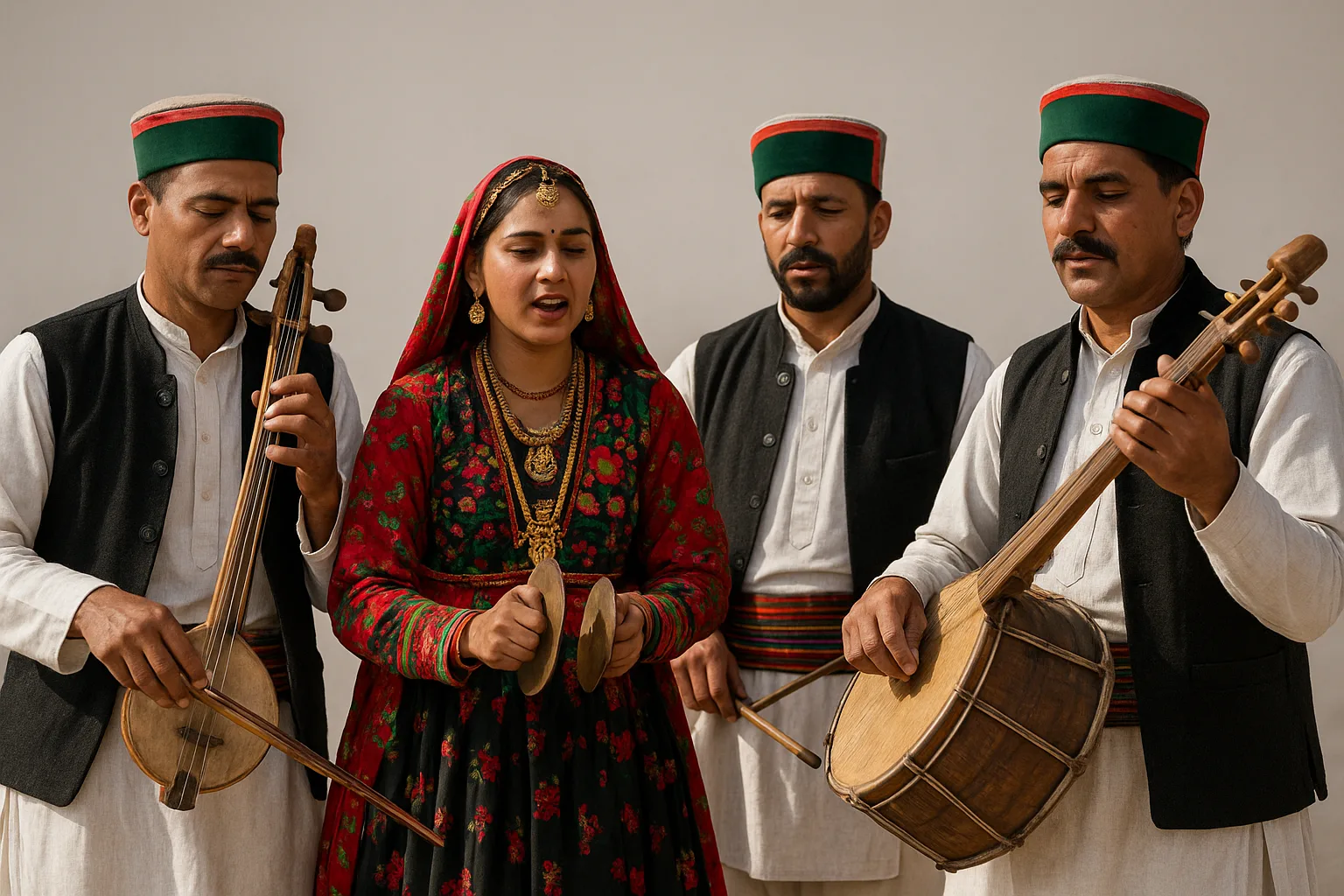
Picture a wedding procession winding through narrow mountain lanes: women in bright luanchadi (long skirts) and embroidered cholis, men wearing tightly woven cholas and distinctive caps. These garments are more than protection against the biting Himalayan cold; they are statements of belonging and status, woven with motifs that recall ancient migrations and local legends.
The pattu, a hand-woven woolen shawl, is perhaps the most iconic symbol of Chamba attire. Local traditions maintain that certain patterns are reserved for specific communities or occasions—a subtle but powerful marker of social order. The distinctive Chamba topi (cap), rimmed with red or green, is worn by elders and youth alike, its style tracing back to the region’s early medieval courts.
Unlike the dress of the neighboring Kangra or Kullu valleys, Chamba’s attire draws from both indigenous and Rajput influences. As documented in 19th-century gazetteers, the arrival of Rajput clans fleeing the Mughal invasions introduced new silks and embroidery styles, which mingled with local wool and dyeing traditions. The result is a vocabulary of dress that continues to signal heritage and adaptation.
Oral Traditions and Living Myth
In Chamba, the spoken word is as much a vessel of history as the written manuscript. Tales of Raja Sahil Varman, the founder of the Chamba kingdom in the 10th century, live on in epic chants and festival songs. Yet these oral traditions do more than recount royal deeds—they encode the rhythms of agricultural life, ancient migration, and cosmic order.
Myth and memory intermingle freely in these hills. Stories of the local serpent deities—the nag devtas—are told alongside accounts of Buddhist wanderers and Rajput warriors. While historians distinguish between these oral myths and the evidence of copperplate inscriptions or Persian chronicles, both are essential to understanding Chamba’s self-image. The Minjar fair, for example, commemorates the annual arrival of maize, but its rituals evoke older fertility cults and the region’s relationship with the Ravi River.
Belief Systems and the Sacred Landscape
Chamba’s religious landscape is a palimpsest: Buddhist influences from the early centuries CE linger in rock-cut shrines and iconography, while Shaivism and Vaishnavism gained ascendancy under later rulers. The hill states that emerged from the 9th century onward—Chamba among them—were shaped by both local animist practices and the formalization of Hindu ritual.
Sanctuaries dedicated to Shiva, Devi, and Nagas dot the mountain slopes, their festivals drawing villagers from across the valleys. The Gaddi shepherds, whose semi-nomadic migrations connected Chamba to distant Himalayan pastures, maintained a distinct set of rituals—honoring local spirits and ancestral guides as much as the great gods of the subcontinent. Even today, folk healers and priests recite ancient mantras in dialects that predate formal temple Sanskrit.
These belief systems are not static relics. The annual procession of the Sui Mata temple, honoring a legendary queen who sacrificed herself for Chamba’s water supply, blends historical memory with mythic reverence, reinforcing communal bonds across generations.
Trade, Migration, and Cultural Exchange
The mountain passes that encircle Chamba have long been arteries of exchange. From the early medieval period, traders and pilgrims traversed these routes, bringing salt, wool, spices, and news of distant lands. The Silk Route’s northern branches touched the region, linking it to the bustling markets of Tibet, Kashmir, and the Punjab plains.
These exchanges left marks not only on Chamba’s economy, but on its language and traditions. Itinerant bards carried stories from court to court, while merchants introduced new musical instruments and textile patterns. The region’s chronicles record diplomatic marriages and alliances with neighboring hill states—Kangra, Bashahr, and Jammu—each interaction subtly altering Chamba’s cultural fabric.
By the time British administrators compiled their detailed gazetteers in the 19th century, they found a society fiercely proud of its independence, but deeply enmeshed in the wider world—a legacy visible in every facet of its folk traditions.
From Ancient Roots to Living Heritage
The language, dress, and folk traditions of Chamba are not museum pieces. They are lived realities, constantly reinterpreted yet anchored in a past that stretches across centuries. The choli and topi appear at village festivals and urban gatherings alike; the old riddles and ballads are sung by schoolchildren and elders in the same breath. This resilience—born of adaptation and memory—gives Chamba its distinct place in the Himalayan story.
As we continue this series, the next post will explore the evolution of Chamba’s visual and performing arts, tracing how miniature painting and folk theatre became new expressions of the region’s enduring soul.
Previous: Festivals That Defined Chamba’s Culture
Next: British Relations with the Chamba State