
Series: History of Sirmaur, Himachal Pradesh, India
Phase 3: Religion & Culture — Part 15 of 30
This article belongs to a historical series examining how expanding empires and regional powers reshaped life in the western Himalayan hills. As external influences pressed into the mountains, local rulers navigated diplomacy, resistance, and accommodation. This phase explores how wider political currents intersected with entrenched hill traditions, altering governance without entirely displacing older structures.
Stone, Silence, and Sunrise: Sirmaur’s Living Heritage
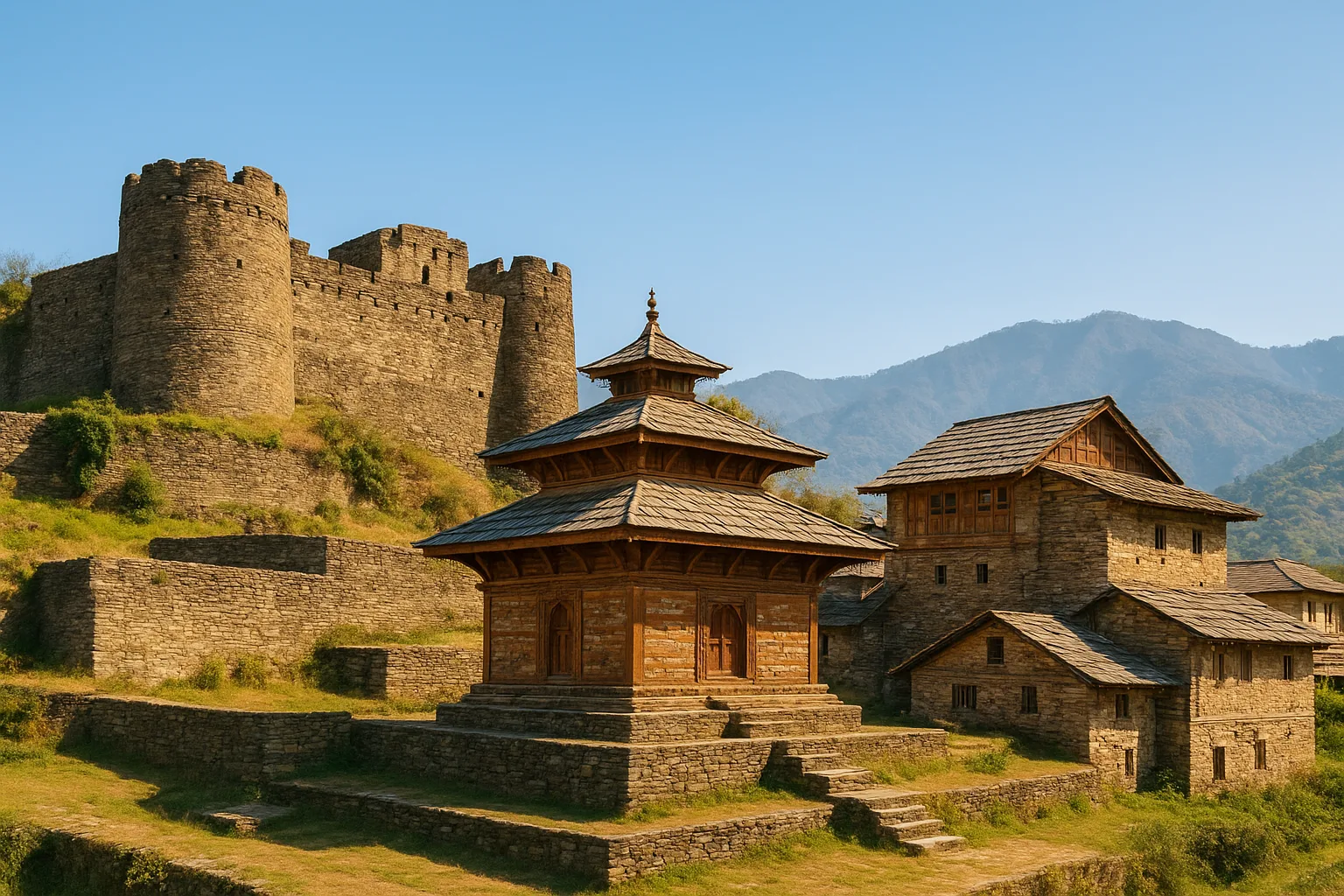
Dawn breaks over the mist-laden ridges of Sirmaur. The wind stirs through lofty deodar forests, carrying the faint scent of resin and wood smoke. Below, in the folds of the lower Himalayas, ancient stones catch the first golden light—walls, shrines, and homes etched with centuries of memory. Here, architecture is more than shelter; it is testimony. Each fort, temple, and dwelling tells a story of faith, fortitude, and community, rooted in the heart of Himachal Pradesh’s Sirmaur district.
Between Legend and Chronicle: Early Settlements Unfold
Much of Sirmaur’s earliest past lingers in the echo between spoken legend and sparse inscription. Oral traditions, lovingly preserved by generations, speak of a land shaped by sages and spirits, where the gods themselves wandered these hills. In the folk imagination, sites like the Shivalik foothills are sanctified by the footsteps of ancient rishis. Yet, as the 11th-century copper plates and later British-era gazetteers confirm, human settlement here has always been shaped by geography: deep valleys for water and grain, high ridges for defense, and the vital arteries of trade winding along the Yamuna, Giri, and Tons rivers.
By the early medieval period, small principalities began to emerge, each fortified against rivals and raiders. The chronicles of Sirmaur’s rulers—such as those unearthed from Rajban and Nahan—hint at a region both fiercely independent and deeply interwoven with the wider Himalayan world.
Forts on the Frontier: Stones that Guarded the Hills
The earliest forts of Sirmaur were pragmatic and formidable, rising from the rock itself. Oral traditions recall the legendary fortresses of Jaitak and Kamrau, perched atop strategic spurs. The Jaitak Fort, for instance, stands as a silent sentinel over the Giri valley—its battered ramparts now softened by moss and wildflowers. Built in the 18th century by Raja Ranjor Prakash, Jaitak became the stage for a fierce Anglo-Gorkha conflict in 1814–1815, an episode well documented in the Sirmur State Gazetteer and British military reports.
- Defensive Design: The fort’s high stone walls, narrow approaches, and concealed cisterns were responses to both the natural environment and the realities of siege warfare.
- Living Spaces: Within these walls, rulers and soldiers alike found refuge. The remains of granaries and audience halls still offer clues to daily life under constant threat.
Other hill forts—less imposing than Jaitak but no less significant—dot the landscape: Rajgarh, Haripur, and the vanished strongholds remembered in local ballads. Each was both a bastion and a symbol of shifting allegiances as Sirmaur’s ruling house navigated the turbulence of Mughal, Sikh, and British ambitions.
Temples Between Heaven and Earth
Where stone fortresses stood for power, Sirmaur’s temples spoke to faith. The temple architecture of the region, much like its belief systems, blends influences from the plains with the artistry of the hills. Wooden sanctuaries with intricately carved doors—such as those at Trilokpur and Renuka—stand beside more austere stone shrines. The latter often occupy dramatic settings: ridgelines, riverbanks, or the sacred lakes revered in both myth and memory.
- Trilokpur Temple: Founded in the 16th century, this iconic Devi shrine draws pilgrims from across northern India. Its whitewashed stone shikhara and timbered mandapa reflect both local craftsmanship and the enduring allure of the goddess tradition.
- Renuka Ji: At the edge of the serene Renuka lake sits one of Sirmaur’s oldest shrines, said by legend to honor the mother of Parashurama. While the temple’s origins are shrouded in oral lore, the site’s continuous worship and annual fairs are well attested in early state records.
Much of the region’s temple architecture is characterized by the katth-kuni style—a technique of alternating timber and stone, well suited to the seismic realities of the Himalayas. Richly carved wooden brackets, mythic motifs, and painted panels reveal both the aesthetic and spiritual values of successive generations.
Homes in Harmony: The Living Architecture of Sirmaur
Beyond palaces and shrines, it is the humble village home that most intimately reflects Sirmaur’s cultural continuity. Traditional houses—ghar—are shaped by necessity and tradition. Oral histories as well as early district surveys describe multi-storeyed dwellings built on steep slopes, their stone plinths anchoring them against monsoon torrents and tremors alike.
- Materials and Methods: Walls of local stone, joined with mud or lime mortar, insulate against winter cold. Heavy slate roofs and deep eaves shield from the mountain rains. Verandas, supported by carved wooden posts, serve as both workspace and social space.
- Community and Custom: Homes often cluster around central courtyards, shared wells, and communal threshing floors. The placement of shrines, grain stores, and cattle sheds within the domestic compound mirrors both belief and practical need.
These architectural choices, passed from parent to child, are visible in villages from Shillai to Paonta Sahib. They echo a deep understanding of the land—its perils, its bounty, and its seasons of hardship and celebration.
Trade, Pilgrimage, and the Flow of Influences
Sirmaur’s built environment did not develop in isolation. Historical records and the accounts of early travelers attest to the region’s role as a crossroads of commerce and faith. The ancient trade routes linking the plains of Haryana and Punjab to the high Himalayan valleys brought not only goods—salt, wool, grain—but also new ideas in art, ritual, and construction.
Stone masons from Kangra, woodcarvers from the Jaunsar-Bawar region, and itinerant priests contributed skills and stories that gradually became part of Sirmaur’s own architectural idiom. Temples adapted motifs from distant shrines; forts incorporated defensive innovations from neighboring states. The process was not one of mere imitation but of adaptation, as the communities of Sirmaur made each influence their own.
Echoes in the Present: Continuity and Change
Today, visitors to Sirmaur might still find a shepherd pausing beside an ancient shrine, or a family gathering in the shadow of a centuries-old fort. The lines between myth and memory, history and daily life, remain blurred yet meaningful. Despite pressures of modernization—concrete replacing carved wood, tin supplanting slate—the essential logic of Sirmaur’s architecture endures: resilience, reverence, and rootedness.
As we move deeper into Sirmaur’s story, the next part of this series will delve into the festivals, rituals, and intangible heritage that animate these enduring spaces—revealing how the spirit of the past continues to shape the life of the region today.
Previous: Festivals and Ritual Life in Traditional Sirmaur
Next: British Entry into the Sirmaur Hills