
Series: History of Kinnaur, Himachal Pradesh, India
Phase 3: Religion & Culture — Part 12 of 30
This article belongs to a historical series examining how expanding empires and regional powers reshaped life in the western Himalayan hills. As external influences pressed into the mountains, local rulers navigated diplomacy, resistance, and accommodation. This phase explores how wider political currents intersected with entrenched hill traditions, altering governance without entirely displacing older structures.
At the Crossroads of the Old Hindustan–Tibet Road
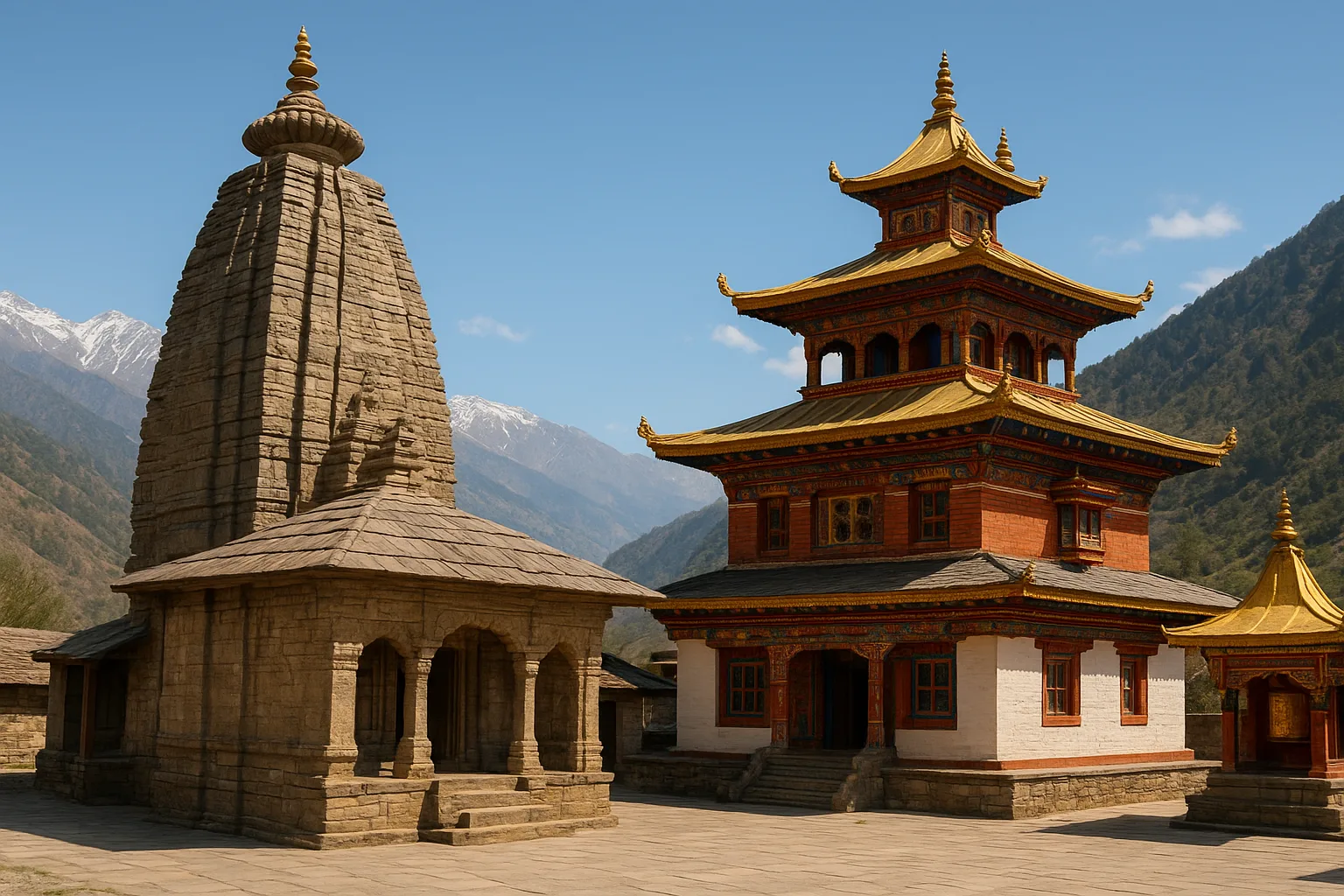
It is dawn in a Kinnauri village, centuries ago. The blue-grey shadows of the Sutlej gorge retreat as sunlight spills across terraced fields. In the courtyard of a wooden temple, elders gather, weaving marigold garlands. Their chants drift on the cold air—part Sanskrit, part Tibetan; devotion offered to both Shiva and Padmasambhava. This is not an unusual scene, but the living pulse of Kinnaur, where two spiritual worlds have melded beneath snow-capped peaks.
An Ancient Frontier: Kinnaur’s Historical Setting
Kinnaur occupies a liminal zone. Bordered by Tibet to the east and the Indian plains to the south, its deep valleys and high passes have long invited movement—and mingling. Early references to the region appear in the ancient Hindu epic, the Mahabharata, as the land of the Kinnaras—mythical beings with human and celestial traits. Later, the region is listed among the “Himalayan borderlands” in Mughal-era chronicles and the British Gazetteers of the 19th century, noted for its distinctive customs and faiths.
This was never an isolated world. The Sutlej River, slicing through Kinnaur’s heart, was both a barrier and a conduit. From the earliest settlements—clusters of stone houses perched above the torrent—Kinnaur’s people traded salt, wool, and turquoise with both Indian and Tibetan neighbors. These exchanges carried not only goods, but also gods and stories.
Mythic Memories and Oral Traditions
Oral tradition retains a powerful grip in Kinnaur. Local legends describe the Pandavas’ exile here, and claim divine origins for the region’s ruling clans. Many villages trace their founding to semi-mythic figures: yogis, Buddhist saints, or wandering ascetics who tamed the wild landscape. The Kinnauris themselves, in their songs and festivals, speak of a world alive with spirits—deotas—guardians who mediate between humans and the unseen.
Yet these tales often evade strict religious boundaries. The same deity might be venerated as both a Hindu god and a Buddhist protector, their shrines standing side by side. In the annual Phulaich festival, for example, offerings are made to both local deities and bodhisattvas, the rituals blending seamlessly.
Emergence of Hill States and Early Communities
By the early medieval period, Kinnaur became part of a shifting mosaic of hill polities. The region was never a single kingdom, but a patchwork of principalities—Bushahr chief among them. These states, documented in later gazetteers and oral genealogies, maintained their autonomy by balancing between powerful neighbors: the Buddhist-ruled west Tibetan kingdoms, and Hindu Rajput states to the south.
Communities in Kinnaur developed distinctive institutions. The devta system—the collective worship of village gods—regulated local governance, land, and justice. But alongside the village temples, Buddhist gonpas (monasteries) appeared, especially in the upper valleys. Monks and lamas, often invited from Spiti and Tibet, introduced new rituals, sacred texts, and artistic forms. Yet they did not displace older beliefs: instead, they adapted, translating Buddhist doctrine into the idiom of mountain spirits and ancestral gods.
Trade, Pilgrimage, and the Flow of Ideas
Kinnaur’s position on the Hindustan–Tibet road was crucial. Each summer, caravans wound up from Rampur and down from Tsaparang, carrying not only salt and wool, but also sacred images, manuscripts, and rumors of distant lands. Pilgrims undertook the arduous journey to Mount Kailash, passing through Kinnaur’s gorges and villages. The great trans-Himalayan fairs—still remembered in oral history—brought together Sadhus, lamas, traders, and ordinary families. Such gatherings were fertile ground for cultural exchange.
By the 10th century, the influence of the great Buddhist centers of western Tibet was unmistakable. Monasteries like Tabo, just beyond Kinnaur’s border, drew artists and monks from across the Himalayas. Yet, even as stone stupas and prayer flags appeared, the old wooden temples, with their carved Hindu iconography, remained central to village life.
Syncretic Belief in Daily Life
In Kinnaur, syncretism is not an abstraction but a lived reality. Village households keep both tormas (Buddhist ritual cakes) and prasad (Hindu offerings) on their altars. Ritual specialists—some called lhamo (Buddhist oracle), others pujari (Hindu priest)—may serve the same community. The recitation of Buddhist mantras mingles with the singing of Hindu hymns during festivals, and sacred spaces are rarely exclusive: a single temple may house images of Shiva, Parvati, Padmasambhava, and Avalokiteshvara.
Social organization reflects this fusion. Kinnauri society—divided into upper-caste kanets, priestly shilpkar, and trading bodh—has absorbed both Hindu and Buddhist customs, including the practice of polyandry and joint family systems. Marriage rituals might invoke both Vedic and Buddhist blessings, underscoring a pragmatic approach to faith.
Legacy: The Enduring Harmony of Two Faiths
Today, the temples of Kinnaur continue to echo with chants that borrow from two worlds. The rhythms of agriculture, the cycles of pilgrimage, and even the architecture of villages bear witness to a syncretism that is both ancient and evolving. In a modern India often marked by religious boundaries, Kinnaur quietly preserves a tradition of shared sacredness—an inheritance from centuries of open borders, trade, and the resilience of mountain communities.
As we continue through this series, the next part will delve into the living rituals and festivals of Kinnaur, tracing how these ancient spiritual currents shape community life amid the dramatic Himalayan landscape.
Previous: Arrival and Spread of Buddhism in Kinnaur
Next: Local Deities and Animistic Beliefs of Kinnaur