
Series: History of Kullu, Himachal Pradesh, India
Phase 3: Religion & Culture — Part 12 of 30
This article belongs to a historical series examining how expanding empires and regional powers reshaped life in the western Himalayan hills. As external influences pressed into the mountains, local rulers navigated diplomacy, resistance, and accommodation. This phase explores how wider political currents intersected with entrenched hill traditions, altering governance without entirely displacing older structures.
Twilight in the Valley: An Ancient Gathering
The October air in the Kullu valley carries a faint chill, scented with cedar and pine. At dusk, the hills glow gold, and distant drums echo along the Beas River. Here, long before festival crowds filled the maidan, the seeds of Kullu Dussehra were sown. Each year, as autumn descended, the valley’s people—shepherds, artisans, royalty—gathered beneath the shadow of the Himalayas, their lives shaped by a landscape both beautiful and perilous.
The Land Before the Festival: Early Kullu and Its People
The Kullu valley, cradled between forbidding mountains and fed by the Beas, has long been a crossroads. Well before recorded history, this highland was inhabited by communities whose traces remain in oral tales and archaeological fragments. The earliest known settlers—possibly the Kol or Koli, later joined by the Kanets and Gaddis—subsisted on agriculture, animal husbandry, and forest produce. Over time, these groups negotiated their identity alongside the valley’s formidable terrain, worshipping river deities and mountain spirits, and adapting their customs to the changing seasons.
By the early centuries of the Common Era, the valley was already knitting itself into a web of trade and pilgrimage. Paths led from Kullu to Ladakh, Tibet, and the plains, bringing not just salt and wool, but new gods, stories, and languages. The region found mention in early chronicles—such as the Rajatarangini and the Maasir-i-Alamgiri—as a remote but coveted principality, perched at the edge of empire.
Myth, Memory, and the Sacred Landscape
Much of what is remembered about Kullu’s past comes wrapped in legend. According to local oral traditions, the valley was once a “cul-de-sac”—a landlocked bowl, until the sage Manu, fleeing a great flood, arrived here and made it habitable. The hills, it is said, were the domain of spirits (deotas), each village with its guardian. These beliefs, while mythic, reveal deep truths about how the region’s people understood fate, nature, and survival.
It is in this context—where every grove and stone carried spiritual charge—that the roots of Kullu’s Dussehra took hold. While the pan-Indian festival of Dussehra commemorates Lord Rama’s victory over Ravana, in Kullu it acquired distinctive local meaning, shaped by the valley’s own sacred geography and political realities.
Emergence of the Royal Court: Statecraft and Faith
By the 15th and 16th centuries, Kullu had emerged as a hill state of consequence, its rulers descended from the legendary Vihangamani Pal. The early rajas styled themselves as protectors of both their people and their gods. The Kullu Gazetteer and regional bardic accounts describe how the royal family established its seat at Naggar before shifting to Sultanpur, orchestrating the valley’s spiritual and administrative life.
An epochal event in the 17th century would forever alter the region’s religious calendar: Raja Jagat Singh, tormented by guilt and seeking redemption, invited the idol of Raghunath (Lord Rama) from Ayodhya to Kullu. The king declared Raghunath the supreme lord of the valley, subordinating his own authority to the deity—a move both theological and deeply political. The first royal Dussehra, held soon after, was not just a festival: it was a proclamation of dynastic legitimacy, a ritual binding the disparate valley deotas into a single sacred order under Raghunath’s aegis.
The Festival Takes Shape: Ritual, Procession, and Assembly
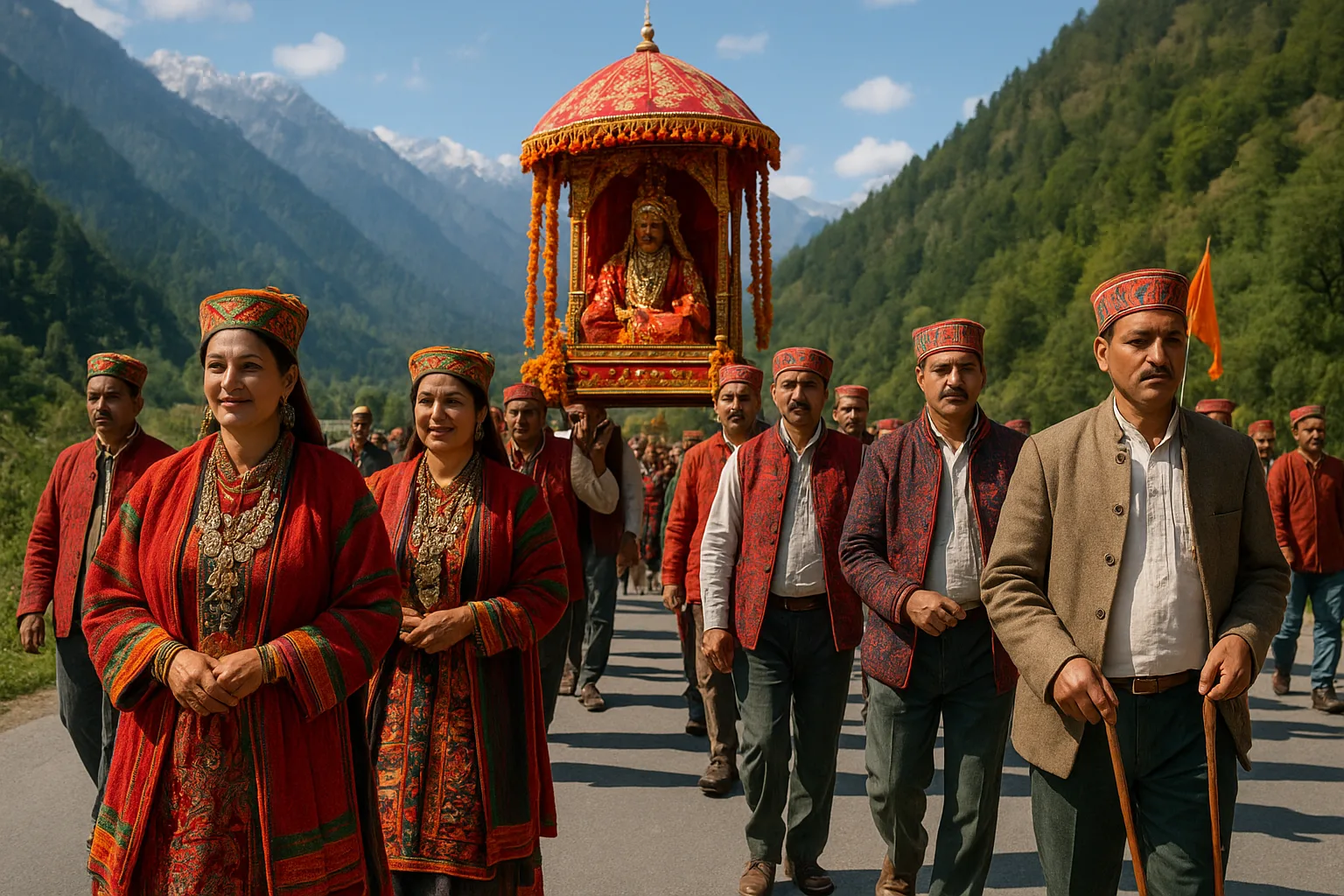
From this royal initiative, Kullu Dussehra evolved into a week-long celebration unlike any other in India. Rather than burning effigies of Ravana on the festival’s main day, the valley’s deities—represented by ornate palanquins and accompanied by their priests and musicians—descend upon Dhalpur Maidan. The raja, once the temporal ruler but now the humble chharibardar (staff-bearer) of Raghunath, joins the assembly. For seven days, the maidan becomes a parliament of gods: alliances are forged, disputes arbitrated, and the social order reaffirmed in sacred theatre.
Regional chronicles and early British gazetteers provide glimpses into these processions, noting the convergence of hundreds of village deities and the peaceful negotiation of power between the court and the countryside. Through these rituals, the festival became a living archive of the valley’s social fabric—its hierarchies, dependencies, and shared aspirations.
Trade, Empire, and the Changing Festival
Kullu’s Dussehra cannot be disentangled from the valley’s connection to broader economic and political currents. Throughout the medieval and early modern periods, the festival coincided with bustling fairs—traders from Tibet, Kashmir, and the Punjab converged to barter woolens, horses, and salt. The influx of people and goods transformed the festival into a cosmopolitan event, a moment when the insular valley opened to the outside world.
With the advent of British colonial rule in the 19th century, Kullu’s royal autonomy waned, but Dussehra endured. Administrators like J.B. Lyall, while noting the festival’s unique features in official reports, recognized its role in both resisting and negotiating imperial authority. The festival’s survival, amid shifting regimes and new technologies, attests to its resilience as both a religious and a political institution.
Enduring Legacy: Dussehra and the Story of Kullu
Today, as dusk falls and the air thrums with drumbeats, Kullu Dussehra remains a living bridge between myth, monarchy, and modernity. The festival’s origins are inseparable from the valley’s journey—from forested enclave to princely state and, later, to a district in democratic India. Each October, the gathering of deities and devotees recalls the first royal procession, the ancient bargains struck between king and god, and the enduring power of ritual to unite a diverse land.
In the next post, we will journey deeper into the sacred geography of Kullu, tracing the biographies of its local deities and the legends that continue to shape the valley’s spiritual life.
Previous: Raghunath Temple: The Religious Turning Point in Kullu History
Next: Local Deities and the Unique Devta System of Kullu