
Series: History of Kullu, Himachal Pradesh, India
Phase 3: Religion & Culture — Part 13 of 30
This article belongs to a historical series examining how expanding empires and regional powers reshaped life in the western Himalayan hills. As external influences pressed into the mountains, local rulers navigated diplomacy, resistance, and accommodation. This phase explores how wider political currents intersected with entrenched hill traditions, altering governance without entirely displacing older structures.
At Dawn in the Valley: The Devtas Awaken
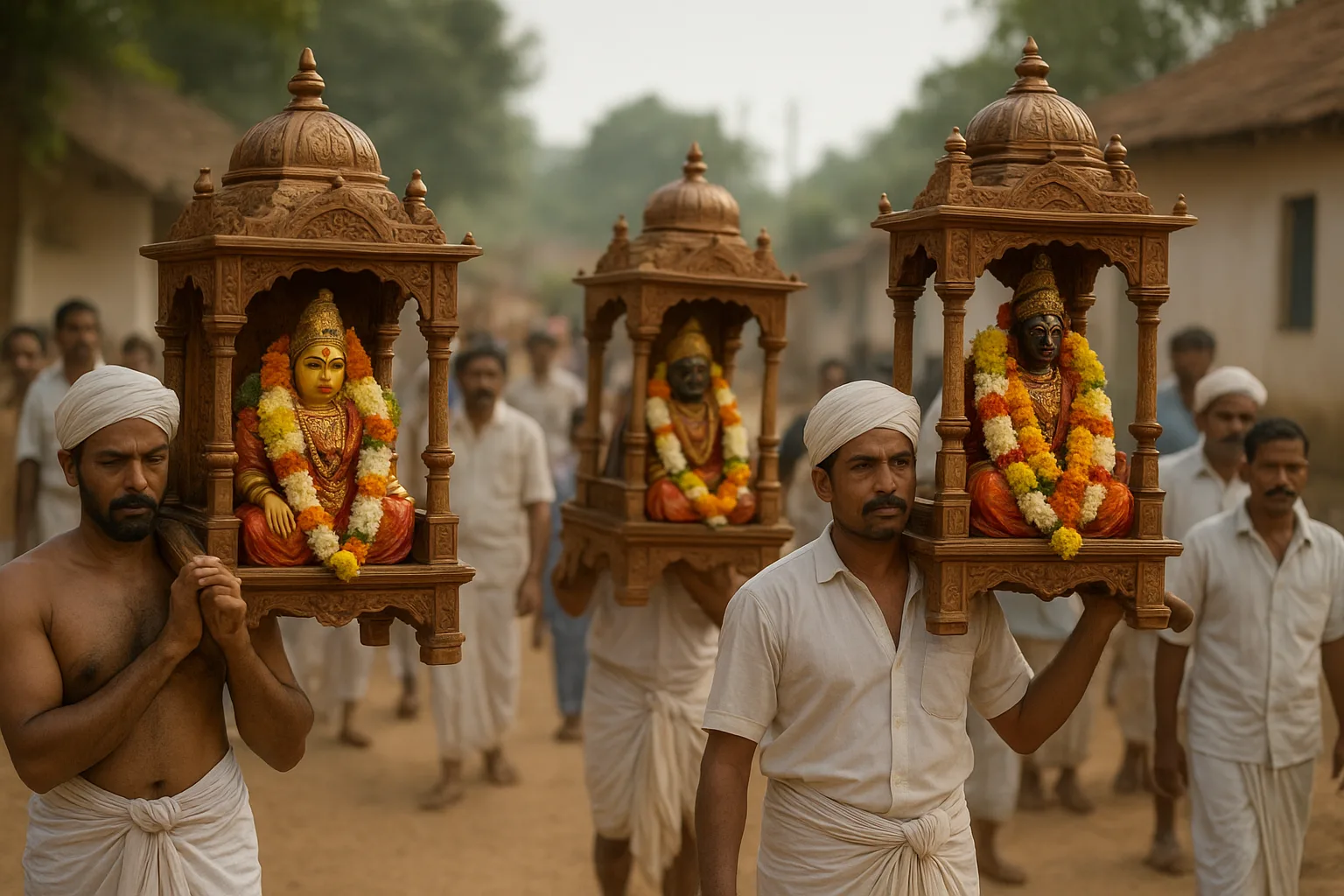
It is early spring in the Kullu valley. Mist curls above the Beas River as the first rays of sun touch snow-bright peaks. In a hamlet clustered around slate-roofed houses, villagers gather near a wooden temple. A hush falls as drummers strike up a beat, and the air shivers with anticipation. The idol of the village devta—adorned with flowers, silver, and brocade—is lifted onto a palanquin. As it sways forward, elders, children, and travelers alike fall into step. This is no ordinary procession. Here, in Kullu, the devtas are not distant gods. They are active participants in daily life, arbiters of justice, and guardians of ancient customs, their presence woven through every season and story.
Land Shaped by Faith: The Early Roots of Kullu
The valley of Kullu is a place where faith is as enduring as stone and as shifting as the river. Modern scholarship anchors its continuous habitation at least to the early centuries CE, though memories stretch further, blending archaeological hints and local tales. The region’s rugged terrain once formed a natural crossroads—an intersection of Himalayan cultures and north Indian trade routes. Over centuries, these pathways funneled not just goods but ideas and beliefs: from the trans-Himalayan passes came influences from Tibet, Ladakh, and beyond, while the fertile riverbanks nourished an evolving society of cultivators, artisans, and pastoralists.
Written records before the 15th century are scarce. Instead, Kullu’s oldest history survives in the stories told at firesides, in temple rituals, and in the names of its winding streams. The earliest communities here likely blended animist reverence for nature with the evolving pantheon of Hinduism, a synthesis visible in the devta system that flourished.
Oral Traditions and the Emergence of the Devta System
For generations, the people of Kullu have explained their world through the voices of their devtas. According to oral tradition, every village, sometimes every hamlet, is under the protection of its own local deity—a devta or devi. These deities are not just worshipped; they are believed to directly intervene in human affairs. The devtas travel, deliberate, and even adjudicate disputes among villagers. They possess distinct personalities, rivalries, and histories, remembered in song and story.
Some devtas are said to have arrived with ancient migrations, others to have emerged from the landscape itself—manifesting in rocks, streams, or groves. Myths tell of gods who traveled from distant lands, seeking refuge in Kullu’s remote valleys. Notably, the devtas are not simply avatars of pan-Indian gods. While many are associated with Shiva, Vishnu, or local manifestations of the goddess, they retain unique local identities, shaped by centuries of shared memory. Their stories exist in a space between myth and history—never fully fixed, always alive in retelling.
From Myth to History: Political Power and Divine Authority
As Kullu’s small hill states began to coalesce in the late medieval period, the devta system became deeply entangled with political authority. The rajas of Kullu—recorded in family chronicles and regional gazetteers—often traced their legitimacy to divine sanction from the local deities. Royal lineages claimed descent from, or special patronage by, the most revered devtas. In times of crisis, rajas sought counsel from the oracles (gurs) who channeled the voices of the gods during trances, a practice that continues in many villages to this day.
This intertwining of the sacred and the secular gave rise to a unique form of governance—the devta councils (jagati). Here, the opinions of village elders, priests, and oracles shaped decisions on land, justice, and social order. The British colonial administrators, writing in the late 19th century, were both fascinated and perplexed by the autonomy and influence wielded by these local religious authorities. Their reports—now held in Himachal Pradesh’s state archives—describe a society in which even the ruler deferred to the will of the devta in matters of law and custom.
Trade, Migration, and the Changing Map of Belief
Kullu’s position along ancient trade corridors shaped the evolution of its religious landscape. Pilgrims and merchants traveling to Lahaul, Spiti, and Tibet brought new rituals and stories, while returning Kullavi traders carried tales of distant lands. Over centuries, the devta system absorbed elements from Shaivism, Vaishnavism, and indigenous Himalayan practices, creating a distinctive spiritual blend.
Emerging hill states in the surrounding regions—Mandi, Chamba, and others—developed their own local pantheons, but Kullu’s devta system stood out for its complexity and resilience. Even as larger kingdoms rose and fell, the valley’s villages clung to their traditions. The oral genealogies of devtas, passed down by temple bards, maintained a sense of local continuity through generations of political change.
Ritual, Identity, and the Everyday World
Unlike distant or abstract gods, the devtas of Kullu are present in the tangible world. Their festivals mark the agricultural cycle, their oracles mediate disputes and offer counsel, and their processions—accompanied by music and elaborate costumes—bind communities together. Each devta is cared for by a hereditary priesthood, the kardars and gurs, whose responsibilities transcend religious ritual and extend to social leadership.
The stories recorded in the Kullu Gazetteer and echoed in the memories of elders reveal how the devta system maintained a delicate balance between continuity and adaptation. When new settlers arrived or calamity struck, it was often the devtas—through their oracles—who mediated integration or offered explanations. In this way, the system anchored identity, providing both a sense of place and a framework for navigating change.
The Devta System in Modern Kullu
Today, the devta processions still wind through Kullu’s villages, though the world around them has changed. Roads and mobile networks reach even remote hamlets, and young people travel far for education and work. Yet, the devta councils continue to gather, and the old temples remain centers of village life. The devtas, as ever, are both keepers of tradition and sources of renewal. Their stories, rooted in a shared past, continue to shape community, identity, and the rhythms of everyday life.
In the next part of our series, we will journey deeper into the sacred geography of Kullu, exploring how temples, festivals, and pilgrimage routes have given enduring form to the valley’s spiritual landscape.
Previous: Kullu Dussehra: Origins of a Royal Festival
Next: Temples, Rituals, and Faith in Traditional Kullu Society