
Series: History of Sirmaur, Himachal Pradesh, India
Phase 3: Religion & Culture — Part 12 of 30
This article belongs to a historical series examining how expanding empires and regional powers reshaped life in the western Himalayan hills. As external influences pressed into the mountains, local rulers navigated diplomacy, resistance, and accommodation. This phase explores how wider political currents intersected with entrenched hill traditions, altering governance without entirely displacing older structures.
Nightfall in the Hills: The Spirit of Sirmaur Awakes
The monsoon clouds hung low over the terraced fields of Sirmaur. In a clearing, the smoke of a sacred fire drifted upward, mingling with the scent of pine and wet earth. Gathered in a loose circle, villagers of a remote hamlet sang old invocations to their local deity—one whose name would not appear in imperial chronicles, but ruled this valley with invisible, unquestioned authority. On this night, as on countless others across centuries, the spiritual pulse of Sirmaur beat strongest in its folk rituals and the faith of its people.
Sirmaur’s Landscape of Belief: Early Beginnings
Sirmaur, set in the southern folds of Himachal Pradesh, has always been a land of transition—a crossroads between the plains of the north Indian heartland and the high Himalayan ranges. By the early historical period (around the first millennium CE), archaeological and oral evidence points to scattered agrarian settlements and trading hamlets. The region’s rugged terrain and river valleys fostered a diverse mosaic of clans, each with its own protective spirit or gram devta.
Regional gazetteers—such as the 19th-century Sirmur State Gazetteer—preserve echoes of an older world where the supernatural was woven into the very landscape. Sacred groves, springs, and boulders marked sites of local veneration, often predating the arrival of organized priesthoods or written records. Oral traditions recount a time when the hills’ earliest inhabitants—possibly Khashas and other indigenous groups—invoked nature spirits for harvest, health, and protection from calamity.
Oral Traditions and Mythic Foundations
Unlike the well-documented temple cultures of the plains, Sirmaur’s religious history is rooted in oral transmission. Legends passed from one generation to the next preserve the exploits of gods, goddesses, and ancestral heroes. Many villages claim descent from semi-divine founders, whose miraculous deeds are recalled in jagran (night vigils) and seasonal festivals. The mythic narratives of deities like Shirgul Maharaj (Mahasu Devta) and Bhangayani Mata blend echoes of pan-Indian Hindu motifs with distinctly local stories—tales of battles with demons, protection from floods, or the settling of inter-village disputes.
These oral traditions do not always align with documented political history, but they offer invaluable clues to the region’s shifting belief systems. Folklore often encodes memory of migration, environmental crisis, or the assertion of clan identity. In Sirmaur, the boundary between myth and memory is porous: a legendary healer or warlord may, centuries later, become the tutelary deity of a valley or lineage.
The Emergence of Hill States and Patron Deities
By the early medieval period, roughly the 8th to 12th centuries CE, new political formations began to shape Sirmaur. The rise of the Sirmaur princely state (with its capital at Nahan from the 17th century) did not erase older customs but often sought their legitimization. Rulers positioned themselves as patrons—or even descendants—of powerful local deities, integrating folk worship into royal ritual. The annual jatar (fair) at Renuka Lake, associated with the goddess Renuka, became both a religious and political spectacle, drawing pilgrims and traders from across the region.
Throughout this era, the movement of traders and pilgrims along the Yamuna and Giri river routes brought new religious influences—the cults of Shiva and Devi, the legends of Pandavas, and later, echoes of Vaishnava and even Sikh traditions. Yet, the persistence of village-level worship reveals a remarkable continuity: the local devta remained the true arbiter of land, law, and community.
Village Shrines and Ritual Specialists
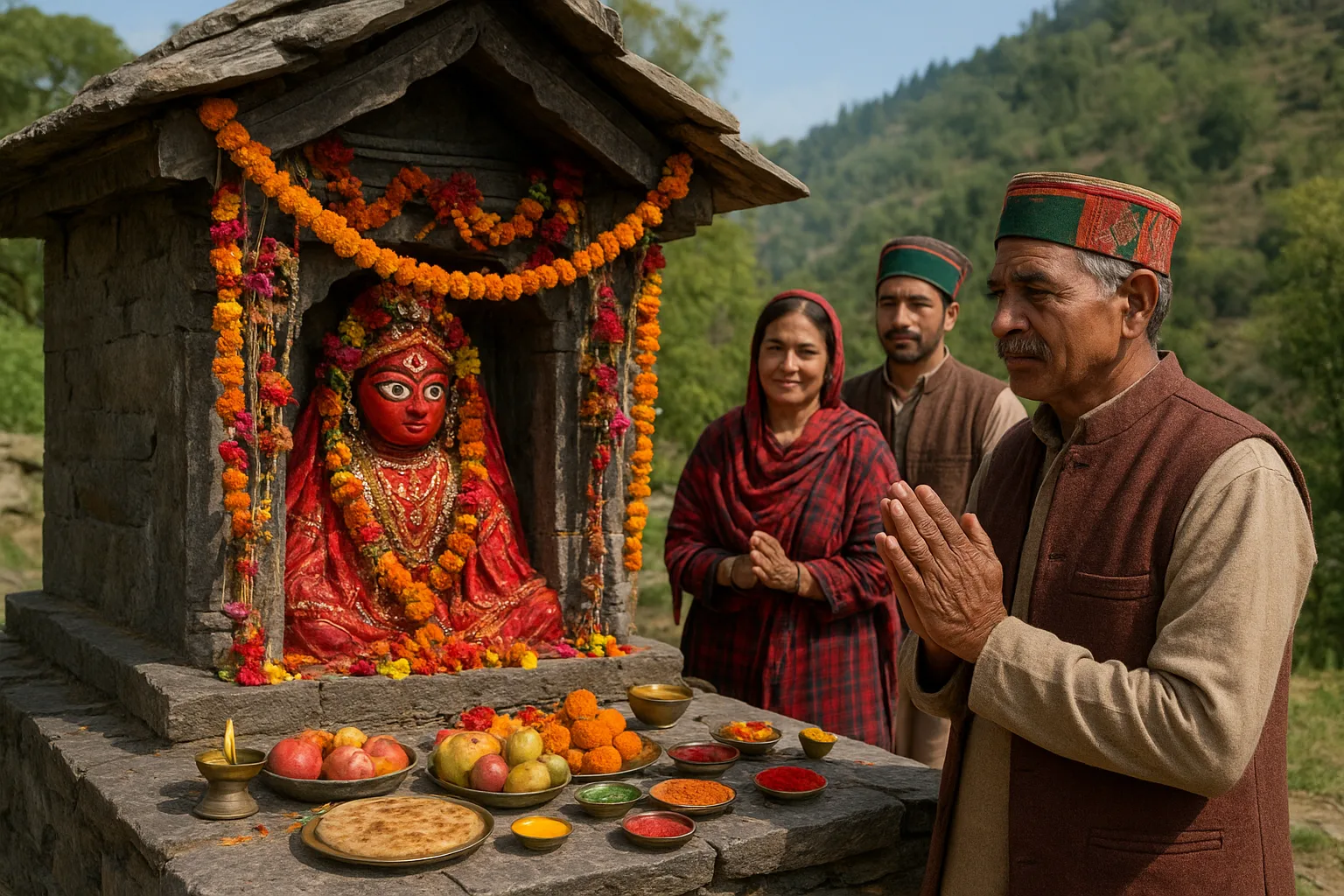
The structure of folk religion in Sirmaur centered on the village shrine, often a simple wooden or stone structure perched at the edge of fields or forests. Here, the pujari (priest) or chela (medium) would interpret the deity’s will through trance, divination, or ritual dance. Unlike the elaborate temple hierarchies of the plains, these shrines emphasized direct communion: a sick child, a pestilence, or a disputed boundary would be brought before the devta for judgment or healing.
Seasonal festivals, such as jagran or mela, provided occasions for communal renewal. The arrival of the deity’s palanquin—carried amid drumming and song—marked moments when the boundaries between mortal and divine seemed most permeable. For many, the devta was not a distant god but a living presence, capable of both wrath and benevolence, shaping the fortunes of the village year to year.
Negotiating Change: Folk Worship in a Shifting World
With the advent of colonial administration in the 19th century, and later integration into the Indian Union, Sirmaur’s religious landscape experienced new pressures. British surveys and gazetteers documented the region’s customs with both fascination and bewilderment, noting the persistence of animal sacrifice, the authority of village oracles, and the intricate networks of local fairs. Yet, folk worship proved resilient. Even as formal education, new religious movements, and state interventions spread, the pull of the village deity—deeply rooted in memory, land, and kinship—remained strong.
Today, as roads and technology knit Sirmaur more tightly to the outside world, these ancient traditions adapt. Some rituals have been reinterpreted, others quietly fade, but still, each autumn and spring, the valleys echo with the sounds of devotion—reminders of a spiritual order that has shaped Sirmaur for over a millennium.
Echoes in the Present: Sirmaur’s Living Heritage
The worship of local deities in Sirmaur is far more than a relic of the past. For many, these traditions offer a sense of belonging and continuity in a rapidly changing world. Village shrines remain centers of social life, and annual fairs continue to draw communities together across caste, class, and even religious divides. The old stories are retold, not as mere legend, but as living memory—reminders of the hills’ enduring capacity for resilience and renewal.
As we move forward in this series, our next exploration will turn to the sacred sites and monasteries that rose in Sirmaur’s borderlands, tracing how Buddhist and later Sikh influences left their own subtle marks on the region’s spiritual map.
Previous: Temples and Sacred Landscapes of Sirmaur
Next: Giripar Culture: Traditions of a Unique Himalayan Region