
Series: History of Kangra, Himachal Pradesh, India
Phase 3: Mughal & Sikh Era — Part 11 of 30
This article belongs to a historical series examining how expanding empires and regional powers reshaped life in the western Himalayan hills. As external influences pressed into the mountains, local rulers navigated diplomacy, resistance, and accommodation. This phase explores how wider political currents intersected with entrenched hill traditions, altering governance without entirely displacing older structures.
Twilight on the Hill: Kangra, 1620
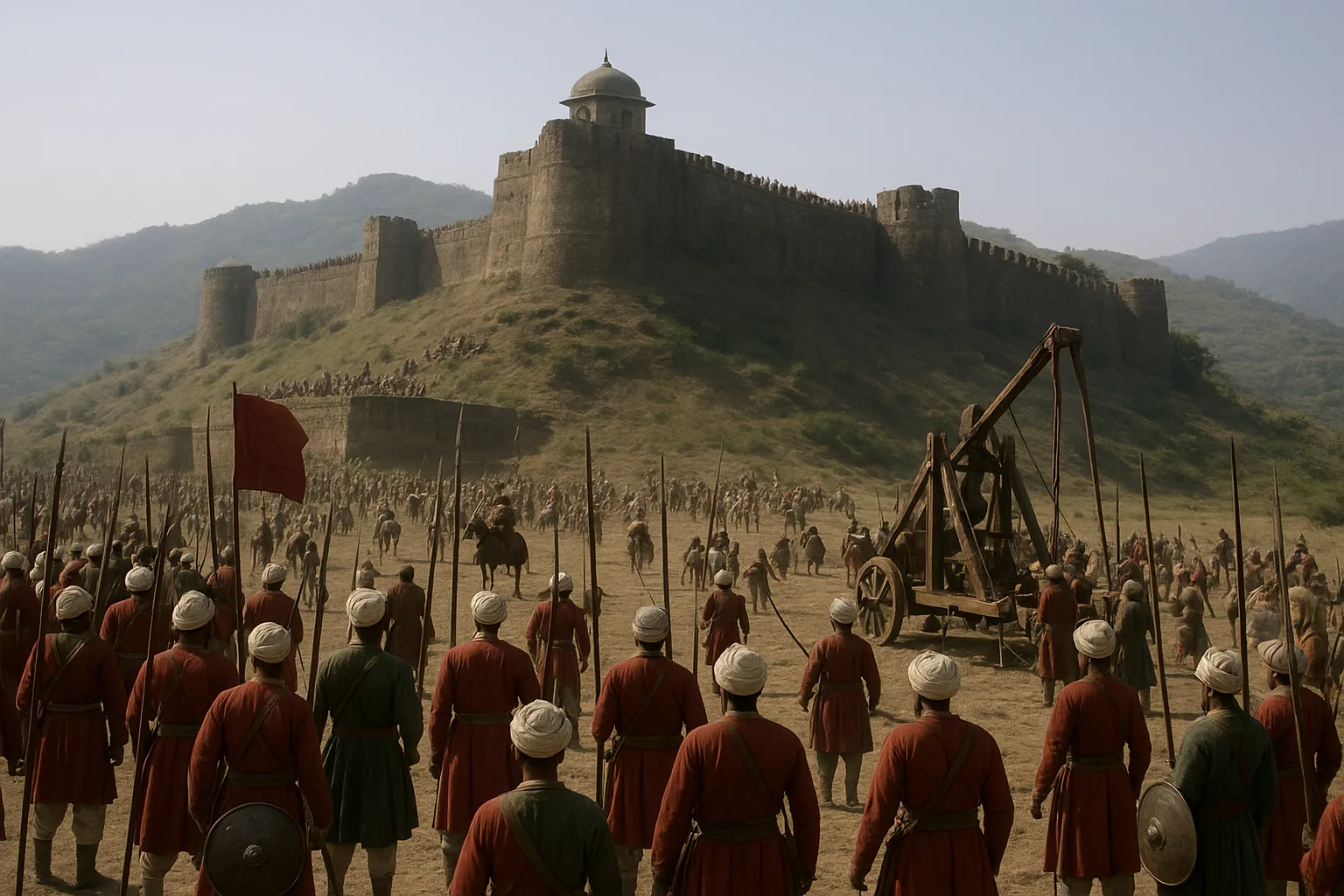
Monsoon clouds churned above the ramparts of Kangra Fort, their shadows crawling across stone walls that had stood since time immemorial. Inside, the air was tense. For months, Mughal banners had fluttered in the valley below, their encampments sprawling along the banks of the Banganga River. The world beyond the fort’s gates was forever changed—Mughal ambition had reached the very heart of the Himalayas.
Yet, this was not just a contest of armies. It was a reckoning for the hill states, a collision of ancient dynastic pride with the sweeping force of empire. As the sun set on Kangra that fateful year, the region’s destiny was being rewritten.
The Ancient Stronghold: Kangra’s Place in the Himalayan World
Long before Mughal trumpets echoed in the valley, Kangra was a seat of power. Rising from a rocky spur above the confluence of the Banganga and Manjhi rivers, its fort was both sanctuary and symbol. Early chronicles and the famed Tarikh-i-Kangra speak of the Katoch dynasty, whose roots stretch deep into legend and oral tradition. While local myth traces the family to the Mahabharata, more cautious historians anchor their ascendancy to the early medieval period—by the 10th century CE, Kangra had emerged as a formidable hill state, its fortunes entwined with those of the wider north Indian plains.
Belief systems here reflected the fusion of indigenous traditions and Himalayan Shaivism, as evident in the temples of Jwalamukhi and Bajreshwari. Trade routes snaked through Kangra, connecting Tibet to the Punjab and Rajasthan, bringing pilgrims, artisans, and merchants in their wake. The valleys echoed with the languages of Pahari hillfolk and the Sanskrit chants of Brahmin priests, while Buddhist influences lingered from earlier centuries.
From Sultanate Shadows to Mughal Ambitions
The strategic value of Kangra did not escape Delhi’s sultans. Mahmud of Ghazni’s notorious raid on the fort in 1009 CE became a touchstone of both historical fact and local memory. Yet, successive Sultanate rulers struggled to hold this mountain bastion; geography and fierce local resistance conspired against them.
By the 16th century, the Mughals had eclipsed their predecessors. Akbar, whose empire spanned from Kabul to the Deccan, saw in Kangra both a military challenge and a spiritual prize. The fort’s temples were renowned for their treasures—gold, silver, and priceless relics. But more than wealth, it was the assertion of sovereignty over the fractious hill states that drew Akbar’s gaze northward.
Gathering Storm: The Road to Siege
In the decades before the siege, Kangra’s rulers played a delicate game—balancing tribute and autonomy, forging alliances with neighboring hill chiefs, and at times acknowledging Mughal overlordship in name. Raja Dharam Chand, and later his son Raja Hari Chand, navigated this perilous landscape, their authority tested by both internal dissent and external pressure.
By the early 17th century, Mughal expansion had encircled the hills. Akbar’s generals secured footholds at neighboring Nurpur and Chamba. Rumors swirled of secret pacts and shifting loyalties. The Katoch court, still luminous but increasingly isolated, prepared for the inevitable confrontation.
The Siege: Imperial Might Meets Hill Resolve
In 1620, with Jahangir now on the throne but Akbar’s legacy still fresh, the Mughal army under Nawab Ali Khan advanced on Kangra. Chroniclers describe a spectacle of force—artillery, elephants, siege engines, and a disciplined corps of imperial troops. The fort’s defenders, drawn from local clans and loyal retainers, braced for the onslaught.
The Mughal siege was relentless. Days stretched into weeks, supply lines were cut, and the defenders’ morale was sorely tested. Oral traditions recall acts of heroism and desperation—families hiding sacred relics, warriors launching daring sallies down the precipitous slopes. Yet, the sheer scale of Mughal power proved overwhelming. By the end of the monsoon, the gates of Kangra Fort fell. For the first time in centuries, the Katoch rulers lost their ancestral seat.
Aftermath: Conquest, Resistance, and Legacy
The fall of Kangra Fort marked more than a military defeat; it sounded the death knell for the old order in the hills. Mughal officials quickly established a faujdar at Kangra, integrating the fort into the imperial system and extracting revenue from its fertile valleys. Yet, the imposition of Mughal rule was neither total nor uncontested. In the years that followed, local resentment simmered beneath the surface, occasionally erupting in revolt. The Katoch dynasty endured, stripped of their fort but not erased from memory, often serving as intermediaries between imperial authority and the hillfolk.
Temples once patronized by the hill kings now saw Mughal envoys at their thresholds. Some traditions claim that Akbar and Jahangir, in their later years, made pilgrimages to Kangra’s sacred sites—a testament to the region’s enduring spiritual magnetism.
Echoes Across Generations
The siege of Kangra Fort remains a defining moment in the region’s history. Its ramparts, battered but unbowed, still rise above the valley—a silent witness to ambition, faith, and resistance. The stories of those months, preserved in oral epics and royal chronicles, continue to shape Kangra’s sense of itself: proud, resilient, and conscious of its ancient roots.
Today, as pilgrims and travelers trace the old paths to Kangra, they walk in the shadow of these events. The fort’s stones, the temples’ fires, and the hills themselves carry the memory of that fateful siege. In the next chapter of this series, we will follow Kangra’s journey under Mughal suzerainty, and the subtle, often unseen currents of adaptation, negotiation, and survival that marked the Mughal era in the hills.
Previous: Trade and Economy in Medieval Kangra
Next: Life Under Mughal Shadow