
Series: History of Kangra, Himachal Pradesh, India
Phase 2: Medieval Power — Part 10 of 30
This article forms part of a continuing series that follows the gradual emergence of organised power in the western Himalayas. As small communities gave way to clans, chieftainships, and hill states, patterns of rule, alliance, and conflict began to take shape. This phase examines how authority was negotiated through land, ritual, and warfare, laying the groundwork for regional kingdoms that would dominate the medieval landscape.
Caravan Bells in the Valley of Gods
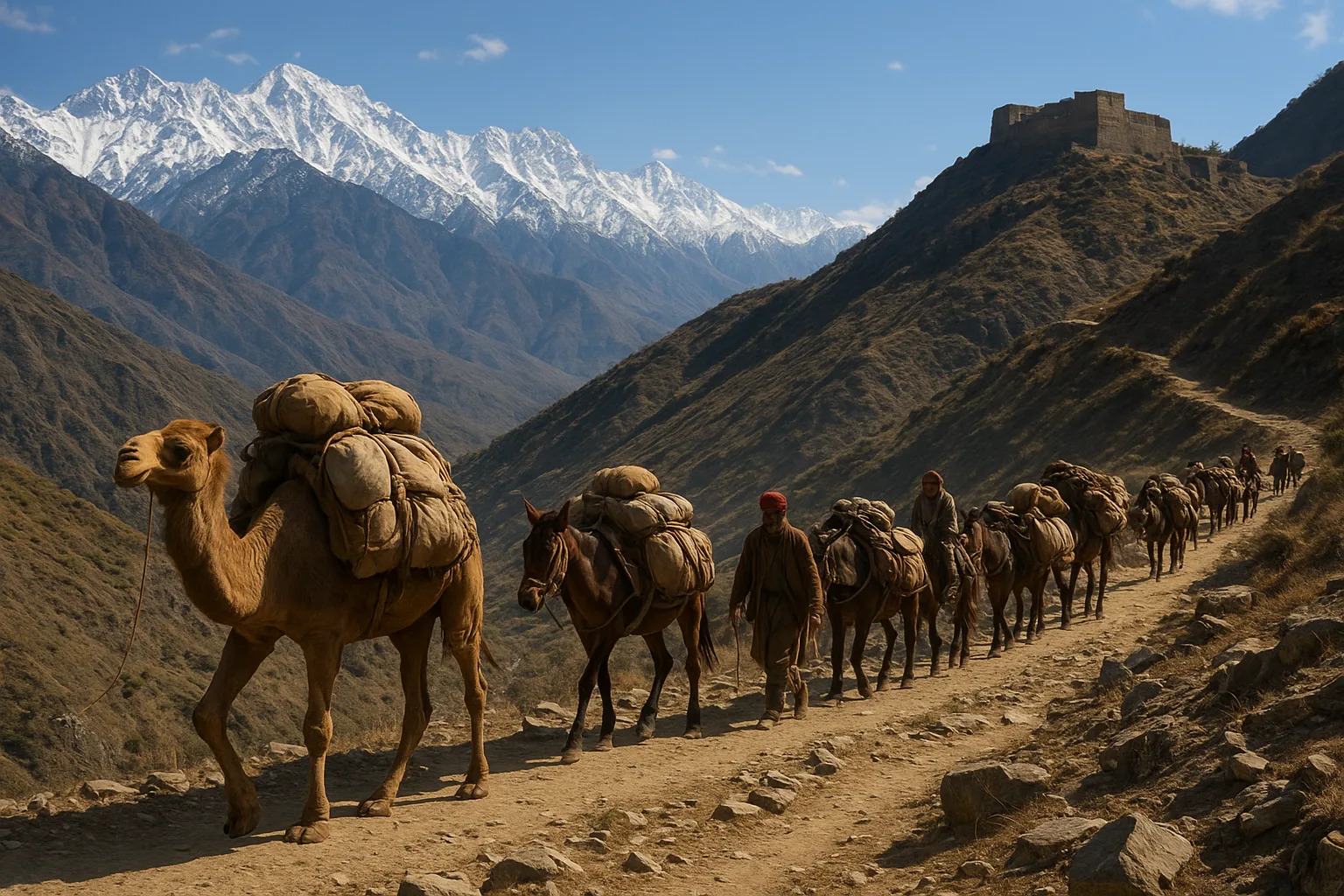
The first pale light of dawn creeps over the towering Dhauladhar range, casting long blue shadows across the emerald fields of Kangra. In the hush before the mountain crows stir, a faint jingle echoes down a winding path—a small group of traders, leading laden ponies, halts at the threshold of the ancient Nagarkot fort. Their wares, wrapped in rough cotton, give off the mingled scents of salt, dried ginger, and indigo. The year is roughly 1100 CE, and Kangra is awake, alive with the promise of commerce and the hum of a civilization straddling myth and history.
Land Between Legends and Empires
Long before Kangra’s name appeared in Mughal chronicles or the pages of British gazetteers, its story was whispered in local ballads and temple hymns. Oral traditions speak of the valley as a land blessed by the goddess Ambika, with the mighty Kangra fort rising as her earthly abode. These tales, cherished by generations, blend with historical inference: by the early medieval period, Kangra had already emerged as a strategic stronghold and trading hub in the Himalayan foothills.
Documented records from the Rajatarangini and regional copper plate inscriptions reveal Kangra’s links to larger political currents—the rise of the Katoch rulers, tributary alliances with distant kingdoms, and its recurring encounters with powers from the plains. Yet beneath the clangor of armies, daily life was shaped by quieter rhythms: the harvest, the market, the flow of goods and ideas along timeworn trails.
Rivers, Roads, and the Web of Trade
Kangra’s geography made it both vulnerable and vital. The Beas and its tributaries carved deep valleys, providing water for fields and channels for movement. It was here that north-south trade routes from Kashmir and Ladakh met east-west corridors linking the Punjab plains to the upper hills and beyond to Tibet.
Caravan traffic brought salt from the Sambhar lake, wool and pashmina from the trans-Himalayan tracts, and muslin, spices, and indigo from the bustling cities of the Indo-Gangetic plain. The local bazaars, especially those around Nagarkot and Jwalamukhi, became points where exchange transcended mere goods: merchants traded gossip, stories, and the subtle politics of the day.
Regional gazetteers such as the Kangra District Gazetteer (1883-84) later chronicled these ancient trade patterns, noting how Kangra’s markets once drew buyers and sellers from as far as Multan, Kashmir, and the Garhwal hills, shaping a cosmopolitan ethos beneath a veneer of feudal autarky.
The People Behind the Markets
Medieval Kangra’s economy was not the domain of a single community. Rajput chiefs and their kin controlled land and levies, but much of the day-to-day commerce was in the hands of Banjaras (itinerant traders), Bhats (chroniclers and brokers), and the thriving communities of Brahmins, Thakurs, and artisans who clustered around temples and forts.
Jain and Vaishya traders—some families tracing their roots to distant Gujarat or Rajasthan—set up shopfronts in the growing settlements. They introduced new weights, measures, and even accounting systems, blending local hill traditions with the commercial know-how of the wider subcontinent. Religious pilgrims, too, became vital economic actors, their journeys to Jwalamukhi, Bajreshwari, and Chintpurni temples stimulating hospitality, crafts, and ancillary trades.
It is in these layered social realities that oral traditions, economic necessity, and political intrigue collided, giving Kangra a distinctive mercantile flavor rare among the Himalayan kingdoms of the time.
Markets, Coinage, and the Art of Exchange
By the 12th and 13th centuries, Kangra’s markets—bazaars at Kangra, Sujanpur, and Jawalamukhi—had developed rhythms that reflected both local needs and the pressures of wider change. Weekly haats (markets) and annual fairs were not just sites of barter but also of complex negotiations over coinage and credit.
Silver and copper coins, bearing the marks of Katoch rulers or, later, the Sultans of Delhi, circulated alongside cowrie shells and locally issued tokens. Land revenue, usually collected in kind (grain, honey, ghee), slowly gave way to cash payments as trade expanded and new fiscal demands arose from overlord states. Cloth merchants from the plains introduced new dyes and textiles, while local smiths and weavers innovated to meet shifting tastes.
Early chronicles and inscriptions, such as those found in the ruins of Kangra fort, hint at the growing sophistication of these economic practices: contracts sealed by temple authorities, debt records etched onto palm leaves, and disputes settled by mixed councils of elders and merchants. Over time, this gave rise to a uniquely Kangra model of market governance—pragmatic, flexible, and deeply intertwined with ritual and kinship networks.
Belief Systems and Economic Life
Religion and economy were inseparable in medieval Kangra. The temples—especially the revered Jwalamukhi and Bajreshwari shrines—were not just spiritual centers but also economic engines. Temple lands, managed by hereditary priests and lay councils, supported vast retinues of workers, artisans, and even small armies. Offerings from pilgrims funded not only religious festivals but also irrigation works, market maintenance, and charitable granaries.
The intertwining of trade and belief is evident in the oral traditions of the valley: tales of miraculous grains multiplying in lean years, or of traders who prospered by sponsoring temple rituals. These stories, while colored by faith, echo real historical practices described in Persian chronicles and Rajput genealogies, where temple treasuries often rivaled those of the ruling chiefs.
Emergence of Hill States and Shifting Frontiers
By the late medieval period, the consolidation of the Katoch dynasty and the emergence of rival hill states—such as Jaswan, Nurpur, and Guler—reshaped the economic map of Kangra. Fortified towns sprang up along key routes, while new administrative practices encouraged the settlement of traders and artisans in previously forested tracts.
Periodic invasions—from Ghaznavid raiders to the armies of Firuz Shah Tughlaq—brought devastation but also forced adaptation. Some communities migrated to safer valleys, others forged alliances that allowed commerce to persist even amid conflict. The pragmatic spirit of Kangra’s mercantile classes, honed over generations of uncertainty, ensured that trade never entirely ceased but found new channels and forms.
Echoes of the Medieval Market
In the markets of modern Kangra, the legacy of these medieval centuries lingers. The rhythms of trade, the fusion of local and cosmopolitan influences, and the enduring ties between faith and economy remain central to the region’s identity. Ancient routes have become highways, but the old stories—of goddess-blessed fortunes and the cleverness of Kangra’s traders—still animate daily life.
As we continue this series, the next part will delve into the political rivalries and shifting alliances that shaped Kangra’s destiny at the crossroads of empires. The pulse of commerce was only one thread in a tapestry woven from power, faith, and resilience—a story that still unfolds in the shadow of the Dhauladhar.
Previous: Temple Culture of Medieval Kangra
Next: Akbar’s Siege of Kangra Fort