
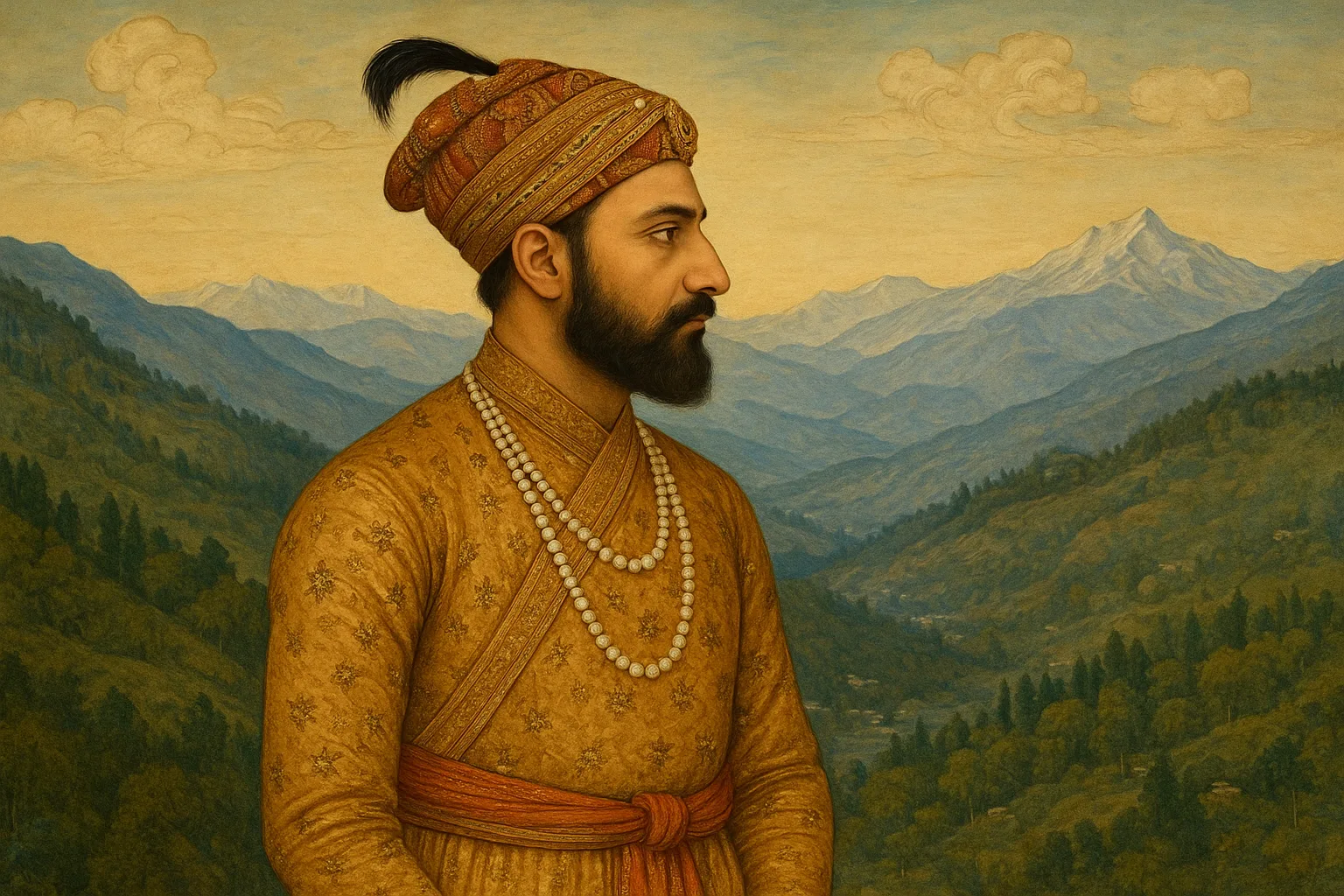
Series: History of Hamirpur, Himachal Pradesh, India
Phase 3: Mughal & Sikh Influence — Part 11 of 30
This article belongs to a historical series examining how expanding empires and regional powers reshaped life in the western Himalayan hills. As external influences pressed into the mountains, local rulers navigated diplomacy, resistance, and accommodation. This phase explores how wider political currents intersected with entrenched hill traditions, altering governance without entirely displacing older structures.
Shadows Over the Valleys: Hamirpur at the Edge of Empire
The year is somewhere in the late 16th century. Mists hang low over the Beas River, curling through dense deodar forests and terraced fields. The people of the Hamirpur hills rise before dawn, attending to goats and fields, unaware—or perhaps quietly wary—of distant powers whose ambitions cast long shadows even into these remote valleys.
Hamirpur, today a tranquil district in Himachal Pradesh, once formed part of an intricate web of small hill states. Its lands, cradled between the Dhauladhar range and the Sutlej, have long witnessed the ebb and flow of dynasties. Yet, it was the arrival of Mughal power in northern India that would test the endurance, adaptability, and spirit of these hills.
Ancient Routes and Early Settlers
Even before the Mughals, the region that would become Hamirpur lay at the crossroads of movement. Oral traditions speak of ancient Rajput clans journeying northward, seeking sanctuary in the folds of the hills. The earliest settlements—places like Nadaun, Sujanpur, and Hamirpur itself—emerged along riverbanks and ridges, protected from the harshest monsoons and cold.
Belief systems in these valleys blended indigenous animism with early Hindu influences. Local deotas (spirits) were venerated in shrines of wood and stone, and seasonal fairs punctuated the agricultural calendar. Trade flowed along rough-hewn tracks, linking the hills to the plains of Punjab and the markets of Kangra and Bilaspur. Salt, grains, and wool passed through, and with them, news and stories—of empires rising and falling far from these quiet slopes.
The Mughal Gaze Turns North
By the early 16th century, the Mughal Empire had begun to assert its dominance over the northern subcontinent. Babur’s victory at Panipat in 1526, followed by the reigns of Humayun and Akbar, drew the attention of imperial chroniclers to even the most distant hill principalities. The Ain-i-Akbari, Abul Fazl’s remarkable chronicle, catalogued the region’s hill rajas—testament to both their autonomy and the watchful eye of the Mughal court.
Yet, the reality on the ground was more complex. The hill rajas—among them the rulers of Kangra, Jaswan, and Guler—maintained a delicate balance. They pledged tribute, sent envoys, and sometimes provided troops for imperial campaigns, but fiercely guarded local traditions and autonomy. Hamirpur, then a part of the larger Kangra and Jaswan territories, was swept into this diplomatic dance.
Oral Tradition, Myth, and Memory
The stories told in Hamirpur’s villages blend fact and legend. Elders recall tales of Mughal envoys winding their way up to Nadaun, bearing gifts and imperial decrees. In some accounts, the great Emperor Akbar is said to have visited these hills—stories that likely conflate diplomatic missions with royal journeys. Such oral traditions, while not strictly historical, point to the psychological presence of the Mughals in local consciousness.
Myth and memory also merge in the region’s shrines. Some temples claim to have been endowed or protected by Mughal grants, a reflection of the complex interplay between imperial authority and local religiosity. In the absence of written documentation, these stories become part of the living history of Hamirpur—an inheritance carried through generations.
Political Realities: Hill States and Mughal Power
Documented history offers a more measured view. Regional gazetteers and early British surveys confirm that direct Mughal administration rarely penetrated the hills beyond the outer valleys. Instead, the empire exercised influence through alliances and tribute arrangements. The rajas of Kangra, whose domain included much of present-day Hamirpur, were frequent visitors to the Mughal court. Their loyalty, however, was often pragmatic—offered in exchange for recognition, military aid, or respite from neighboring rivals.
One notable episode stands out: the Battle of Nadaun in 1691. Though technically just beyond Hamirpur’s modern borders, the battle pitted the Mughal governor of Punjab against an alliance of hill rajas and Sikh forces. The clash was less about conquest and more about control of revenue and trade, but it left a psychic mark on the region. The victory of the hill rajas, with Sikh support, signaled a growing confidence among the hill states and a waning of direct Mughal power.
Trade, Faith, and Everyday Life
For most people in Hamirpur, the Mughal era was not defined by imperial edicts or armies, but by subtler shifts. Trade routes grew busier as Mughal peace stabilized the plains. Hill artisans found new markets for their woolens and woodwork. Some families recall ancestors who traveled to Lahore or Delhi, returning with unfamiliar coins and stories of splendor, but also of danger.
The Mughal period also saw the continued spread of Vaishnavism and Shaivism, blending with local deota worship. The empire’s relative religious tolerance under Akbar and his successors allowed these traditions to flourish, while Sufi mystics and itinerant mendicants occasionally made their way into the valleys, further enriching the cultural tapestry.
Hamirpur’s Identity Forged in Encounter
In the end, the Mughal presence in the hill regions around Hamirpur was less an occupation than a series of encounters—some direct, most filtered through the ambitions and anxieties of local rulers. The hills, with their strong sense of place and community, absorbed the outside influences, transforming them in ways uniquely their own.
Today, echoes of that era linger in the region’s festivals, architecture, and oral traditions. The resilience of Hamirpur’s people, shaped by centuries of negotiation with distant empires, remains visible in their pride and self-reliance. As we prepare to follow the region’s journey into the age of Sikh ascendancy in the next part of our series, the Mughal legacy endures—not in monuments, but in memory, myth, and the enduring spirit of the hills.
Previous: Temples and Faith in Medieval Hamirpur
Next: Why Hamirpur Remained Largely Autonomous Under the Mughals