
Series: History of Solan, Himachal Pradesh, India
Phase 3: Religion & Culture — Part 11 of 30
This article belongs to a historical series examining how expanding empires and regional powers reshaped life in the western Himalayan hills. As external influences pressed into the mountains, local rulers navigated diplomacy, resistance, and accommodation. This phase explores how wider political currents intersected with entrenched hill traditions, altering governance without entirely displacing older structures.
The Midnight Pilgrimage: A Town Awaits Its Goddess
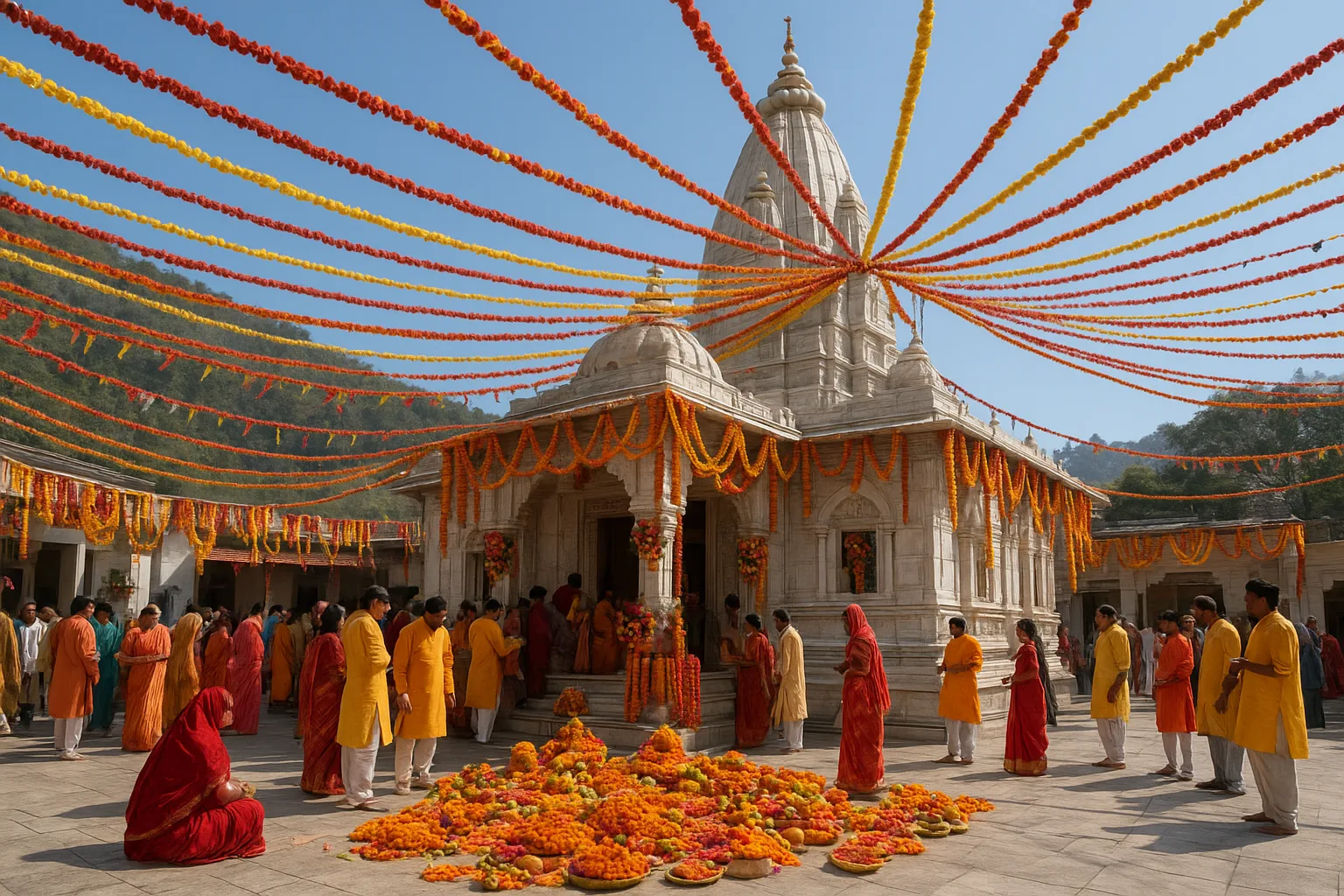
On a moonless night, the narrow lanes of Solan—nestled in the lower Himalayas—echo with anticipation. Hundreds of villagers, torches flickering, line the route from the centuries-old Shoolini Devi Temple to the heart of the city. For three days and nights, Solan transforms into a living epic, its people bound by a ritual older than any shopfront or schoolhouse. At the center of this fervor is a palanquin, swaying gently on the shoulders of devotees, carrying the idol of Shoolini Devi—the goddess who, legend says, gave the city its very soul and its name.
In the Shadow of Legends: The Birth of Shoolini Devi’s Cult
Solan’s earliest stories are whispered in the mists that shroud its hills. Before British cantonments and railway lines, this region was covered in dense forests, home to small settlements and older faiths. Oral traditions, still recounted by elders, speak of a time when evil spirits and wild beasts haunted the valleys. It is here, according to legend, that Shoolini Devi—an incarnation of goddess Durga—first revealed herself.
The myth tells of villagers plagued by a demon who threatened crops and cattle. In their desperation, the people performed austere rituals, seeking divine intervention. One night, a young woman appeared, radiating power and compassion. She challenged the demon, her weapon a deadly shool (trident), and banished darkness from the valley. The villagers recognized her divinity, naming her Shoolini Devi, and built a humble shrine where she had stood. Over time, this sanctuary became the beating heart of Solan.
Kings, Devotees, and a Growing Sanctuary
By the early 18th century, Solan’s fame as a place of pilgrimage had reached the courts of local rulers. The Baghat princely state, which governed these hills, saw the strategic and spiritual power of the goddess. Raja Ram Prakash, a notable early 19th-century ruler, is said to have restored the temple, commissioning intricate woodwork and stone carvings that can still be admired today.
The Shoolini Devi Temple became more than just a spiritual refuge—it was a center for justice, arbitration, and community life. Festivals drew people from distant valleys, weaving Solan into the broader religious tapestry of Himachal Pradesh. The annual Shoolini Mela, a tradition dating back at least two centuries, became an anchor for trade, marriage alliances, and the resolution of disputes.
Shoolini Mela: Ritual, Commerce, and Community
Every year, as spring yields to summer, Solan erupts in color and music. The Shoolini Mela is not merely a festival; it is the city’s collective memory in motion. For three days, the goddess’s idol is taken from her temple through the city in a ritual procession. Drums, flutes, and chants fill the air, echoing the ancient belief that Shoolini Devi’s journey brings protection and prosperity.
The mela is also a historic marketplace. In the 19th century, traders would arrive with salt, wool, and spices from Tibet and Punjab, setting up stalls that transformed Solan into a vibrant bazaar. For rural Himachalis, it was a rare opportunity to exchange goods, news, and stories. Old photographs and colonial records from the British Raj period capture these scenes—men in turbans, women in colorful shawls, children clinging to their mothers’ hands, all orbiting around the goddess’s palanquin.
Colonial Encounters: New Powers, Enduring Faith
When the British established their cantonment in Solan in 1846 after the First Anglo-Sikh War, the town’s landscape began to change rapidly. New roads, schools, and administrative offices rose alongside ancient shrines. Yet, the cult of Shoolini Devi remained remarkably resilient.
Colonial officials, initially bemused by the fervor of the Shoolini Mela, soon recognized its significance. Records from British gazetteers describe the annual festival as a time when “the native population suspends all other affairs.” The British, keen to maintain local stability, even provided logistical support during the festival, ensuring that the goddess’s procession remained uninterrupted.
Notably, British anthropologists and travelers such as Emily Eden recorded their impressions of Solan’s devotion. To them, the Shoolini cult was both exotic and admirable—a force that seemed to unify a diverse community under the benevolent gaze of their goddess.
The Goddess in Modern Memory: Identity and Continuity
In the decades following India’s independence, Solan blossomed from a sleepy hill town into a bustling city and district headquarters. New industries, educational institutions, and government offices have brought waves of migrants and modern influences. Yet, the goddess’s presence remains palpable.
Contemporary Solanites, whether old-timers or newcomers, speak with reverence of Shoolini Devi. The temple’s courtyard is never empty; students pray for exam success, business owners for prosperity, and families for protection. The annual mela now attracts not only local devotees but also tourists and researchers eager to witness the living tradition.
In city parks and council meetings, the conversation often circles back to Shoolini—the goddess who, through myth and memory, continues to shape civic identity. Her name adorns universities, hospitals, and countless businesses, a constant reminder of the city’s origins.
How Shoolini Devi Shapes Solan Today
The story of Shoolini Devi is not just a tale from the past; it is the living pulse of Solan. Each year, as the goddess’s palanquin weaves through a city transformed by time, her legend binds generations together. The rituals, the festivals, and the communal spirit forged around her worship sustain a sense of belonging and continuity in an era of rapid change.
Solan’s identity—rooted in faith but open to the world—owes much to the goddess who gave it her name. In a region where many towns struggle to remember their origins, Solan stands apart, its history alive in every prayer and procession. As you walk its bustling streets or seek quiet in the shadow of her temple, you find not just traces of legend, but the enduring presence of Shoolini Devi—the goddess who remains the heart of Solan.
Previous: Temples and Faith in Pre-Colonial Solan
Next: Temples and Sacred Landscapes of Solan District