
Series: History of Sirmaur, Himachal Pradesh, India
Phase 2: Medieval Kingdom — Part 10 of 30
This article forms part of a continuing series that follows the gradual emergence of organised power in the western Himalayas. As small communities gave way to clans, chieftainships, and hill states, patterns of rule, alliance, and conflict began to take shape. This phase examines how authority was negotiated through land, ritual, and warfare, laying the groundwork for regional kingdoms that would dominate the medieval landscape.
Morning on the Terraced Slopes
The faint clang of a distant temple bell cuts through the mist on a Sirmaur hillside, somewhere in the 13th century. Below, stone houses cluster on narrow terraces, their slate roofs shining damp in the dawn. Smoke curls from hearths as villagers stir awake, ready to tend fields nurtured by ancient streams. Life here, in these borderlands of the western Himalayas, is both unyielding and quietly ordered—a mosaic of custom, faith, and emerging authority that will define Sirmaur for centuries to come.
The Land and Its Beginnings: Sirmaur’s Early Medieval Context
Sirmaur’s story in the medieval era unfolds at the crossroads of myth, memory, and a slowly coalescing written record. According to oral traditions, the region’s earliest settlements were shaped by the migrations of Rajput clans and indigenous communities, who carved fields and villages from dense forests. Yet, it is only in the records of later chroniclers and regional gazetteers—such as the ‘Gazetteer of the Sirmur State’—that we glimpse the contours of a polity taking shape by the 11th and 12th centuries.
By the early medieval period, Sirmaur was neither a remote backwater nor a major kingdom, but an evolving hill realm. Its valleys threaded the upper reaches of the Giri and Tons rivers, forming a natural corridor between the plains of northern India and the high passes to Tibet. The presence of ancient trade routes—some said to echo the old salt and wool paths—made Sirmaur a quiet but vital node, drawing traders, pilgrims, and power-seekers alike.
Communities and Settlements: The Social Fabric
Historical inference, supported by later land records and village names, suggests that Sirmaur’s medieval population was a tapestry of Rajputs, pastoral Gaddis, agrarian Kanets, Brahmins, and a scattering of artisan castes. Settlement patterns followed the land: compact hamlets rose on defensible ridges; larger villages hugged the rivers, supporting rice, millet, and barley fields shaped by communal labor.
Belief systems, too, intertwined old and new. Ancient cults of local deities—called devtas—were venerated in sacred groves and stone shrines, their priests mediating between village and spirit world. Over time, these practices mingled with mainstream Hinduism, as Brahminical influence grew under the patronage of Sirmaur’s emerging rulers. Yet, even as temples rose and Sanskritized rituals took root, the rhythms of daily life remained deeply local, governed by cycles of agriculture and worship.
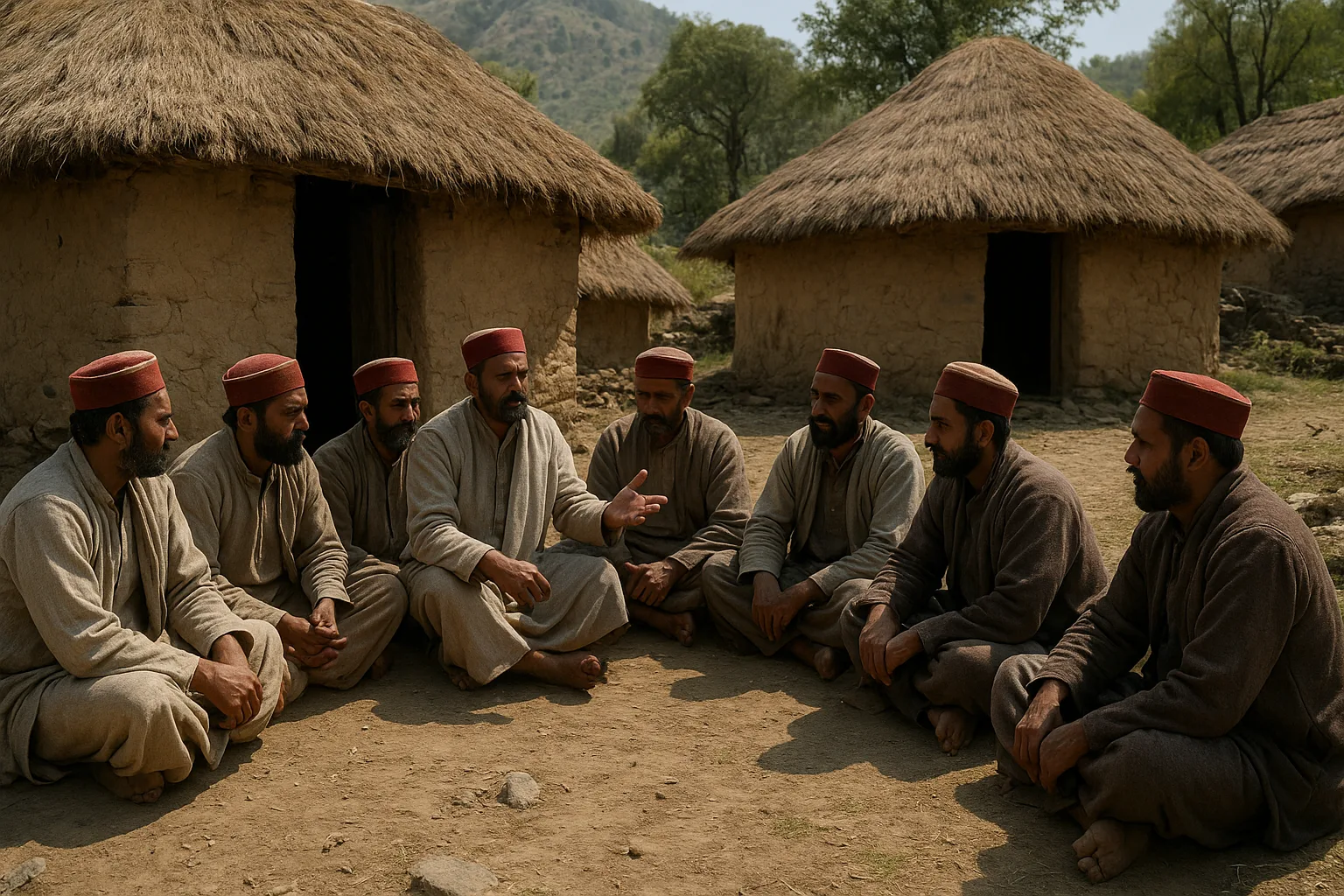
Village Councils and Customary Authority
In the absence of a strong centralized state, medieval Sirmaur’s villages relied on self-governing councils—panchayats—to resolve disputes, distribute land, and enforce customary law. These bodies, typically composed of elders from leading families, wielded real power over everyday affairs. Oral tradition holds that such councils could even challenge the decisions of the Raja’s own officials, especially in remote valleys where royal authority was distant.
Justice in these times was pragmatic rather than codified. Fines, ritual purification, and social ostracism were common remedies for infractions. Property disputes, marriage arrangements, and water rights all came under the panchayat’s purview, knitting the community together in a web of obligation and mutual dependence. The system was not always equitable, but it reflected the realities of a society where survival depended on cooperation—and where memory was law.
The Rise of the Sirmaur State: Lords, Taxes, and Control
By the mid-medieval period—likely the 13th and 14th centuries—a more formalized Sirmaur kingdom had begun to take shape. Chronicles and copperplate grants suggest the emergence of hereditary rulers, styled as Rajas, who traced their lineage to earlier local chieftains. The capital shifted between fortified hilltops, with Nahan gradually asserting itself as the royal seat.
Administration remained light-touch compared to the great plains kingdoms. The Raja’s realm was divided into parganas—districts overseen by appointed thanedars or local lords—who collected taxes in kind and maintained order. Tribute flowed upward: a share of grain, honey, timber, and sometimes labor. In return, the ruler pledged protection, the maintenance of sacred sites, and—when possible—access to external trade.
Yet royal control was always negotiated. Powerful village councils, local deities, and seasonal migrations limited the king’s direct reach. The administration’s legitimacy depended as much on ritual authority as on force. In times of famine or invasion, the Raja’s ability to coordinate relief and defense could make or break dynasties, as later chronicles would record.
Trade, Pilgrimage, and the World Beyond
Sirmaur’s villages, though remote, were not isolated. The region’s location along the trans-Himalayan routes meant that peddlers and traders regularly brought salt, wool, spices, and metalware. Local fairs—often tied to religious festivals—became bustling marketplaces, where villagers mingled with outsiders from as far as the Punjab, Garhwal, and even Ladakh.
Pilgrims, too, passed through Sirmaur’s shrines and temples, some seeking the blessings of local godlings, others en route to larger Himalayan sanctuaries. Hospitality was both a duty and an opportunity. Over generations, this traffic fostered a subtle cosmopolitanism: new crops, unfamiliar coins, and distant news filtering into even the most secluded hamlets.
Faith, Ritual, and Identity
Religion in medieval Sirmaur was less a monolith than a living tapestry. The worship of devtas and ancestral spirits remained a powerful force—village festivals, processions, and ritual dramas punctuated the agricultural year. Oral epics, often sung in dialect, blended local legend with the broader currents of Hindu myth.
Meanwhile, the royal house claimed divine sanction, commissioning temples and patronizing Brahmin scholars who codified genealogies and rituals. Over time, Buddhist and Jain influences, though never dominant, left faint traces in regional art and folklore, hinting at Sirmaur’s role as a crossroads for ideas as well as goods.
The Quiet Legacy of Medieval Sirmaur
As the medieval centuries waned and new powers rose across northern India, Sirmaur’s villages continued to pulse with the same measured rhythm—shaped by custom, faith, and a delicate balance between local autonomy and distant authority. The administrative patterns, communal values, and layered identities forged in this era still echo through Sirmaur’s hills today, visible in festivals, village councils, and the stubborn pride of its people.
In the next part of our journey, we will trace how these deeply rooted institutions weathered the arrival of new dynasties and the waves of conquest and change that marked the late medieval period in the Himalayas.
Previous: Wars, Alliances, and Hill Politics of Medieval Sirmaur
Next: Temples and Sacred Landscapes of Sirmaur