
Series: History of Hamirpur, Himachal Pradesh, India
Phase 2: Medieval Period — Part 8 of 30
This article forms part of a continuing series that follows the gradual emergence of organised power in the western Himalayas. As small communities gave way to clans, chieftainships, and hill states, patterns of rule, alliance, and conflict began to take shape. This phase examines how authority was negotiated through land, ritual, and warfare, laying the groundwork for regional kingdoms that would dominate the medieval landscape.
Twilight in the Hills: Hamirpur’s Medieval Village Life
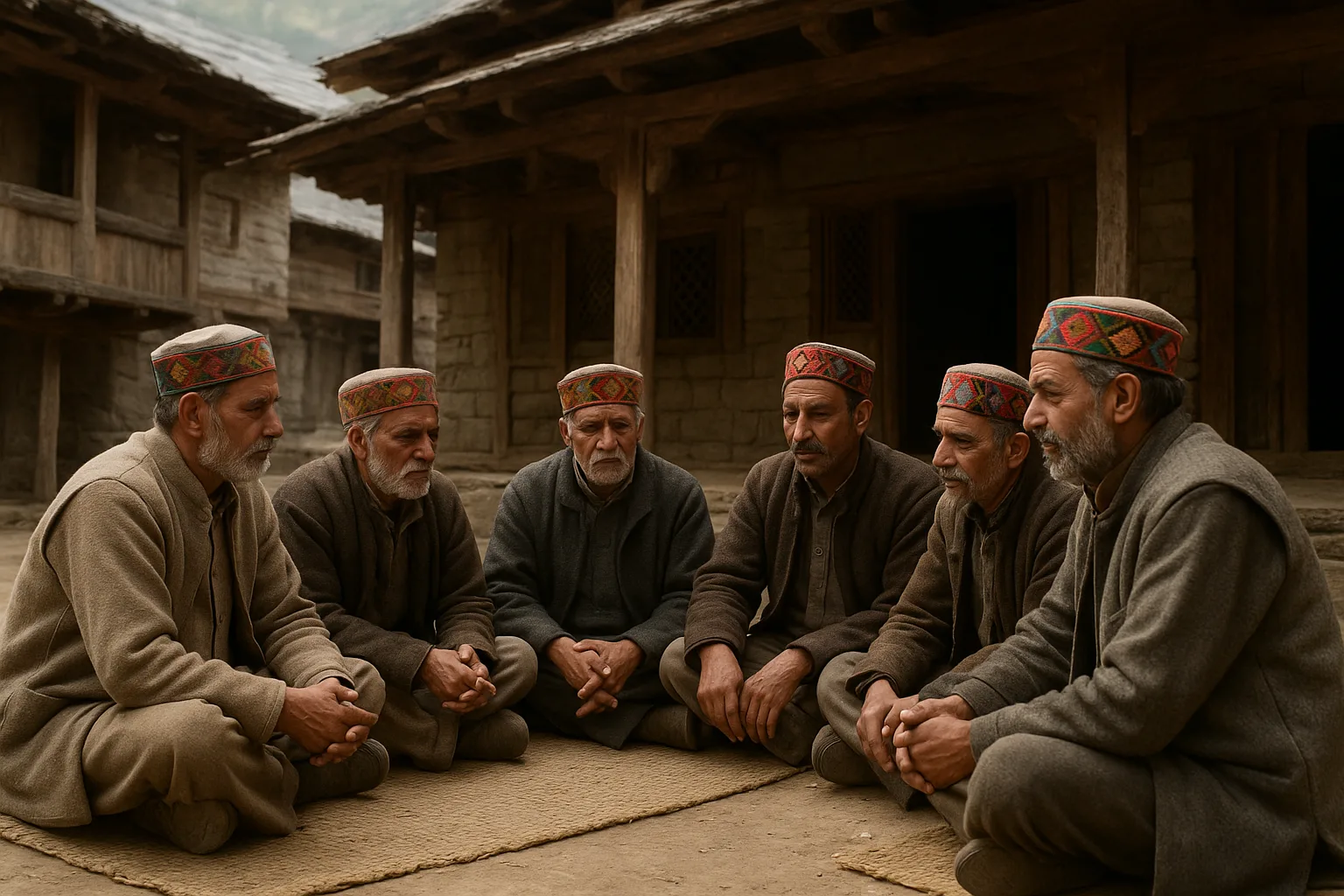
The late afternoon sun gilds the terraced slopes above the Beas River, casting long shadows across hamlets nested in the folds of what is now Hamirpur district. The year is somewhere in the twelfth century, though the villagers mark time in seasons and festivals, not in written calendars. Smoke coils from stone hearths, the air thick with the scent of pine and cow dung, as elders gather outside the largest house, ready to resolve a dispute over irrigation water. This is the face of governance in medieval Hamirpur—quiet, communal, and deeply rooted in the rhythms of the hills.
Anchoring the Region: Hamirpur in the Medieval Landscape
Hamirpur’s medieval history unfolds against the broader backdrop of the Western Himalayas, an area continually shaped by migration, trade, and political flux. The region, situated in the lower hills between the Sutlej and the Beas, was never the seat of a mighty kingdom. Instead, it was a patchwork of small settlements, each with its own traditions, overseen by local chiefs and kin-based councils. Early chronicles—such as those later compiled in the Punjab Hill States Gazetteer—note Hamirpur as a land of hardy cultivators, herders, and artisans, loosely bound to larger hill states but fiercely protective of their autonomy.
Oral Traditions and Myths: The Bones of Memory
In the absence of extensive written records from this era, oral traditions have carried the memory of Hamirpur’s early governance. Village elders recall tales of legendary ancestors—some tracing their lineage to the Pandavas or local saints, others to Rajput warriors who fled the plains during periods of upheaval. These stories, embroidered over centuries, blend myth with memory, but they also reflect the region’s longstanding emphasis on communal decision-making and the sanctity of custom.
Yet, as with much of early hill history, it is important to distinguish folklore from verifiable fact. While mythology may root a village’s pride in heroic origins, historical inference instead looks to the enduring institutions—councils, customary law, and religious assemblies—that sustained order through centuries of change.
Villages, Councils, and Customary Governance
The backbone of administration in medieval Hamirpur was the panchayat, a council of elders drawn from leading village families. These councils convened beneath the shade of peepal or banyan trees, their authority derived not from royal decree but from consensus and tradition. Disputes over land, water, or marriage were resolved through dialogue, fines, or, when necessary, social ostracism. The panchayat’s rulings were rarely written down, but their memory lingered in the stories of each generation.
Customary law shaped every aspect of life. The division of agricultural land followed inherited norms; irrigation schedules (vital in the dry hills) were set by agreement; and festivals—whether in honor of local deities or ancestors—served to renew communal bonds. The role of village priests and hereditary functionaries was central, bridging the sacred and the social, and ensuring that rites were observed for both the living and the dead.
Chiefs, Chieftaincies, and the Rise of Hill States
Though most villages prized their independence, by the early medieval period, Hamirpur’s landscape began to see the emergence of local chieftaincies. These were often led by powerful families—sometimes of Rajput, sometimes of indigenous origin—who commanded respect through martial prowess or spiritual authority. According to regional traditions, the Katoch clan and their rivals asserted control over parts of what is now Hamirpur, levying tribute and offering protection in exchange for allegiance.
These chieftains rarely exercised direct rule. Instead, they brokered disputes between villages, collected modest revenues (often in grain or livestock), and acted as intermediaries with larger hill states to the north and west. The pattern was one of negotiation rather than domination—early chronicles and gazetteers describe these arrangements as “loose overlordship,” a phrase that captures the balance between autonomy and allegiance that defined the era.
Trade Routes, Temples, and Early Settlements
Hamirpur’s location at the crossroads of minor trade routes—connecting the fertile Kangra valley with the Sutlej basin and the plains beyond—brought both opportunity and vulnerability. Traders carried salt, wool, and dried fruit, passing through markets that doubled as spaces for negotiation and the exchange of news. Temples, often perched on hilltops or beside sacred springs, acted as both religious and administrative centers. Their priests and custodians managed land grants, resolved disputes, and served as keepers of the collective memory.
Early settlements clustered around reliable water sources, with hamlets gradually merging into larger villages as agricultural techniques improved. Belief systems blended Hindu, Buddhist, and animist elements, reflecting the influence of wandering monks and local shamans. Over time, the consolidation of the Katoch and Jaswan chieftaincies brought increasing stability, though most day-to-day governance remained firmly in village hands.
Governance Amidst Change: Medieval Hamirpur’s Enduring Legacy
As the medieval period drew to a close, Hamirpur’s villages had developed a distinctive administrative ethos: pragmatic, participatory, and deeply embedded in local custom. The memory of these centuries—of councils meeting at dusk, of chieftains mediating disputes, of temples anchoring community life—continues to shape Hamirpur’s identity. Today, the echoes of panchayat governance still resound in the region’s local councils, and the old routes remain visible in the patterns of settlement and trade.
In the next part of this series, we will follow the evolution of Hamirpur’s political landscape as larger hill states assert firmer control, and the region is drawn into the shifting fortunes of medieval North India’s dynasties.
Previous: Hamirpur’s Political Ties with the Kangra Kingdom
Next: Agriculture and Rural Economy in Medieval Hamirpur