
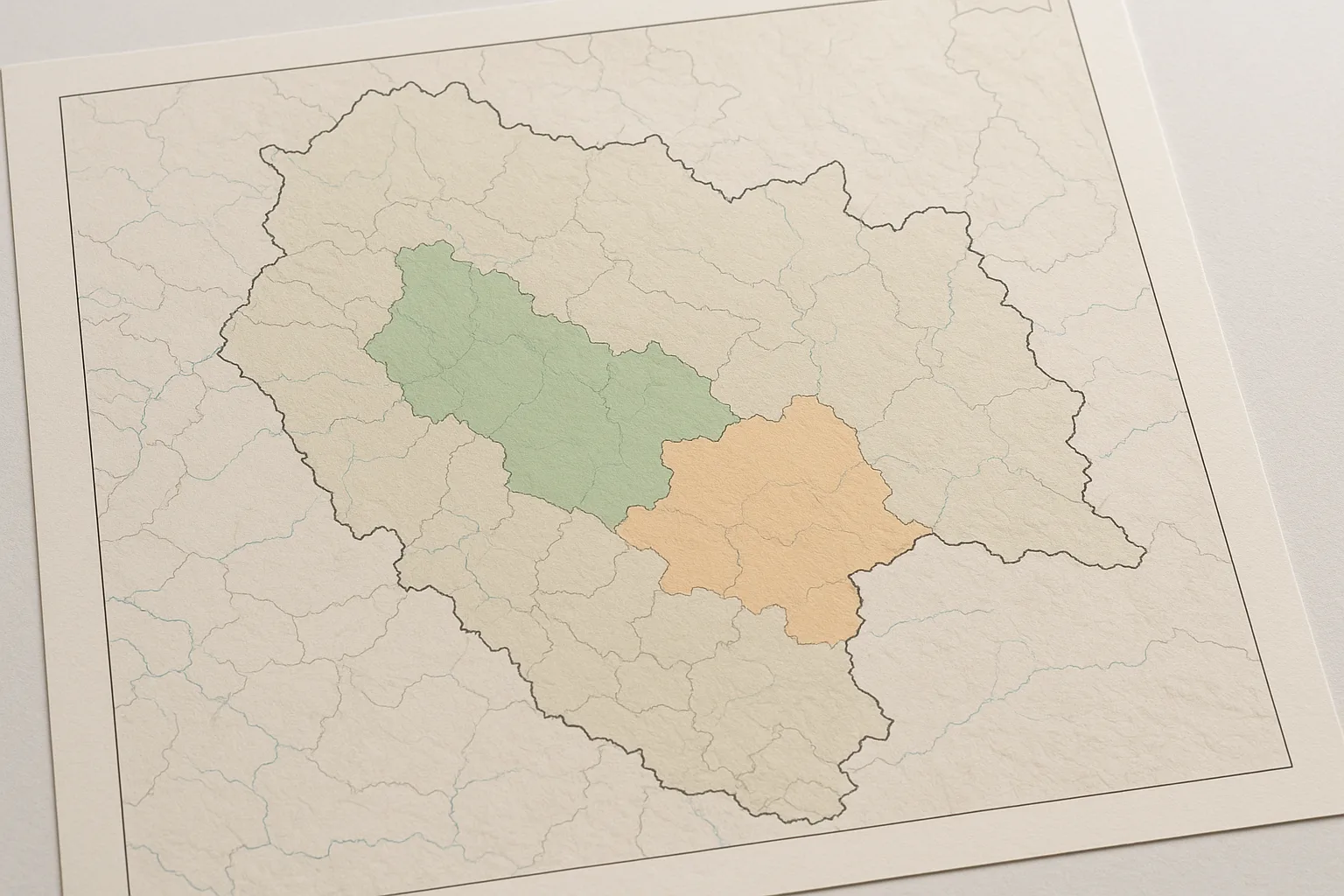
Series: History of Hamirpur, Himachal Pradesh, India
Phase 2: Medieval Period — Part 7 of 30
This article forms part of a continuing series that follows the gradual emergence of organised power in the western Himalayas. As small communities gave way to clans, chieftainships, and hill states, patterns of rule, alliance, and conflict began to take shape. This phase examines how authority was negotiated through land, ritual, and warfare, laying the groundwork for regional kingdoms that would dominate the medieval landscape.
Twilight in the Hills: Hamirpur’s Medieval Crossroads
It is a damp monsoon evening, sometime in the late twelfth century. Mist clings to the pine-studded slopes above the Sutlej and Beas rivers. Villagers in the scattered hamlets of what is now Hamirpur gather outside their wooden homes, listening for distant drumbeats—signals from the fortresses of their lords. The hills are alive with rumor: the Kangra king’s envoys are passing through, seeking tribute for the coming year. Here, at the heart of the lower Himalayas, the fates of countless small communities are being woven into the tapestry of a much larger kingdom.
Anchoring Hamirpur in the Medieval Past
The region known today as Hamirpur, Himachal Pradesh, occupied a strategic and often contested position between major Himalayan powers. By the early medieval period, Hamirpur was not a single polity but a mosaic of chiefdoms, clan territories, and nascent hill states. Its valleys offered fertile soil and passageways for traders, while its ridgelines provided natural defenses.
The Kangra Kingdom, centered around the formidable Nagarkot (modern-day Kangra Fort), was one of the oldest and most influential powers in the western Himalayas. Regional gazetteers and chronicles such as the Tarikh-i-Kangra point to Kangra’s extensive reach, which waxed and waned over centuries but repeatedly drew in the territories of present-day Hamirpur.
Oral Traditions and Clan Memories
Much of Hamirpur’s early medieval history survives in the oral traditions of Rajput, Brahmin, and tribal communities. Elders recount tales of ancient migrations—how the Katoch Rajputs, descending from the legendary Trigarta rulers, sent their younger sons to govern outlying regions under Kangra’s suzerainty. In these stories, the hill chiefs (known as thakurs or ranas) pledged loyalty to the Kangra raja, offering grain, wool, and military levies in exchange for protection and autonomy.
Yet, as is often the case with oral history, these accounts blend memory with myth. The story of Hamir Chand, for whom Hamirpur is said to be named, arises from both documented genealogy and popular legend—his reign is placed somewhere between the late twelfth and early thirteenth century, but the details remain elusive. What emerges clearly, however, is the sense of a region inextricably linked with Kangra’s fortunes, its identity forged in the crucible of shifting allegiances.
Trade, Belief, and the Fabric of Early Settlements
Archaeological remains and early chronicles hint at a vibrant network of settlements across Hamirpur’s river valleys and hilltops. The proximity to ancient trade routes connecting the Punjab plains to Tibet and the Central Himalayas brought not only merchants but also new religious ideas. Buddhist monastic sites, Shaivite shrines, and folk deities coexisted, reflecting centuries of cultural exchange.
The rise of the Kangra Kingdom coincided with the spread of temple architecture and the patronage of local artisans. Stone idols—some still worshipped in village shrines—speak to a period when Hamirpur’s clans, while politically subordinate, retained distinct spiritual identities. Periodic fairs and markets, often held under the shadow of Kangra’s banners, further knit these communities into the wider economic and cultural orbit of the kingdom.
Recorded Rivalries and Political Intrigue
Historical inference, drawn from regional chronicles and the administrative records of later Mughal and Sikh rulers, suggests that Hamirpur was both a prize and a pawn in the long struggle for dominance in the hills. The Katoch dynasty’s power was repeatedly challenged—from within by ambitious vassals, and from without by neighboring hill states such as Jaswan, Guler, and Mandi.
Hamirpur’s fortresses, like those at Nadaun and Sujanpur Tira, became staging grounds for these conflicts. During the fourteenth and fifteenth centuries, as Mongol and later Mughal pressures mounted, Kangra’s rulers relied on their Hamirpur feudatories for troops and provisions. The chronicles recount episodes of rebellion as well—local chiefs taking advantage of Kangra’s distractions to assert independence, only to be brought to heel by force or diplomacy.
Communities, Customs, and Shifting Allegiances
By the late medieval period, Hamirpur’s social landscape reflected centuries of negotiation with Kangra’s authority. Dominant Rajput clans—such as the Chandel, Pathania, and Jaswal—held hereditary estates granted for loyalty in war. Brahmin families curated local histories and rituals, while artisan castes and pastoral Gujjar communities maintained the rhythms of daily life.
Customs such as rakhi (protection pacts) and joint festival observances reinforced the sense of connection with Kangra, even as local traditions persisted. Oral epics sung during harvest festivals still recount the exploits of warriors who rode under Kangra’s banners, yet whose hearts remained loyal to their own valleys and villages.
The Enduring Legacy of Medieval Bonds
The political and cultural ties forged between Hamirpur and the Kangra Kingdom continue to echo in the region’s identity. Place names, family lineages, and even patterns of local governance reflect a heritage shaped by centuries of alliance, rivalry, and exchange. The intricate relationships established in those mist-shrouded centuries—between overlord and vassal, temple and market, myth and memory—have left a subtle but indelible mark on Hamirpur’s collective consciousness.
As we move forward in this series, the next chapter will explore how these medieval alliances weathered the arrival of new powers—the Mughal Empire and the rising Sikh influence—and how Hamirpur’s communities adapted to the challenges and opportunities of an ever-changing political landscape.
Previous: Rise of Local Hill Chieftains in Medieval Hamirpur
Next: Village Administration and Governance in Medieval Hamirpur