
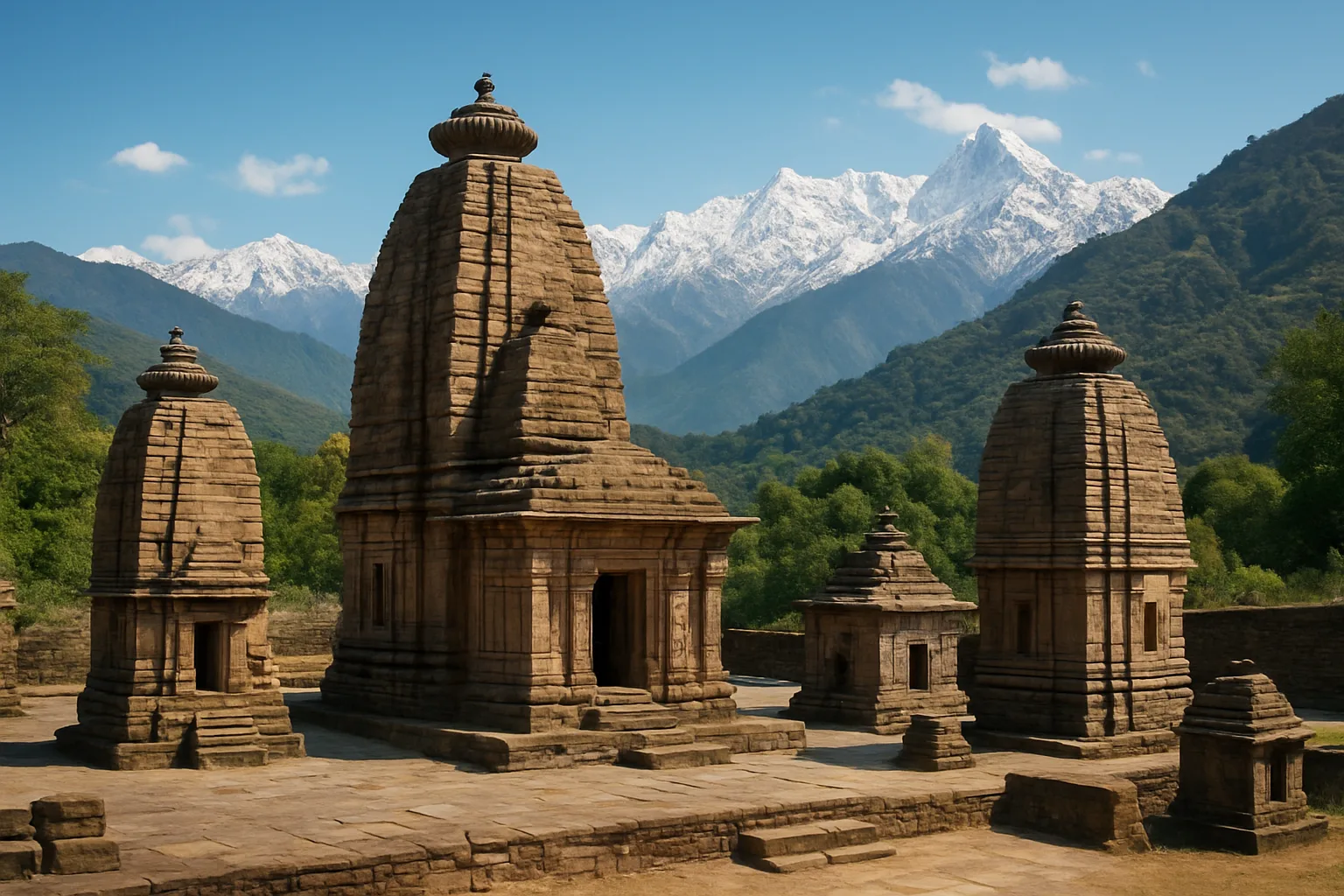
Series: History of Kangra, Himachal Pradesh, India
Phase 1: Ancient Trigarta — Part 4 of 30
This article is part of a broader historical series exploring the earliest layers of human presence in the western Himalayas. Beginning with landscape, belief, and early patterns of movement and settlement, the series traces how communities adapted to mountainous environments long before formal states or written records emerged. These foundational centuries shaped cultural memory, local traditions, and relationships with the land that would endure through later periods of change.
Under the Shadow of the Dhauladhars
Morning mist lingers in the valleys of Kangra, the snow-capped Dhauladhar range looming above. It’s the fourth century BCE. Smoke from hearths curls above clustered hamlets, their mud walls daubed with ochre symbols. The air is thick with the aroma of incense and grain, punctuated by the calls of herders guiding cattle along age-old forest paths. Here, in the Himalayan foothills, the story of Kangra’s ancient society is already centuries old, entwined with the sacred landscape that so powerfully shaped its people.
Kangra: Ancient Trigarta and Its Place in Early India
Long before Kangra bore its present name, the region was known as Trigarta. This land—so named for its association with three great rivers, the Ravi, Beas, and Sutlej—appears in Sanskrit epics and the earliest political chronicles. Trigarta is mentioned in the Mahabharata as a formidable hill state, its warriors allied with the Kauravas in that legendary conflict. But where myth meets memory, clues to real society emerge.
References from regional gazetteers and the Rajatarangini, the Kashmiri chronicle, point to a patchwork of hill chieftains and early polities as far back as the sixth century BCE. These communities, clustered around the fertile valleys and river plains, began to coalesce into what would later become the ruling houses of Kangra. Yet religion—woven into the rhythms of field and forest—remained the enduring force binding society together.
Oral Traditions, Myth, and the Living Landscape
Much of early Kangra’s story survives in oral tradition, echoing through folk songs and temple recitations. The land itself was, and remains, sacred. Myths tell of the goddess Ambika (Durga), whose shrine at Jawalamukhi—where flames emerge from the earth—became a center of pilgrimage long before written records. The deodars were said to shelter wandering sages; the rivers, believed to be goddesses incarnate, received offerings at every crossing.
These stories, passed from elders to children beneath starry Himalayan skies, shaped the spiritual contours of the region. While it is challenging to separate myth from fact, the continued veneration of local deities reveals the persistence of these ancient beliefs in Kangra’s collective memory.
Early Communities and Social Structure
Archaeological surveys and early British gazetteers, such as the Kangra District Gazetteer of 1883-84, hint at a mosaic of agricultural societies. The region’s earliest inhabitants likely included tribes such as the Khasas and Dasas, who practiced animal husbandry and shifting agriculture in the lower valleys. Over time, Indo-Aryan settlers migrated into the region, bringing new languages and social customs.
Village life revolved around extended families, or gotras, with elders mediating disputes and guiding religious observance. The emergence of clan-based chieftaincies—such as those of the Katoche and Jaswal dynasties—would later lay the groundwork for Kangra’s princely states. Yet even in these formative centuries, social hierarchy remained relatively fluid, shaped as much by the demands of the rugged terrain as by inherited status.
Belief Systems: Between Vedas and the Local Gods
The spiritual life of ancient Kangra was strikingly syncretic. Vedic rituals arrived with migrating priestly families, who performed fire sacrifices on riverbanks and hilltops. But these practices did not supplant older faiths. Instead, the worship of local deities—grama devtas and kul devis—thrived alongside Brahmanical rites.
Temples, often little more than cairns of stone or wooden shrines, dotted the landscape. Offerings of grain, ghee, and flowers appeased both the high gods and the spirits guarding fields and forests. Oral epics recounted the deeds of warriors and sages, while folk festivals celebrated the cycles of planting and harvest. Buddhism, too, left faint traces—traders and monks traveling from Gandhara and Kashmir brought with them stories and relics, some of which would later find sanctuary in Kangra’s monasteries.
Trade, Pilgrimage, and the Dawn of the Hill States
Kangra’s valleys, nestled between Punjab and Tibet, sat astride ancient trade routes. Caravans carried salt, gold, and wool; pilgrims journeyed to the shrines of Jwalamukhi, Chintpurni, and Baijnath. These exchanges brought not only goods, but also new ideas—Buddhist, Jain, and early Shaiva influences mingled with local traditions.
The prosperity generated by trade fostered the rise of fortified settlements. By the close of the first millennium BCE, these hill forts—kotlas—became centers of political and religious life. The rulers of Trigarta, later known as the Katoch dynasty, began to assert their authority from their high stone citadels—most notably at Nagarkot, present-day Kangra Fort. Here, in the shadow of the mountains, the lines between sacred and secular power blurred.
Written Memory: Chronicles and Invaders
While oral tradition preserves the spiritual heart of Kangra, the earliest written records arrive with outside chroniclers. The Chinese Buddhist pilgrim Xuanzang, visiting in the seventh century CE, described a land dotted with monasteries and temples—evidence of a vibrant, pluralistic society. Later, the Rajatarangini chronicled the alliances and conflicts of Kangra’s rulers, often framing their power in religious terms.
Repeated invasions—from the Mauryan period through the rise of the Gurjara-Pratihara and early Muslim rulers—introduced new religious influences but also reinforced the centrality of local gods and traditions. Temples were rebuilt, legends retold, and the memory of ancient Trigarta persisted, braided into every stone and stream.
Echoes of the Past: Modern Kangra’s Enduring Spirit
Walk through Kangra today and the imprint of its ancient society is unmistakable. Village shrines stand beneath the same deodar groves. Festivities still mark the sowing and reaping, and stories of the gods are sung as they have been for millennia. Even as new faiths and practices have arrived, the foundational patterns laid in those distant centuries remain visible—in the resilience of Kangra’s people, their profound connection to place, and the enduring sanctity of the land.
As we move forward in this series, we’ll follow Kangra’s journey through the age of empires—charting how ancient traditions both shaped and resisted the great forces that swept across the Himalayan foothills.
Previous: Early Settlements in the Kangra Valley
Next: Strategic Importance of Kangra’s Geography