
Series: History of Kangra, Himachal Pradesh, India
Phase 1: Ancient Trigarta — Part 5 of 30
This article is part of a broader historical series exploring the earliest layers of human presence in the western Himalayas. Beginning with landscape, belief, and early patterns of movement and settlement, the series traces how communities adapted to mountainous environments long before formal states or written records emerged. These foundational centuries shaped cultural memory, local traditions, and relationships with the land that would endure through later periods of change.
Valleys Wrapped in Mist: A Dawn in Ancient Kangra
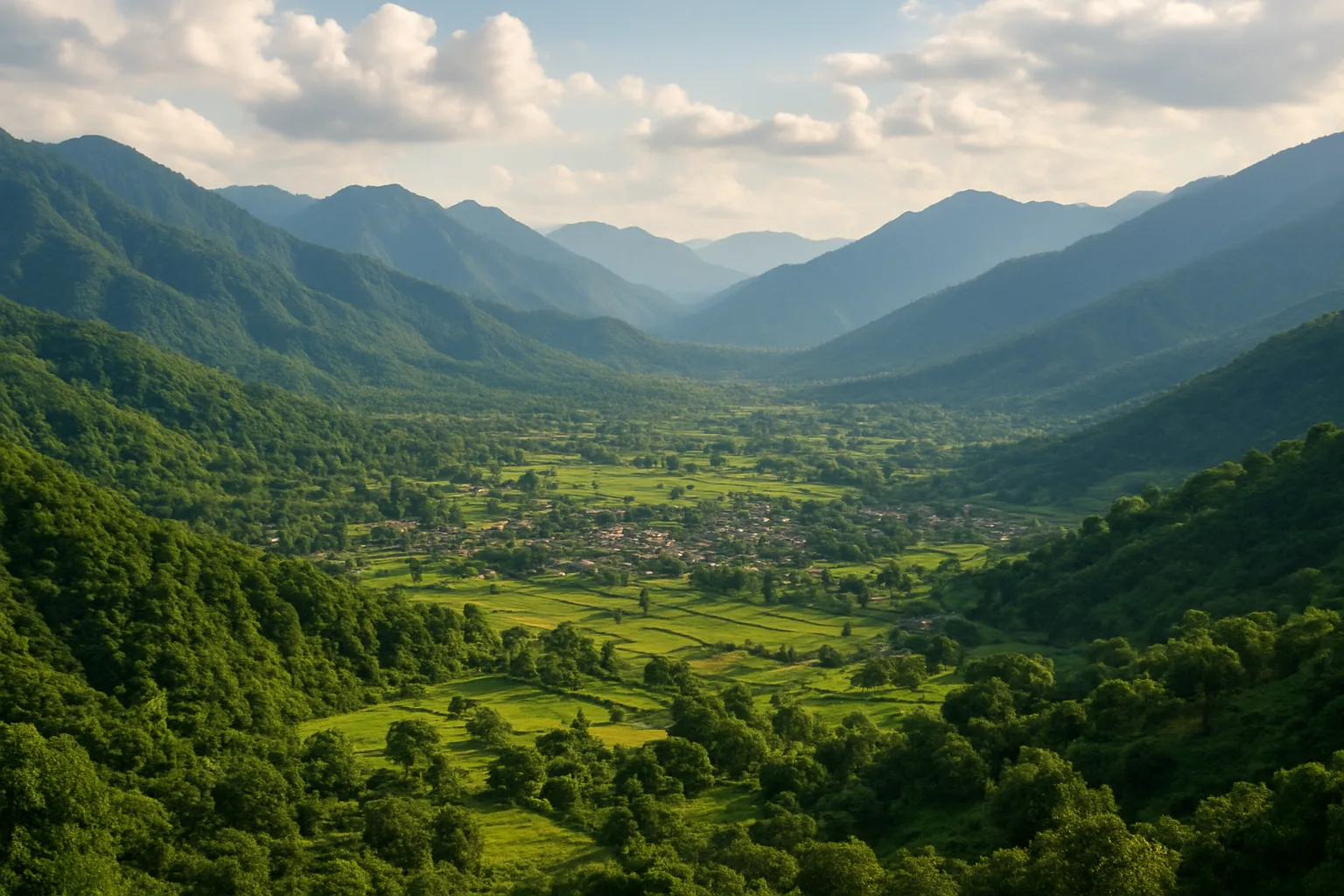
As the first pink light crept over the Dhauladhar peaks, the Kangra valley awoke—a patchwork of rivers, dense forests, and scattered hamlets. The year is uncertain, and the world beyond these hills is a tapestry of shifting kingdoms and forgotten tribes. Yet the land itself endures, its contours shaping the lives of those who call it home. The Beas river cuts a blue vein through the valley floor, while watchful eyes in hillside forts scan the passes that have, for centuries, made Kangra a prize and a refuge.
The Land of Trigarta: A Geographical Anchor
Kangra’s earliest identity emerges from the name Trigarta—literally, “three rivers.” Mentioned in ancient epics and later in regional chronicles, Trigarta’s boundaries stretched across what is now western Himachal Pradesh and parts of the Punjab plains. Its heart lay in the confluence of the Beas, Sutlej, and Ravi rivers. This land was not just a backdrop for legends; its geography dictated the fortunes of those who settled here.
The valley’s natural defenses were formidable. Ringed by the Dhauladhar range to the north and shielded by dense forests to the south, Kangra was both accessible and protected. Fertile alluvial plains along the Beas nurtured agriculture, while the hills offered sanctuary against invaders. Early travelers and chroniclers, from the writers of the Mahabharata to later court historians, marveled at the region’s abundance—and its strategic importance.
Oral Traditions and the Mythic Landscape
Long before written records, Kangra’s geography was woven into oral traditions. Local lore tells of sage Vashistha’s penance on the banks of hot springs, and the Pandavas’ brief refuge in these valleys during their exile. Such stories, passed from generation to generation, do more than embellish the land’s mystique; they reveal how people saw their environment as sacred and powerful.
Yet, as historians, we must distinguish between the evocative power of these tales and the harder contours of evidence. While the Mahabharata places Trigarta among the adversaries of the Pandavas, and later Puranic texts echo these associations, the precise chronology and extent of early Kangra remain partly in shadow—illuminated in turn by archaeology, tradition, and the steady hand of the landscape itself.
From Nomads to Settlements: Shaping Communities
By the early first millennium BCE, the valleys and hills of Kangra saw a gradual transition from nomadic foragers to settled agriculturalists. Archaeological finds—pottery shards, burial sites, early tools—suggest a network of small communities clustering along riverbanks and forest clearings. These settlers were drawn by the valley’s fertile soil and reliable resources: water, wild game, and timber.
The region’s topography encouraged the development of distinct villages, often isolated by ravines or dense woods. Over time, these clusters evolved into early hill states, each ruled by localized chiefs who owed their power as much to strategic location as to martial prowess. Oral genealogies preserved by bardic families—many still active in Kangra today—trace local lineages back to these formative centuries.
Belief Systems Rooted in the Land
The mountains and rivers shaped not only livelihoods but also beliefs. Early religious sites—natural caves, river confluences, sacred groves—marked the spiritual geography of Kangra. The cult of Shiva, closely linked to the rugged landscape, took root here long before temple architecture flourished. Later, the goddess Ambika (a form of Durga) would become central to Kangra’s sacred identity, her shrines often perched at vantage points overlooking the valley below.
These belief systems, while deeply local, were never isolated. Pilgrims, wandering ascetics, and traders brought new ideas along with them, blending local deities with broader currents of Vedic and then later Hindu traditions. The land itself—its mountains regarded as the abodes of gods—remained the constant frame of reference.
Trade Routes and the Meeting of Worlds
Kangra’s location, at the crossroads of northwestern India, gave it an outsized role in early commerce. Ancient paths threaded their way from the plains of Punjab through the Kangra valley and into the Himalayan foothills, linking traders from distant lands. Salt, grain, wool, and precious stones moved along these routes—sometimes in the packs of yak caravans, sometimes under the guard of armed escorts wary of bandit raids.
Regional gazetteers, compiled centuries later, recall the valley’s reputation as a market for “goods from north and south, east and west.” The strategic passes through the Dhauladhar not only facilitated trade but also exposed Kangra to waves of migration and military incursion. From the earliest hill states to the later Rajput dynasties, power in Kangra was inseparable from control over these arteries of movement.
The Emergence of Hill States and Early Polities
By the close of the first millennium BCE, Kangra’s scattered communities coalesced into more organized polities. Early chronicles—such as those referenced in the Rajatarangini and local bardic narratives—mention the rise of small hill principalities. Here, geography played kingmaker: rulers who commanded the high ground or controlled key river crossings could levy tribute from traders and dictate terms to their rivals.
The fortress at Nagarkot (later Kangra Fort) rose atop a steep hill, dominating the valley below. This citadel, whose origins likely predate written records, became the seat of power for the Katoch dynasty, whose lineage is celebrated in both oral tradition and early medieval chronicles. As the series will explore in coming chapters, the region’s political fortunes would ebb and flow with the tides of invasion and alliance—but always, the land itself remained the constant, shaping every contest for supremacy.
Legacy of the Land: Kangra’s Geography Today
Walk the fields of Kangra today and the ancient boundaries are still visible—if you know where to look. Villages nestle in the same river valleys, shrines cling to windswept ridges, and the great fort still stands, battered but unbowed. The region’s geography, once the crucible of power and identity, continues to anchor its people to a story that began millennia ago.
In the next part of this series, we will journey deeper into the emergence of Kangra as a center of power, tracing the rise of its first legendary dynasties and the forging of alliances that would shape northern India for centuries to come.
Previous: Religion and Society in Ancient Kangra
Next: Rise of the Katoch Dynasty