
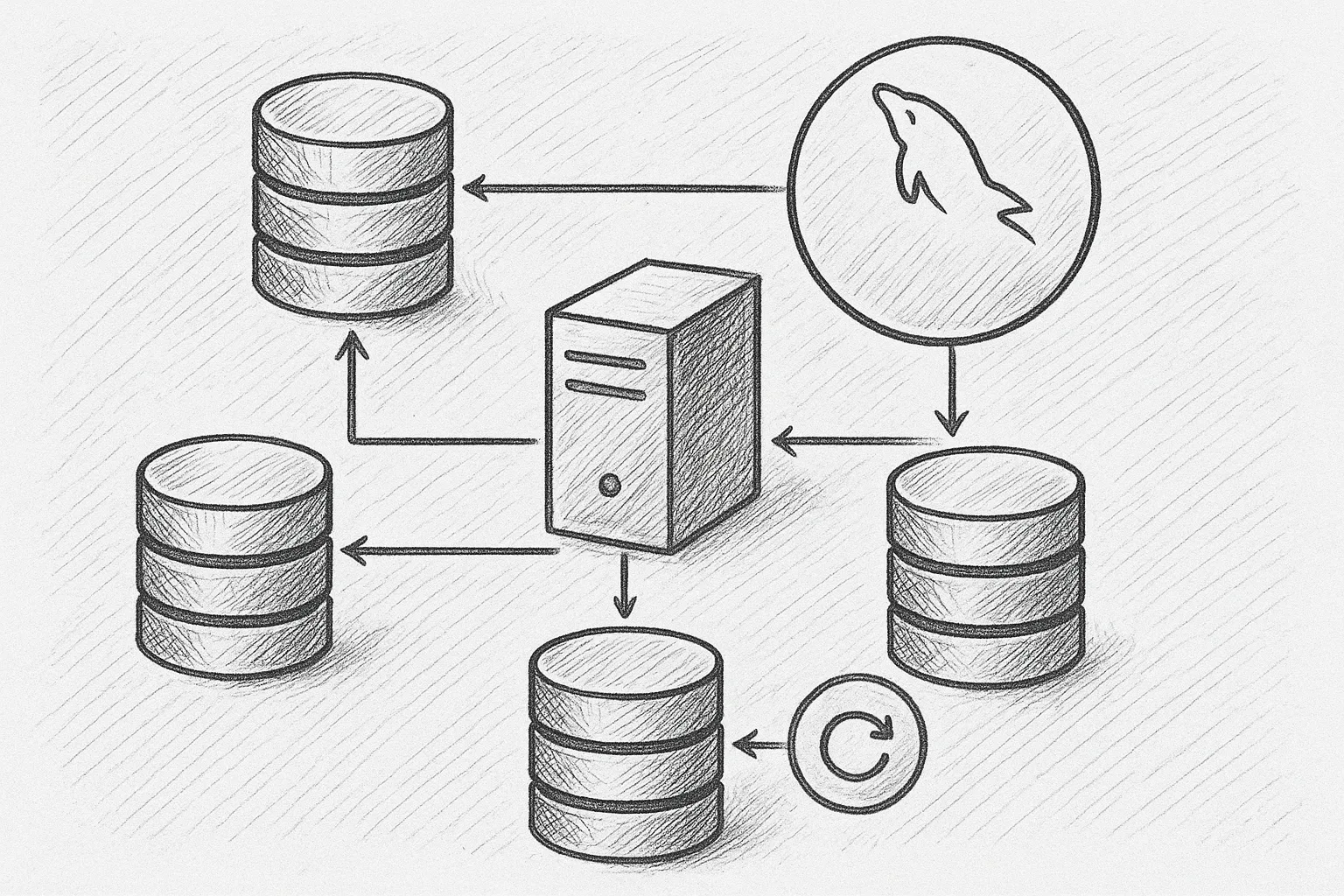
MySQL now offers two main patterns for high availability: traditional replication (asynchronous or semi-sync) and InnoDB Cluster based on Group Replication. Both are widely used, both are supported, and both can work well when designed correctly. The challenge is knowing when to choose InnoDB Cluster instead of a classic primary-replica setup.
This article focuses on architectural trade-offs and operational realities, not marketing claims. The goal is to help general engineers and DBAs pick the right tool for their environment.
Quick mental model: Replication vs InnoDB Cluster
At a high level:
Classic replication (async/semi-sync)
┌───────────┐      binlog      ┌───────────┐
│  Primary  │ ────────────▶   │  Replica  │
└───────────┘                  └───────────┘
  (writes)                        (reads)

InnoDB Cluster (Group Replication)
┌───────────┬───────────┬───────────┐
│ Member 1  │ Member 2  │ Member 3  │
│ (RW)      │ (RO/RW*)  │ (RO/RW*)  │
└───────────┴───────────┴───────────┘
  Shared group, automatic failover, quorum
Classic replication is a simple log shipping model: one primary writes the binary log, replicas apply it. InnoDB Cluster uses a distributed protocol (Group Replication) to coordinate writes across multiple members, with quorum-based decisions.
Core decision: Do you need coordinated HA or flexible topology?
Replicate-first thinking:
- If you want maximum topology flexibility, minimal background magic, and you are comfortable managing failover logic yourself, traditional replication is usually better.
- If you want built-in high availability with automatic failover, consistent views of cluster state, and integrated tooling, InnoDB Cluster is often the right choice.
Most decisions boil down to four dimensions:
- Failure handling and recovery
- Consistency and conflict handling
- Operational tooling and automation
- Topology complexity and performance
When InnoDB Cluster is usually the better choice
1. You need automatic failover with minimal custom glue
InnoDB Cluster is designed for managed HA:
- Group Replication manages membership and quorum.
- MySQL Router can automatically reroute traffic to the correct primary or reader nodes.
- The shell (dba.* commands) provides state inspection and recovery workflows.
Typical fit:
- Small to medium teams without a dedicated DBA.
- Environments where application code should not embed complex failover logic.
- Where an orchestrator or custom failover system would be overkill or hard to maintain.
Example architecture:
App ──▶ MySQL Router ──▶ InnoDB Cluster (3 members)
                       ┌───────────┬───────────┬───────────┐
                       │ Primary   │   Replica │   Replica │
                       └───────────┴───────────┴───────────┘
Failover is handled by the cluster; the router updates routing automatically. You avoid writing custom election logic.
2. You prioritise consistency over topology tricks
InnoDB Cluster uses Group Replication with a consensus protocol. In the default single-primary mode:
- Only one node accepts writes.
- Transactions are replicated with certification; conflicting writes are detected and rolled back.
- Members agree on the order of transactions.
This fits scenarios where:
- You want predictable behaviour under failover (no diverging replicas).
- Multi-DC, multi-primary setups are not required.
- Data correctness is more important than squeezing every last millisecond from write latency.
Classic replication can be tuned for durability, but it is inherently log-shipping: replicas can lag and diverge during failover if not carefully managed.
3. You want a supported, standardised HA pattern
Many organisations prefer using the vendor’s reference architecture for HA. InnoDB Cluster provides:
- Documented deployment patterns.
- Standard CLIs and metadata tables for monitoring state.
- Clear expectations for failover behaviour.
This is valuable when:
- You need a predictable, well-documented pattern for audits and compliance.
- Your operations team supports many stacks and cannot specialise deeply in MySQL internals.
- You want to reduce the amount of custom automation to maintain.
4. You can accept the constraints Group Replication imposes
InnoDB Cluster is opinionated. You trade some flexibility for safety:
- Topology is limited (e.g. 3–9 members is typical; no arbitrary cascades).
- All members must meet certain configuration and network requirements.
- Write latency includes group coordination overhead.
If those constraints fit your workload and infrastructure, the simplified operations can be a strong benefit.
When classic replication is usually the better choice
1. You need complex or large fan-out topologies
Classic replication excels at flexible layouts:
- Dozens of replicas off a single primary.
- Cascading replicas (replica of a replica).
- Dedicated replicas for ETL, reporting, or long-running queries.
- Cross-region replicas with relaxed RPO/RTO.
           ┌───────────┐
           │  Primary  │
           └─────┬─────┘
       binlog    │
                 ├────────────┬────────────┐
           ┌─────▼─────┐┌─────▼─────┐┌─────▼────┐
           │ Replica 1 ││ Replica 2 ││ Replica 3│
           └───────────┘└───────────┘└──────────┘
InnoDB Cluster does not target large fan-out read scaling from a single group. If you need many replicas, especially for heavy reporting, classic replication is usually simpler and more efficient.
2. You already have mature failover automation
If your environment already uses tools like orchestrator-style topology management, VIPs, or load balancers with health checks, you may not need the built-in HA from InnoDB Cluster.
Classic replication fits when:
- You have well-tested promotion procedures.
- Your team is comfortable with replication internals (GTIDs, relay logs, recovery).
- You prefer explicit, scriptable control over which node becomes primary.
3. You want minimal write latency and simple semantics
Group Replication adds coordination overhead. For latency-sensitive workloads with a single primary and local replicas, classic asynchronous replication often provides:
- Lower write latency (no group-wide certification).
- Fewer moving parts in the critical write path.
- Predictable behaviour when replicas lag (they simply fall behind).
If you can tolerate some replication lag and handle failover explicitly, classic replication can be more performant and easier to reason about.
4. You need cross-version or cross-engine flexibility
Classic replication allows more heterogeneous setups, for example:
- Different MySQL minor versions during rolling upgrades (within supported compatibility ranges).
- Replicas with different storage engines or configuration tuned for reporting.
InnoDB Cluster expects homogeneous configuration across members and is more restrictive. If you rely on heterogeneity for certain use cases, classic replication is more accommodating.
Step-by-step: Deciding between InnoDB Cluster and replication
Step 1: Define your failure scenarios
List what you must handle:
- Single node crash.
- Host loss or AZ loss.
- Network partition between nodes.
- Planned maintenance and upgrades.
For each, write down:
- Maximum acceptable downtime (RTO).
- Maximum acceptable data loss (RPO).
- Who or what triggers failover (human vs automation).
If you need sub-minute RTO with minimal manual intervention, InnoDB Cluster is attractive. If you can tolerate some manual steps, classic replication remains viable.
Step 2: Evaluate operational maturity
Ask:
- Do we have on-call staff with MySQL replication expertise?
- Do we already run automation for failover and topology changes?
- How comfortable are we debugging replication issues under pressure?
If the answer is “not very”, leaning on InnoDB Cluster’s integrated tooling and automatic failover can reduce risk.
Step 3: Map performance and workload patterns
Consider:
- Write intensity: high write throughput and very low latency often favour classic replication.
- Read scaling: if you need many read replicas, classic replication is usually simpler.
- Consistency: if you value consistent cluster state and conflict detection, InnoDB Cluster is strong.
Step 4: Check infrastructure constraints
InnoDB Cluster requires:
- Reliable, low-latency network between members.
- Stable DNS or IP addressing for members and router.
- Uniform configuration (InnoDB, GTIDs, binary logging, etc.).
On RHEL/Rocky Linux, ensure:
- Firewalld or other firewalls allow intra-cluster ports.
- Time synchronisation (chrony or ntpd) is correctly configured.
- SELinux rules are adjusted if necessary for MySQL and Router communication.
If your network is unreliable or high-latency between sites, prefer classic replication for cross-region links and keep InnoDB Cluster within a single region or low-latency domain.
Step 5: Prototype both on a small scale
Before committing, build two small environments on Rocky Linux:
-
Classic replication test
- 1 primary, 2 replicas.
- Set up GTID-based replication.
- Test manual promotion of a replica.
- Measure write latency and replication lag under load.
-
InnoDB Cluster test
- 3-node InnoDB Cluster with MySQL Router.
- Simulate a primary crash and observe automatic failover.
- Measure application behaviour during failover.
- Measure write latency and throughput under the same workload.
Use these results to validate assumptions and refine your choice.
Best practices whichever path you choose
- Use GTIDs for replication to simplify failover and recovery.
- Enable binary logging and InnoDB crash-safe settings consistently.
- Automate backups and test restores regularly.
- Monitor replication lag, cluster state, and error logs.
- Script repeatable provisioning on RHEL/Rocky Linux (e.g. Ansible or similar).
This article offers general technical guidance. Validate all configurations in a safe environment before applying them to production.
Conclusion
InnoDB Cluster is a strong choice when you want built-in, vendor-supported high availability with automatic failover and consistent cluster state, and you can accept its topology and performance constraints. Traditional replication remains the best tool for flexible, large, or specialised topologies, and when you already have mature automation for failover. Evaluate your failure requirements, operational maturity, workload, and infrastructure, then prototype both approaches. The right answer is rarely “InnoDB Cluster everywhere” or “replication forever”, but a deliberate match between architecture and operational reality.
Leave a Reply