
Series: History of Una, Himachal Pradesh, India
Phase 1: Ancient & Early Roots — Part 3 of 30
This article is part of a broader historical series exploring the earliest layers of human presence in the western Himalayas. Beginning with landscape, belief, and early patterns of movement and settlement, the series traces how communities adapted to mountainous environments long before formal states or written records emerged. These foundational centuries shaped cultural memory, local traditions, and relationships with the land that would endure through later periods of change.
The First Furrows at Dawn
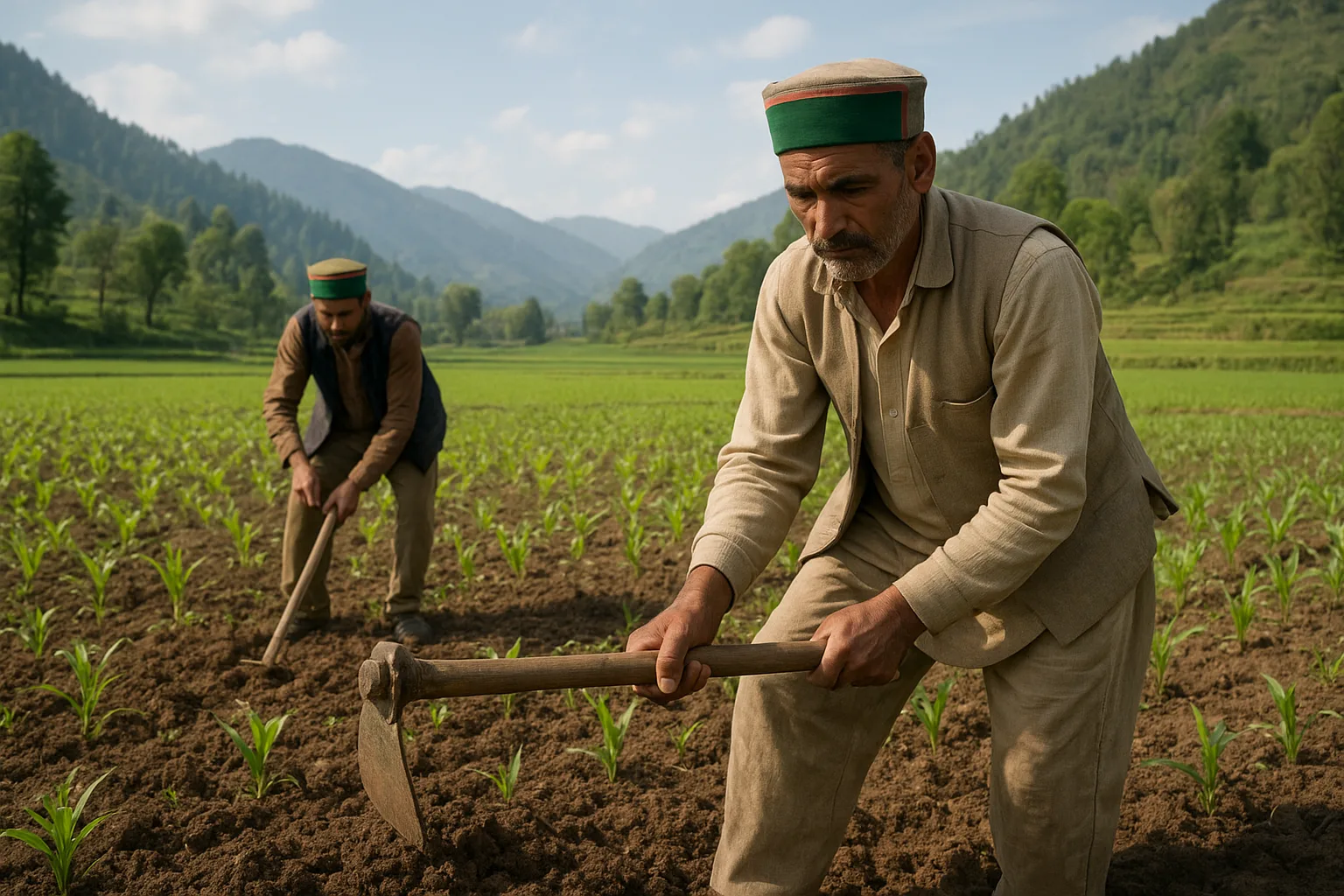
As the first rays of sun slipped over the foothills of the Shivalik range, a hush fell over the valley where the Swan River wound its way through ancient forests. It was here, along this fertile corridor in Una, that small groups of people gathered in the predawn light, clutching simple wooden digging sticks and baskets woven from wild grasses. Their hands, calloused from seasons of toil, were about to perform the oldest ritual known to humankind: the sowing of seed into earth.
Today, it is difficult to imagine what Una looked like more than four thousand years ago, before the rise of great cities, before even the stories of grand kingdoms. But the clues are still there, in the river’s soft alluvial banks, and in the fragments of pottery and grain unearthed by archaeologists. These were the first agrarians of Una—people who would quietly change the face of the region forever.
From Foraging to Farming
For centuries, the people of Una’s valleys and hills lived as hunter-gatherers, moving with the seasons and the migrations of wild game. Their world was one of forests teeming with deer and wild boar, rivers rich with fish, and hillsides lush with berries and roots. But as the population grew and the climate shifted, a new way of life beckoned. Across what is now Himachal Pradesh, the Neolithic revolution—marked by the domestication of plants and animals—began to take root.
The transition was gradual but unmistakable. Archaeological evidence from the neighboring Kangra and Bilaspur regions, whose ancient trade and cultural ties with Una are well documented, reveals the emergence of polished stone tools, grinding stones, and the remains of primitive granaries. In Una, too, similar implements have been found, suggesting that by around 2000 BCE, families had begun to settle in small clusters, clearing patches of land for wheat, barley, and lentils.
This transformation was not just technological—it was deeply spiritual. The act of sowing and harvesting became woven into the rhythms of daily life. The people of Una developed seasonal rituals to honor the spirits of the fields, seeking protection for their crops from the unpredictable monsoon and the ever-present threat of wild animals.
Life Along the Swan River
The Swan River, often called the ‘lifeline of Una’, shaped the destiny of these early settlers. Its annual floods nourished the soil, making the surrounding plains exceptionally fertile. Villages sprang up along its banks, connected by footpaths and, eventually, by the rudimentary trade routes that would tie Una to the wider world.
Life in these villages followed the pulse of the seasons. Spring brought the sowing of seeds, summers were spent tending to the growing crops, and autumn signaled the time for harvest and communal feasting. Winters, though harsh, were softened by the warmth of fires and the sharing of stored grain.
Archaeological digs in the area have revealed storage pits lined with river pebbles, used to keep grain safe from pests. Simple mud-brick homes clustered together, often built atop low mounds to escape the reach of floodwaters. The air would have been filled with the sounds of livestock—early forms of cattle, goats, and sheep—whose dung enriched the fields and whose milk and meat sustained the community.
Innovation and Adaptation
Farming in Una was never an easy task. The region’s hilly terrain and erratic rainfall presented constant challenges. Yet, the ingenuity of Una’s early agrarians is evident in the adaptations they made. They learned to build small embankments and irrigation channels to control water flow, copying techniques likely observed in the more advanced Indus Valley sites to the west.
As their skills grew, so did their ability to produce surplus grain. This surplus was transformative. It freed some members of the community to focus on pottery, textiles, and tool-making, setting the stage for greater social complexity. By the late Bronze Age, Una’s villages were part of a wider network of exchange, trading salt, seeds, and woven cloth with neighboring settlements in the Punjab plains and the Himalayan foothills.
In these exchanges, Una’s people absorbed not just goods, but new ideas—about crops, pottery styles, and even early scripts. The influence of larger cultures, including the Harappan civilization, may have reached Una in subtle ways, visible in the decorative motifs on pottery shards and in burial practices that hint at a growing social stratification.
Rituals, Beliefs, and Daily Life
The early agrarians of Una lived by the sun, stars, and the rhythm of the river. Their spirituality was rooted in the cycles of nature, and their rituals reflected a reverence for the land. Small clay figurines of women, found in nearby regions and likely present in Una as well, suggest the worship of fertility goddesses linked to agricultural bounty. Seasonal festivals marked the beginning and end of the sowing and harvesting periods, with music, dance, and communal meals reinforcing bonds of kinship and cooperation.
Daily life revolved around collective labor. Women and men worked side by side in the fields, children tended animals or collected firewood, and elders taught the stories of their ancestors. Each family contributed to communal granaries, ensuring that all would have enough to eat through lean times.
Despite the hardships—drought, floods, disease—the sense of community was strong. Archaeological evidence of joint burial sites and shared housing points to a culture where survival depended on mutual support. The landscape itself bears witness to their resilience, marked by ancient terraces and abandoned fields that still lie beneath the grass of modern Una.
Encounters and Influences
While Una’s early farmers were largely self-sufficient, they were never isolated. The region sat at an intersection of ancient trade routes, linking the Himalayan highlands to the fertile plains of the Punjab. Traveling merchants brought copper tools, beads, and stories from distant lands. Over time, these encounters left their mark, introducing new crops—like peas and chickpeas—and new ideas about governance and social order.
By the first millennium BCE, the seeds of change were everywhere. Metal tools began to replace stone, village councils emerged to settle disputes, and the boundaries between Una’s communities and their neighbors grew more porous. Yet, the core of Una’s identity—its connection to the land and the rhythm of agriculture—remained steadfast.
Legacy of the First Farmers
The story of Una’s early agrarian communities is not just a tale of survival, but of quiet revolution. Their innovations in farming, storage, and social organization laid the foundation for everything that followed. Later generations would build temples and forts, wage wars and forge alliances, but it was the first farmers who turned Una from wilderness into homeland.
Vestiges of their world linger in the terraced fields that still contour the hills, and in the folk songs sung during harvest festivals. The communal spirit, forged in the struggle against flood and famine, continues to shape Una’s social fabric. Even today, agriculture remains at the heart of local identity, a living legacy of those ancient hands that first sowed the valley’s soil.
As we move forward in this series, tracing Una’s path from early settlements to the rise of kingdoms and beyond, the story of its first farmers reminds us that history is built not only by kings and conquerors, but by the countless ordinary people whose labor and ingenuity shape the world they inherit.
Previous: Geography That Made Una a Gateway to the Hills
Next: Una’s Place in Ancient Trade and Migration Routes