
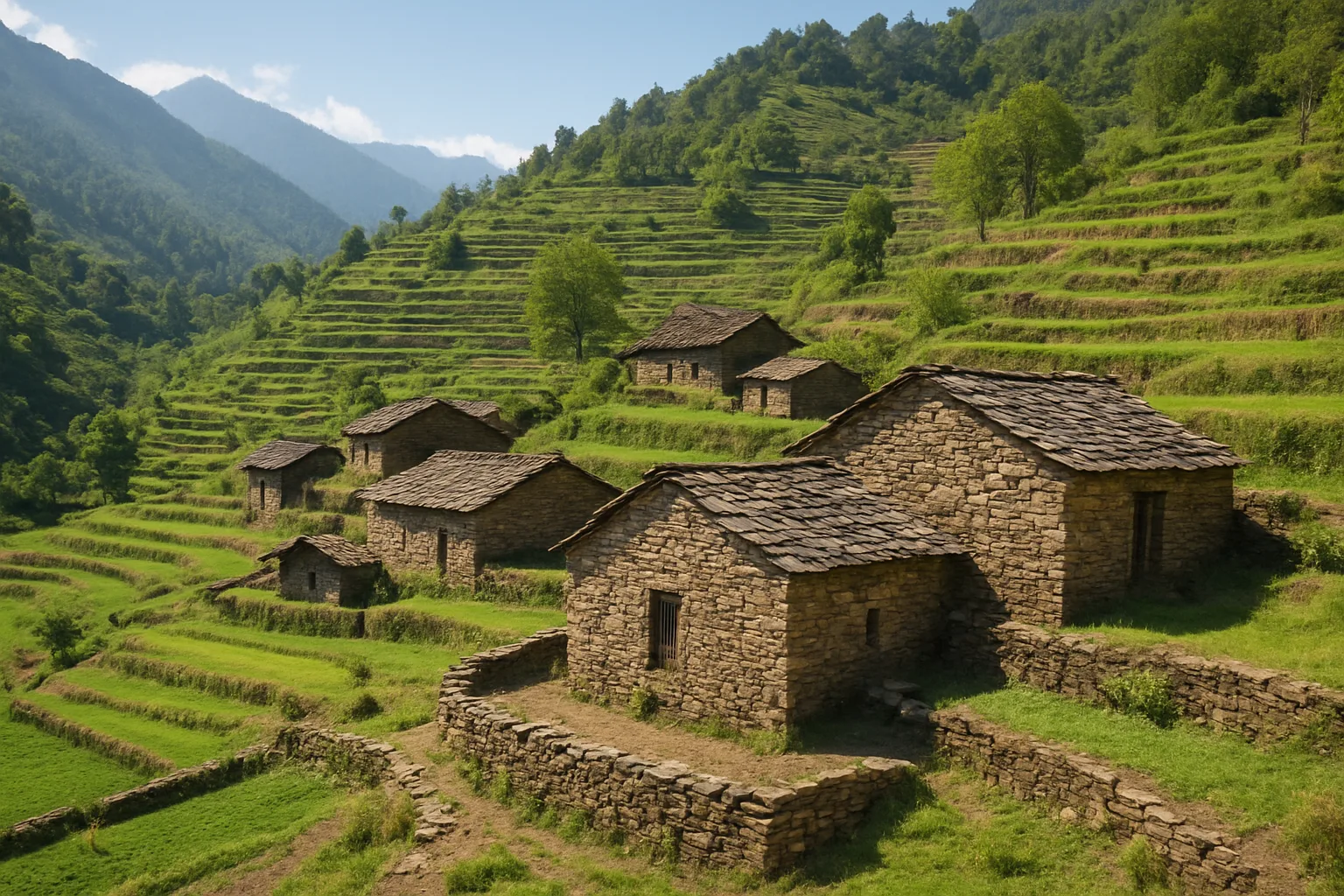
Series: History of Sirmaur, Himachal Pradesh, India
Phase 1: Ancient & Early Roots — Part 1 of 30
This article is part of a broader historical series exploring the earliest layers of human presence in the western Himalayas. Beginning with landscape, belief, and early patterns of movement and settlement, the series traces how communities adapted to mountainous environments long before formal states or written records emerged. These foundational centuries shaped cultural memory, local traditions, and relationships with the land that would endure through later periods of change.
Twilight on the Giri River: The First Footprints
The sun dipped behind the Shivalik hills, casting long shadows over the winding Giri river. Somewhere near its banks, long before any kingdom rose or temple stood, a group of early settlers sat around a fire. They had come with the monsoon, drawn by the river’s promise—fish, fertile soil, and shelter beneath the dense sal forests. It’s here, in these ancient valleys of today’s Sirmaur district, that the first chapters of human life in Himachal Pradesh quietly unfolded.
The Land Before Borders: Sirmaur’s Prehistoric Canvas
Long before Sirmaur’s name echoed in royal chronicles, the region’s story was written in stone tools and pottery shards. Archaeologists find evidence of protohistoric settlement along the Yamuna and Giri rivers—axes, scrapers, and microliths nestled in the alluvial plains. These artifacts, dating back thousands of years, speak of a people who hunted, gathered, and slowly began to cultivate the land. The district’s rolling hills and river valleys, now dotted with villages, once echoed only with the songs of birds and the cautious steps of early humans.
The Mythic Tapestry: Legends of Serpent Kings and Sages
As the centuries turned, Sirmaur’s landscape became woven with legend. Ancient texts—like the Puranas and later local vamshavalis—recall the region as a haunt of sages and nagas (serpent deities). The Giri and Tons rivers, sacred in local lore, are said to have been the playgrounds of these mystical beings. Oral traditions tell of the great sage Parashurama wandering these hills, his axe carving out valleys and his penance sanctifying the forests. Whether myth or memory, these stories gave the land its first spiritual identity—a place where the divine and the earthly intertwined.
Ancient Crossroads: The Peoples and Paths of Sirmaur
Geography made Sirmaur a natural corridor between the plains of North India and the rising Himalayas. In the early centuries BCE, tribal communities like the Kiratas, Khasas, and Nagas are believed to have inhabited these hills. Their lives left traces in the rhythms of agriculture, forest lore, and hill fortifications whose remnants still guard Sirmaur’s ridges. Through these passes, merchants, pilgrims, and armies moved, linking the region to Vedic kingdoms in the south and Buddhist centers emerging further north.
Echoes of Empires: Mauryan Shadows and Ashokan Footprints
The third century BCE brought distant tremors to Sirmaur’s valleys. According to ancient edicts, the Mauryan emperor Ashoka sent emissaries and possibly even missionaries into the Himalayan foothills. Though direct evidence in Sirmaur is scant, the influence of Ashokan dhamma—non-violence, moral law, and Buddhist values—likely touched the region through trade and travel. The spread of Buddhism, glimpsed in scattered stupas and rock inscriptions in nearby areas, hints at a time when Sirmaur’s hills resonated with chants and debates about the nature of existence.
Shifting Sands: The Rise of Kingdoms and the Formation of Identity
By the early centuries CE, the patchwork of tribes and petty chieftains began to coalesce into more organized polities. The earliest known mention of Sirmaur as a distinct region emerges in medieval chronicles, but its roots stretch deeper. Hill forts rose atop strategic summits—places like Nahan and Rajban later became centers of power. The coming centuries would see the gradual emergence of the Sirmaur dynasty, but even at this early stage, the land’s identity was shaped by its role as a meeting ground—between forest and field, myth and history, outsider and native.
Memory in the Stones: Temples, Caves, and Early Culture
Across Sirmaur, signs of ancient devotion linger. The caves of Trilokpur, the sacred groves near Shivalik ridges, and the early shrines to Shiva and Devi suggest a culture balancing animist roots with emerging Hindu traditions. Stone sculptures and fragments of ancient temples have been unearthed—silent witnesses to centuries of worship and artistic expression. These relics, seen today in local museums and village altars, form an unbroken chain to the beliefs and hopes of Sirmaur’s earliest communities.
Ancestral Echoes: How Sirmaur’s Ancient Past Endures
Walk the fields around Paonta Sahib or the wooded slopes outside Nahan, and you’ll find the past still whispering. Village festivals echo the rhythms of ancient harvests. Place-names recall vanished clans and legendary beings. The balance between forest and field, custom and change, remains central to Sirmaur’s way of life. In every prayer offered at the Giri river, in every folk story told by the hearth, the ancient roots of Sirmaur shape its present identity—a district where memory runs as deep as the hills themselves.
Resonance Across the Centuries
As we move deeper into the chronicle of Sirmaur, the ancient beginnings we’ve traced here serve as the foundation for what followed—the rise of dynasties, the forging of alliances, the defense of autonomy on Himachal’s southern frontier. But even as palaces and politics came to shape the region, the imprint of its first peoples remains. Sirmaur’s history is not just found in the archives or the ruins, but in the living landscape: the rivers, the ridges, and the enduring spirit of its people. In the next post, we’ll explore the emergence of the Sirmaur dynasty and the forging of royal power in these storied hills.
Next: Geography That Shaped Early Life in Sirmaur