
Series: History of Mandi, Himachal Pradesh, India
Phase 1: Ancient & Mythological Roots — Part 2 of 30
This article is part of a broader historical series exploring the earliest layers of human presence in the western Himalayas. Beginning with landscape, belief, and early patterns of movement and settlement, the series traces how communities adapted to mountainous environments long before formal states or written records emerged. These foundational centuries shaped cultural memory, local traditions, and relationships with the land that would endure through later periods of change.
The Night the Ghats Awoke
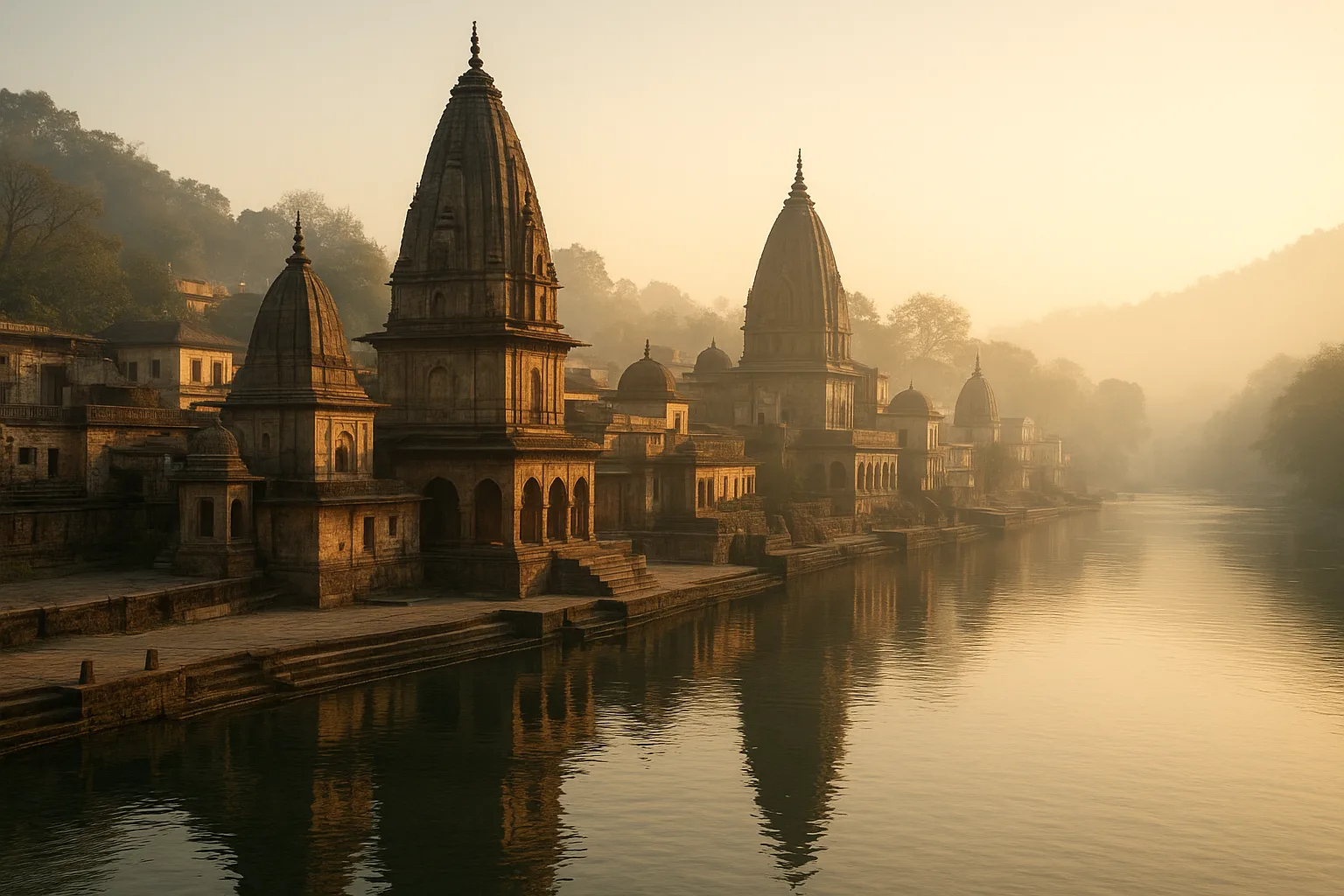
On a misty spring night, the air in Mandi buzzes with anticipation. Pilgrims drift along the banks of the Beas River, their footsteps echoing between rows of ancient stone temples. As the moonlight shimmers on the river’s surface, temple bells toll, and incense smoke rises, weaving through the Himalayan air. In this charged moment, Mandi feels less like a modern hill town and more like a living relic—one that locals, travelers, and scholars have long called the “Kashi of Himachal Pradesh.” But what lies beneath this title? Why does this remote valley evoke the sacred city of Kashi (Varanasi) on the Ganges? The story of Mandi’s transformation into a northern Kashi is both mythic and deeply human, shaped by faith, ambition, and the enduring pull of the divine.
Echoes from the Mythic Past
Long before Mandi became a city of temples, its hills were cloaked in legends. Ancient texts and oral traditions suggest that this region was once part of the fabled Kuluta kingdom, with its roots stretching into the Mahabharata era. Local stories recount sages wandering these slopes, meditating on the banks of the Beas, and invoking gods in the shadow of snowcapped peaks. The Beas itself was said to be the playground of rishis and celestial beings, lending the land an aura of sanctity. These tales, passed down through generations, planted the seeds for a spiritual landscape that would soon burst into stone and ritual.
A Royal Vision: The Founding of Mandi
The story of Mandi’s transformation begins in the early 16th century with Raja Ajbar Sen. Originally the ruler of Bhiuli, a settlement near present-day Mandi, Ajbar Sen was drawn to the confluence of rivers and the natural fortifications of these hills. According to chroniclers, he experienced a series of dreams urging him to establish a new capital on this sacred ground. Heeding these visions, Ajbar Sen founded the city of Mandi in 1526. But his ambitions were not merely political: he envisioned a city that would rival the great spiritual centers of India, a place where devotion, art, and power would intertwine.
Ajbar Sen’s first act as founder was to bring the idol of Madho Rai (Lord Vishnu) from Bhiuli to Mandi, installing it as the city’s presiding deity. This symbolic gesture established a model that later rulers would expand, setting the tone for centuries of temple-building and ritual patronage. Over generations, the city grew not just in size, but in spiritual stature.
Temples Rise: Crafting a Sacred Landscape
By the 17th century, Mandi was humming with construction. Successive kings—most notably Raja Suraj Sen and Raja Ishwari Sen—commissioned an astonishing array of temples. More than eighty shrines, many dedicated to Shiva, sprang up along the riverbanks and hillsides. Each temple, built in the distinctive stone shikhara style, echoed the architecture of Varanasi, Kashi’s sacred city on the Ganges. The city’s very layout, with its ghats, spires, and processional routes, was designed to evoke the holy geography of India’s spiritual heartland.
The Triloknath Temple, with its towering spire and intricate stone carvings, emerged as a centerpiece of local worship. The Bhutnath Temple, built in the mid-16th century and dedicated to Shiva, became the epicenter of Mandi’s annual Shivaratri celebrations—a festival that continues to draw thousands. Pilgrims compared the steps to the Beas with the ghats of Kashi, and the temple bells rang out with the same fervor as those on the banks of the Ganges.
This deliberate mirroring was not lost on contemporary travelers and chroniclers. By the 18th century, visitors were already calling Mandi the “Varanasi of the Hills”—a place where Himalayan serenity merged with the spiritual energy of the Gangetic plains.
Divine Patronage and Sacred Festivals
Mandi’s rulers did not merely build temples; they wove religious ritual into the fabric of civic life. Every spring, the city burst into color for the Mandi Shivaratri Fair, a tradition initiated by Raja Ajbar Sen and expanded by his successors. For seven nights, deities from every corner of the valley—dozens of them, each carried in palanquins and flanked by musicians—descended into the city. The spectacle, reminiscent of the grand processions of Kashi, transformed Mandi into a living tableau of faith.
Royal patronage ensured that the city’s temples were not static monuments but living institutions. Priests, artisans, and musicians received royal support, while festivals and fairs offered a stage for communal renewal. The city’s rulers saw themselves as custodians of dharma, responsible for maintaining the sacred order. Through these acts, they bound their authority to the divine, reinforcing Mandi’s reputation as a Himalayan Kashi.
Encounters and Continuity: Mandi in the Colonial Era
The arrival of the British in the 19th century brought new eyes to Mandi’s spiritual landscape. British officers and travelers, struck by the city’s dense concentration of temples, described it as “a miniature Benares.” Colonial gazetteers marveled at the rituals, the architecture, and the fusion of local and pan-Indian traditions.
Yet, even as political control shifted, the city’s sacred rhythms endured. The patronage of local rulers continued, and temple festivals persisted, weaving together old mythologies with new realities. Mandi’s status as the Kashi of Himachal Pradesh was thus not just a matter of geography, but of lived tradition—carried forward by priests, pilgrims, and ordinary townspeople alike.
Why the Name Endures
Today, Mandi’s skyline is still punctuated by temple spires. The city’s narrow lanes open onto courtyards where ancient rituals unfold each day, much as they did centuries ago. Local legends, carved in stone and sung in festivals, reaffirm the city’s connection to the divine. The comparison to Kashi endures not just because of the sheer number of temples—over eighty by most counts—but because Mandi has, for generations, been a stage for profound spiritual encounter.
To walk through Mandi is to move through layers of myth and history, where every stone seems to whisper stories of devotion and dynasty. The city remains a place where the sacred is not distant, but woven into daily life—a living Kashi on the banks of the Beas.
Reflections: The Past in the Present
For the people of Mandi, the echoes of this history are not mere nostalgia. The city’s identity—its festivals, its architecture, its communal rhythms—still turns on the axis of its sacred legacy. Pilgrims continue to arrive, drawn by the promise of spiritual renewal; artisans and priests carry forward crafts and rituals centuries old. Even as the world outside races ahead, Mandi remains anchored in the mythic and the real, a testament to the enduring power of place. The “Kashi of Himachal Pradesh” is not a relic, but a living promise—one whose roots stretch from the riverbanks of ancient legends to the bustling heart of a modern Himalayan town.
Previous: Mythological Origins of Mandi: Legends from the Puranas
Next: Ancient Trade Routes That Shaped Early Mandi