
Series: History of Lahaul & Spiti, Himachal Pradesh, India
Phase 2: Medieval Trans-Himalayan Rule — Part 9 of 30
This article forms part of a continuing series that follows the gradual emergence of organised power in the western Himalayas. As small communities gave way to clans, chieftainships, and hill states, patterns of rule, alliance, and conflict began to take shape. This phase examines how authority was negotiated through land, ritual, and warfare, laying the groundwork for regional kingdoms that would dominate the medieval landscape.
Winter Shadows and Council Fires
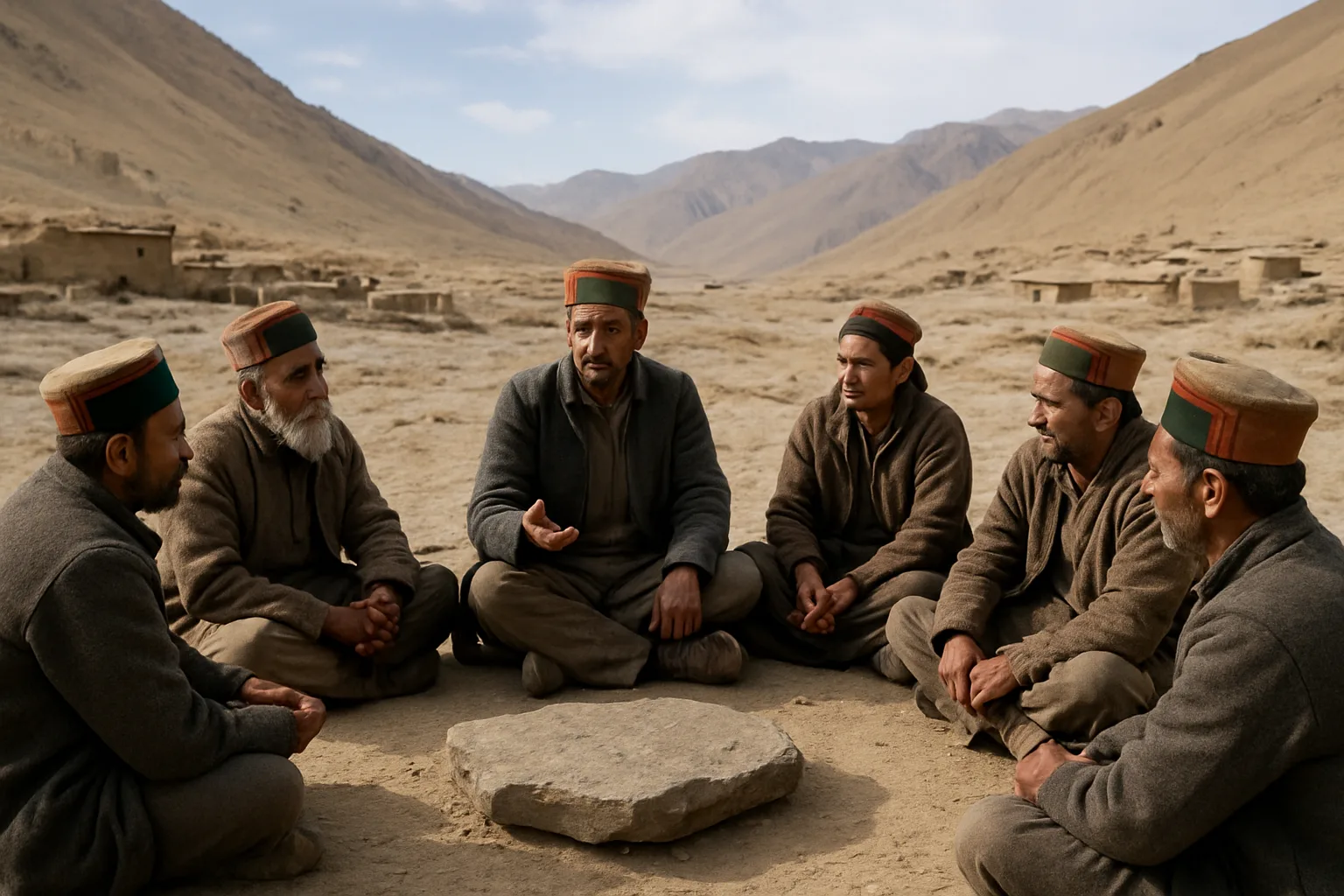
The wind sifts through the stones of an ancient village above the Chandra River, its cold breath rippling across terraced fields dusted with snow. In a dim, smoky room, elders gather around a hearth—faces weathered by sun and wind—speaking in low tones. Each word, measured and deliberate, carries the weight of tradition and the memory of countless winters. Here in medieval Lahaul-Spiti, amid towering peaks and narrow valleys, the story of governance and law is written not in royal decrees, but in the living customs of its people.
Between Empires and Isolation: Setting the Stage
By the 11th century CE, Lahaul and Spiti occupied a unique threshold between worlds. To the south and west, the rising hill states of Kullu and Chamba vied for influence, their reach occasionally stretching into the high valleys. To the north and east, the shadow of the Tibetan plateau loomed. Trade caravans wound through the passes, carrying salt, wool, and stories—yet, for much of their history, the villages of Lahaul-Spiti remained largely self-reliant, governed by custom rather than distant rulers.
Early chronicles like the Kullu Gazetteer and accounts from Tibetan pilgrims hint at a world shaped by both remoteness and exchange. Oral traditions recall legendary migrations and the settling of clans, but beneath the myth, archaeology and written records suggest the gradual emergence of compact, self-governing hamlets, each with its own rhythms and codes.
The Village as World: Settlements and Communities
Medieval Lahaul-Spiti was never a land of sprawling towns. Instead, clusters of homes huddled along rivers, where glacial melt enabled barley, buckwheat, and peas to grow. Within these hamlets, kinship and community ties ran deep. The dominant communities—such as the Bodh in Lahaul and the Bhotia of Spiti—traced their roots through both oral legend and remembered migration, blending indigenous beliefs with Buddhist and pre-Buddhist customs.
Each settlement was more than a collection of houses: it was a microcosm, with its own temples, sacred stones, and communal granaries. The goba (village headman) presided over daily life, but true authority lay with the assembly of elders and the consensus of the people. In these mountain worlds, survival demanded cooperation, and so the village council—often called khumjung or yulpa—became the heart of local governance.
Law By Memory: Customary Justice and Social Order
In the absence of formal courts, disputes in Lahaul-Spiti were settled around the hearth. Customary law, handed down orally, governed everything from land inheritance to marriage, irrigation rights to the movement of livestock. Transgressions—whether a stolen yak or a broken marriage promise—triggered careful deliberation by the council. The goal was less punishment than reconciliation, for in a land where neighbors depended on each other, harmony was prized above all.
Some of these traditions, such as the division of water from glacial streams or the sharing of labor at harvest, survive in local memory. Others, like ancient forms of trial by ordeal or ritual oaths, are known mainly through oral accounts and the recollections of elders. Rarely written down, these laws adapted to circumstance, blending Tibetan Buddhist ethics with older animist beliefs, and evolving with the needs of each generation.
Belief, Ritual, and the Sacred Order
Religion was woven tightly into governance. Buddhist monasteries—such as the legendary Key and Tabo—rose along the trade routes during the medieval period, their lamas acting as mediators, scribes, and keepers of peace. Yet, in many villages, ancient deities and spirits still commanded respect. Rituals to appease mountain gods were conducted by lhama and gyalpo, blurring the boundaries between spiritual and secular authority.
When disputes threatened to divide a community, it was not unusual for decisions to be sanctified with offerings at sacred stones or under the gaze of local deities. In this way, customary law drew its force not only from consensus but from the shared conviction that peace and prosperity depended on harmony with both ancestors and the land itself.
Trade, Outside Influence, and the Emergence of Hill States
Despite their isolation, the villages of Lahaul-Spiti were never wholly cut off. Ancient trade routes—connecting Ladakh, Kullu, and Tibet—brought new ideas, objects, and occasional waves of political influence. From the medieval 12th century onward, the growing power of the Kullu and Chamba kingdoms increasingly brushed against the region’s autonomy. Chronicles record instances when taxes were levied or local headmen acknowledged distant kings, but in practice, external rule was often more nominal than real.
It was only in periods of crisis—drought, invasion, or the failure of a harvest—that villages might look outward, seeking protection or arbitration from a neighboring raja or monastery. Even then, the rhythms of customary law and local council remained the primary means of self-government, resilient against the shifting tides of highland politics.
Memory and Modernity: Legacy of Ancient Law
Much of what shaped medieval Lahaul-Spiti endures today: the centrality of village councils, the role of elders, and the belief that law must serve the needs of the living community. In many hamlets, oral tradition still guides decisions on land, marriage, and water—though now within the framework of the Indian state. The sacred stones remain, and the echoes of council fires linger in the stories told on long winter nights.
As we continue this series, we will journey deeper into the era of expanding kingdoms and the changing balance between local custom and external authority. Next, we will trace how the rise of regional powers further transformed the political and legal landscape of Lahaul-Spiti, and what was gained—and lost—in the process.
Previous: Lahaul Between Kullu, Chamba, and Ladakh Powers
Next: Agriculture and Pastoralism in Medieval Lahaul–Spiti