
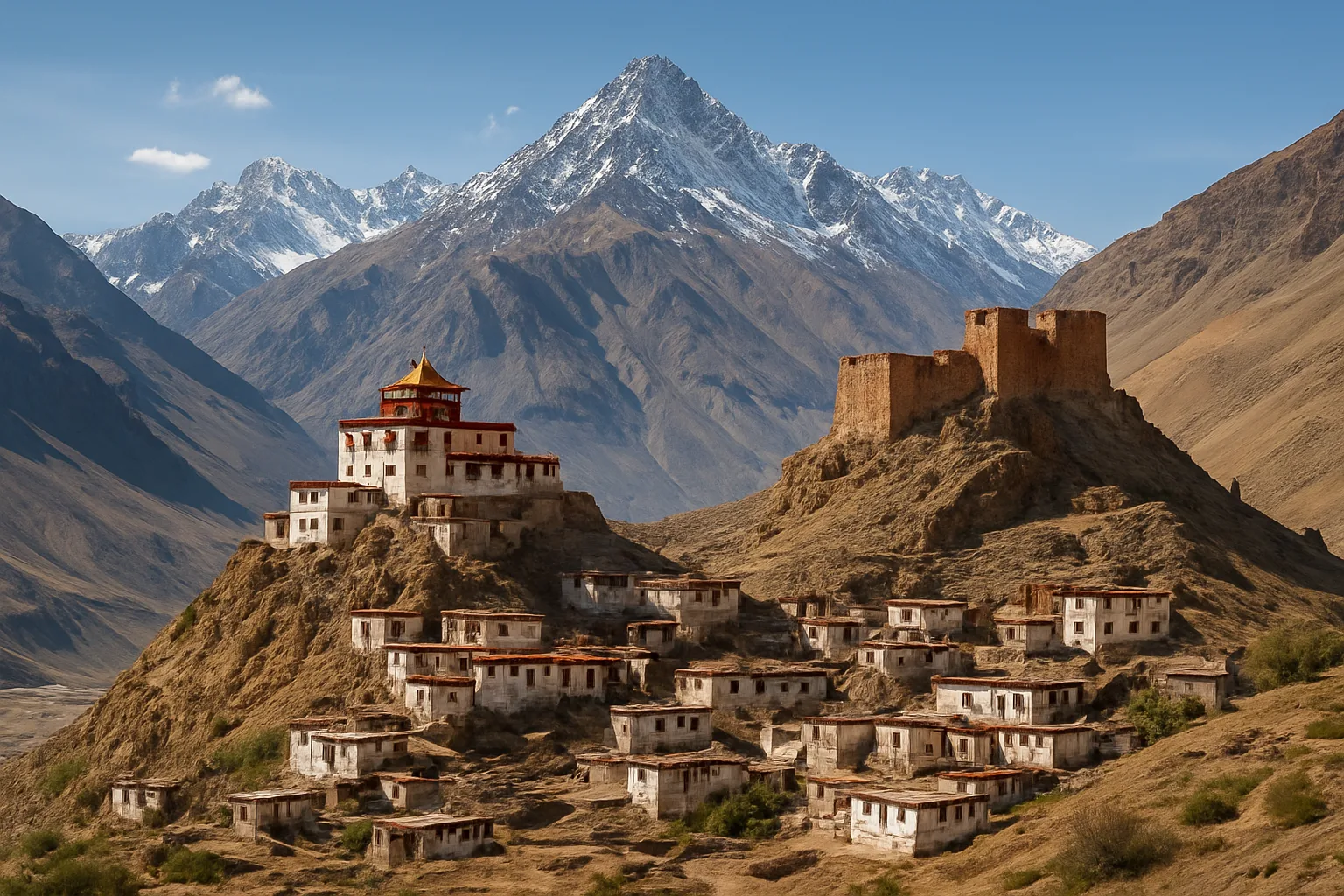
Series: History of Lahaul & Spiti, Himachal Pradesh, India
Phase 2: Medieval Trans-Himalayan Rule — Part 7 of 30
This article forms part of a continuing series that follows the gradual emergence of organised power in the western Himalayas. As small communities gave way to clans, chieftainships, and hill states, patterns of rule, alliance, and conflict began to take shape. This phase examines how authority was negotiated through land, ritual, and warfare, laying the groundwork for regional kingdoms that would dominate the medieval landscape.
A Winter Dawn in Ancient Spiti
The wind’s whistle threads through the stone alleys of Tabo as dawn breaks, the high Trans-Himalayan sky painted with the faintest rose. It is the eleventh century, and the valley is hushed beneath its perennial snows. In the monastery’s shadow, monks in ochre robes stir from sleep, while yak caravans, heavy with salt and wool, prepare to move toward the Ladakhi passes. Here, in the farthest reaches of what is now Himachal Pradesh, the influence of distant kingdoms has begun to etch itself into the mountains—shaping faith, politics, and the very rhythms of daily life.
Spiti Before the Himalayan Kingdoms
Long before the great monasteries and stone fortresses, Spiti was a land of scattered settlements and oral traditions. Early chronicles—later echoed in regional gazetteers—describe a world where indigenous communities eked out a living along the riverbanks, their beliefs shaped by animist practices and the awe of towering peaks. These people, ancestors to the present-day Bodh and Rang communities, left behind little in the way of written record, but their oral traditions survive: tales of mountain spirits, sacred springs, and legendary founders whose names linger in village lore.
Archaeological hints—a chorten here, a petroglyph there—suggest gradual contact with the outside world. Yet, until the first millennium CE, Spiti remained largely isolated, its high passes impassable for much of the year, its people bound more to the land than to distant rulers.
Trade Routes and Early Encounters
The silence began to break as Trans-Himalayan trade routes took shape. By the early medieval period, Spiti’s valley had become a minor but strategic artery between Ladakh, western Tibet, and the Indian plains. Salt caravans from the Changthang plateau moved southward; wool, barley, and turquoise flowed in return. These routes were more than lines of commerce—they were conduits for ideas, faiths, and new political ambitions.
Oral and written traditions agree that this era saw the gradual rise of hill principalities along the Sutlej and Spiti rivers. The emergence of the Purang-Guge kingdom in western Tibet, and the growing power of Ladakh to the north, would set the stage for centuries of shifting allegiances, tribute, and cultural exchange.
Ladakh’s Shadow Over Spiti
By the tenth and eleventh centuries, the kingdom of Ladakh had become a formidable regional power. Its rulers, the Namgyal dynasty, looked southward with interest. Spiti, with its strategic passes and proximity to the trade corridors of Tibet, was both a gateway and a prize. Local oral legends tell of Ladakhi raiders and soldiers crossing the high passes; regional chronicles, such as the Ladakhi La-dvags rgyal-rabs, mention Spiti as a territory of periodic tribute and intermittent occupation.
Yet Ladakhi influence was rarely absolute. The valley’s remoteness and fierce winters served as natural defenses, ensuring that any political control—from Ladakh or beyond—was negotiated, not imposed. Local chieftains, known variously as Wazirs or Nono, maintained a degree of autonomy, balancing their ties between Ladakh, Tibet, and the emerging polities of Kinnaur and Lahaul. The result was a patchwork of alliances and rivalries, shifting with the fortunes of trade and the moods of the mountain gods.
The Tibetan Buddhist Renaissance
It was in the sphere of religion, rather than warfare, that the influence of Ladakh and Tibet left its most lasting mark. The tenth and eleventh centuries witnessed a great Buddhist revival across the western Himalayas, spurred by the efforts of Tibetan kings and Indian monastic teachers. Spiti’s monasteries—most famously Tabo, established in 996 CE under the patronage of the Tibetan king Yeshe-Ö—became beacons of this renaissance.
Tabo’s frescoes and scriptures bear the imprint of both Kashmiri and Tibetan artistry. Buddhist doctrine, rituals, and monastic governance, imported from the great centers at Tholing and Lhasa, became interwoven with local practices. The translation of Sanskrit texts into Tibetan, undertaken by monks from both sides of the mountains, fostered a shared spiritual world that transcended political boundaries.
Oral tradition credits wandering yogis and scholars—some local, others from distant monastic universities—with converting valley chieftains and founding smaller hermitages. Over time, Buddhism supplanted older animist beliefs, though traces of the ancient faith lingered in local festivals and rites.
Everyday Life and the Ties That Bound
For Spiti’s people, the influence of Ladakh and Tibet was felt in ways both grand and ordinary. Architectural styles shifted: whitewashed stupas and fortress-like monasteries rose above villages, mirroring those of the Indus valley. Ladakhi dialects and Tibetan script entered local usage, visible in prayer flags, business ledgers, and the earliest legal documents.
Yet Spiti retained its distinct identity. Marriage alliances, seasonal migrations, and the rhythms of barley harvests continued to be governed by local custom. Even as the great kingdoms jostled for influence, the valley’s communities maintained a careful balance between openness and self-reliance—adapting foreign ideas to suit the demands of their high-altitude world.
Throughout this period, Spiti served as a meeting ground, a place where cultures collided and quietly blended. The echoes of this past persist in the valley’s polyglot dialects, its syncretic festivals, and the deep reverence for both the land and the faiths it has harbored.
Enduring Legacies in the Modern Valley
Today, as prayer wheels spin in the shadow of thousand-year-old monasteries, the legacy of Ladakh and Tibet remains inseparable from Spiti’s sense of self. The seasonal caravans have dwindled, but the trade routes mapped by ancient kingdoms still connect villages, languages, and beliefs. Local histories—recorded in monastery libraries and recited by elders around the hearth—hold the memory of centuries when Spiti was both a crossroad and a kingdom in its own right.
The valley’s resilience, forged in the crucible of Himalayan geopolitics, continues to shape its response to the challenges of the present: climate, migration, and the delicate balance between isolation and openness. In the next part of our series, we will follow the fortunes of Spiti as new powers—Mughal, Sikh, and Dogra—cast their eyes toward these storied mountains, ushering in an era of conquest, contestation, and change.
Previous: Early Political Organisation of the Spiti Valley
Next: Lahaul Between Kullu, Chamba, and Ladakh Powers