
Series: History of Lahaul & Spiti, Himachal Pradesh, India
Phase 3: Religion & Culture — Part 15 of 30
This article belongs to a historical series examining how expanding empires and regional powers reshaped life in the western Himalayan hills. As external influences pressed into the mountains, local rulers navigated diplomacy, resistance, and accommodation. This phase explores how wider political currents intersected with entrenched hill traditions, altering governance without entirely displacing older structures.
Stone, Silence, and Sanctuary: An Ancient Scene Unfolds
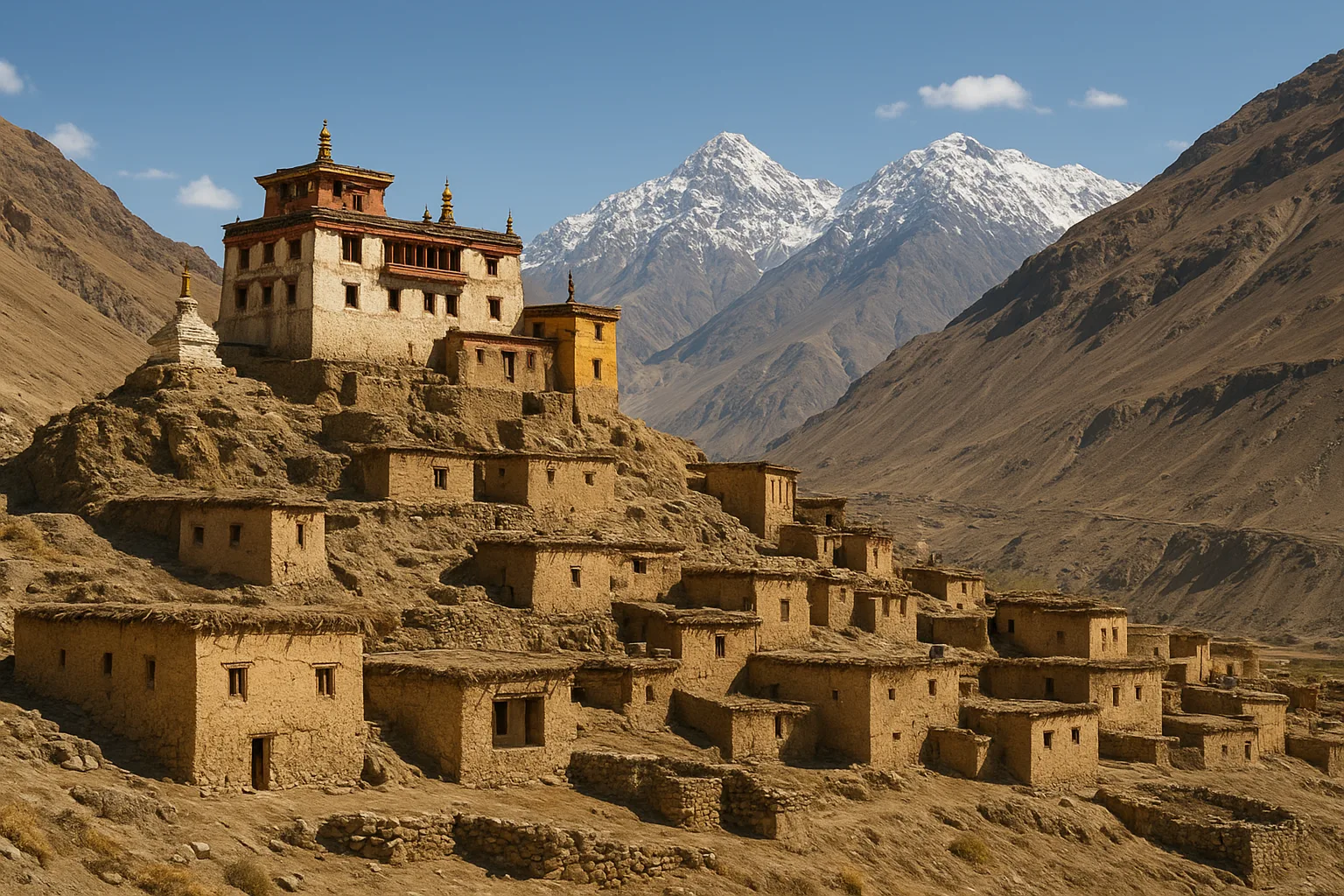
In the blue hush of early dawn, a single lamp flickers in the window of a house pressed against the mountain. Its walls are thick, shaped from earth and stone, and crowned with prayer flags that flutter in the bitter wind. Beyond, perched on a promontory above the river’s roar, a monastery clings to the cliff—its whitewashed bulk rising like a fortress of faith above the frostbitten valley. This is Lahaul-Spiti, winter-bound and eternal, where architecture is not mere shelter but a dialogue with the land, the gods, and the centuries.
Where Worlds Converged: The Ancient Crossroads
Even before the earliest written records, the high valleys of Lahaul and Spiti stood at a crossroads of Himalayan civilizations. To the north lay Ladakh and Tibet, to the south the fertile Kullu and Kangra valleys. Here, trade routes threaded through passes like the Baralacha La and Kunzum La, carrying salt, wool, and stories. These routes shaped not only the economy but also the built environment, as travelers, monks, and merchants brought with them new techniques and visions of home and sanctuary.
Oral traditions from the region speak of founding clans—like the Thakurs of Lahaul and the Nono families of Spiti—who settled and staked out their territories along the riverbanks. Early chronicles, such as the Tibetan annals and British-era gazetteers, describe scattered hamlets and fortified dwellings. The harshness of climate and need for defense against both nature and rival clans led to the emergence of a distinctive architectural language: one that combined the practical and the spiritual in equal measure.
Myth, Memory, and the First Foundations
Local legends tell of the region’s earliest homes as gifts from gods or as sanctuaries for wandering yogis. The story of Padmasambhava, the 8th-century Buddhist master, is especially cherished; myth holds that he meditated in caves near Tabo and Ki, sanctifying the very stone and setting the stage for monastic construction. While such tales are woven with reverence, the archaeological record suggests that settled life—built from mud, stone, and timber—emerged gradually as communities learned to survive the cycles of flood and frost.
Historical inference, supported by the design of ancient granaries and defensive towers, points to a society deeply attuned to its environment. Roofs were flat, heavy with earth to insulate against the cold and to store fuel. Windows were small, preserving heat and offering narrow views of the world outside. In oral memory and surviving structures, the line between legend and lived experience blurs—but the physical remains persist, testifying to resilience and ingenuity.
Monasteries as Mandalas: The Spiritual Heart of the Landscape
The rise of Buddhism in these valleys—beginning in the 10th century—brought a new architectural vocabulary. Monasteries, or gompas, arose not as random clusters but as carefully oriented mandalas, aligned with both geomantic principles and the practicalities of defense. The Tabo Monastery, founded in 996 CE, is perhaps the most celebrated: its rammed-earth walls enclose a sanctum whose murals and sculptures echo the artistic styles of Kashmir, Central Asia, and Tibet. Within, butter lamps illuminate centuries-old frescoes depicting bodhisattvas and celestial dancers.
Other major gompas, like Ki and Dhankar, cling spectacularly to cliffs, their tiered construction both a concession to topography and a statement of spiritual aspiration. Timber beams from distant forests, stone quarried from the valley floor, and mud plaster mixed with ochre all contributed to an ensemble at once humble and sublime. Oral tradition holds that monks and villagers built these sanctuaries by hand, singing mantras as they shaped each brick—a memory still alive in annual maintenance rituals and festivals.
Homes of Earth and Sky: Domestic Architecture in the High Himalaya
While monasteries drew the eye and spirit upward, the traditional homes of Lahaul and Spiti were grounded in the rhythms of agrarian life. The basic house—a kat-kuni or rammed earth structure—was designed to weather blizzards and earthquakes alike. Walls were up to a meter thick, with wooden tie beams locking the building together. The flat roofs, layered with willow and mud, doubled as threshing floors or storage for hay and dung fuel. Interior rooms clustered around a central hearth, the heart of family life and ritual.
Painted symbols and prayer flags adorned the eaves, warding off misfortune and inviting blessings upon the household. The boundary between sacred and secular blurred: niches for family deities or Buddhist icons were carved into living room walls, and the annual cycle of festivals brought monks and villagers together for communal feasts and prayer. In Spiti, where timber was scarce, homes were often built entirely from stone and mud, their forms echoing the fortress-like monasteries above.
Political Upheaval and Architectural Adaptation
The arrival of new rulers and shifting allegiances—from the ancient Zhangzhung kingdom to the later Ladakhi and Kullu overlords—left their imprint on local architecture. Fortified residences emerged, blending domestic comfort with defensive necessity. The remains of castles at Gondhla and Khangsar still loom above their valleys, their battered walls testifying to centuries of contest and negotiation. British gazetteers of the 19th century, visiting the region after its incorporation into the princely state of Chamba, noted the enduring strength and simplicity of both homes and monasteries—remarking on their resistance to the earthquakes and storms that shaped daily life.
Yet even as outside influences arrived—whether in the form of new building materials or administrative decrees—the core principles of local architecture endured. Villagers continued to rely on communal labor, ancestral knowledge, and a deep sense of belonging to both land and lineage.
Living Traditions: Architecture as Memory and Identity
Today, the stone monasteries and earthen homes of Lahaul-Spiti stand as both relics and living spaces. Modernization has brought concrete and tin roofs, but many families still maintain their ancestral houses—patching cracks with river mud, replacing beams as their forebears did. Monasteries remain at the center of community life, their festivals and rituals drawing pilgrims from across the Himalaya. The architecture is not a frozen artifact but a continuing conversation between past and present, shaped by both necessity and devotion.
As we leave the shadowed courtyards and sunlit rooftops of these ancient homes, it becomes clear that Lahaul-Spiti’s architecture is more than a response to climate or conflict. It is a testament to endurance, adaptation, and the enduring power of belief. In the next part of this series, we will step inside these spaces to explore the rituals, festivals, and daily rhythms that animate life in the high valleys—tracing the threads of memory that bind generations and communities together.
Previous: Rituals, Festivals, and Spiritual Life of the Region
Next: British Entry into the Remote Valleys of Lahaul and Spiti