
Series: History of Lahaul & Spiti, Himachal Pradesh, India
Phase 3: Religion & Culture — Part 14 of 30
This article belongs to a historical series examining how expanding empires and regional powers reshaped life in the western Himalayan hills. As external influences pressed into the mountains, local rulers navigated diplomacy, resistance, and accommodation. This phase explores how wider political currents intersected with entrenched hill traditions, altering governance without entirely displacing older structures.
Midwinter in the Shadow of the Trans-Himalaya
The wind howls down from the Kunzum Pass, carrying with it a brittle cold and a strange, electric hush. In the village of Kaza, it is the time of Losar—the Tibetan New Year. Households are alive with activity: floors are swept, barley cakes baked, and juniper branches readied for the sacred smoke that will drift skyward. Children bundle in wool, peering out at monks winding through lanes, beating drums whose low notes seem to shake the mountain itself. The festival, as old as memory, is not merely celebratory; it is a bridge to ancestors and spirits, to a world where every rock and river is alive with meaning.
Land Between Worlds: Early Peoples and Sacred Geographies
Long before written records, the valleys of Lahaul and Spiti witnessed the slow migration of pastoralists and traders, drawn by the promise of water and the crossing of ancient passes. Archaeological finds—a petroglyph here, a tumulus there—suggest that as early as the first millennium BCE, small communities eked out a living on these high plateaus. Oral traditions, passed in fireside whispers, tell of primordial deities who shaped the landscape: the spirit-river Chandra, the shape-shifting mountain gods, and the demons held at bay by ritual and prayer.
Yet, separating myth from memory is a subtle task. The region’s earliest spiritual life was likely animistic, shaped by landscape and climate. Sacred groves, stones, and springs became focal points of village ritual. The arrival of Buddhist influences, centuries later, layered new meanings atop older beliefs—a syncretism visible even today.
Trade, Pilgrimage, and Emerging Hill States
By the early first millennium CE, Lahaul-Spiti was more than an isolated backwater. The valley corridors formed arteries of the trans-Himalayan trade—from Kashmir and Ladakh to the west, Tibet and Kinnaur to the east. Caravans bearing salt, wool, and turquoise wound through the region, pausing at shrines both Buddhist and indigenous. With the movement of traders came new stories and religious practices. The rise of small chieftaincies and hill states, referenced in early gazetteers and chronicles, introduced new forms of authority. Monasteries were founded along these routes, acting as both spiritual and economic hubs.
These new centers—Tabo, founded in 996 CE, and Key Monastery, with roots possibly as early as the 11th century—became keepers of scriptural tradition and local lore. They also shaped the ritual calendar, weaving together Buddhist festivals with older, seasonal rites tied to the land.
Myth, Memory, and the Ritual Year
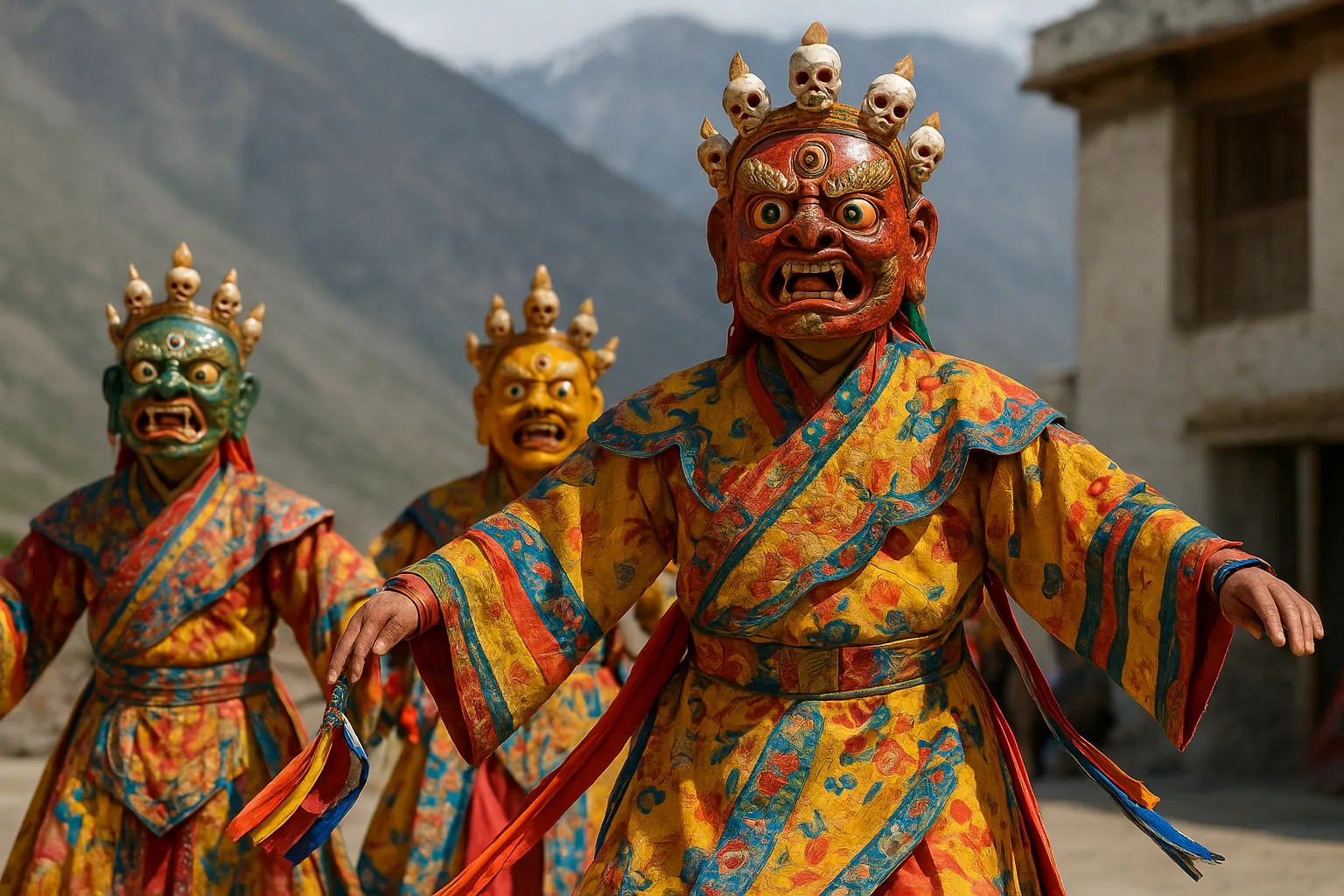
Every season in Lahaul-Spiti opens with ritual. In spring, villagers mark Phagli—the expulsion of winter’s demons. Men don elaborate masks and dance through the streets, their movements recalling ancient exorcisms. Summer brings Sazo, when deities are ceremoniously sent to their high-altitude abodes. The harvest is celebrated with feasts and collective prayers, honoring both Buddhist teachings and pre-Buddhist fertility customs. Oral traditions, even as they intertwine with Buddhist doctrine, retain a stubborn independence: tales of mountain nymphs, protective spirits, and the ever-watchful eyes of the gods.
Historical inferences drawn from regional gazetteers note how, by the 18th and 19th centuries, the spiritual life of Lahaul-Spiti had become a patchwork of influences. The festivals were never static; they adapted to new rulers, shifting climate, and the perennial demands of survival.
Monastic Authority and the Village Cosmos
With the consolidation of monastic power from the 17th century onward, rituals in Lahaul-Spiti became both more formalized and more public. The annual Cham dances—vivid, masked performances staged in monastery courtyards—enacted Buddhist cosmology and the eternal struggle between good and evil. Yet, beneath the spectacle, local customs persisted: the placement of household shrines, the recitation of oral epics, and the quiet offerings to unnamed deities in the shadow of every home.
Political history left its mark. When the region fell under the suzerainty of Ladakh, and later the Dogra rulers and the British, monasteries became not only religious but administrative centers. They mediated disputes, collected taxes, and maintained the ritual calendar. The interaction between lay communities and monastic authority created a spiritual ecosystem unique to Lahaul-Spiti—rooted in tradition, yet always in negotiation with the currents of history.
Continuity and Change in the Modern Era
The 20th century brought roads and schools, new faiths and new faces. Yet, the rituals and festivals of Lahaul-Spiti endure. Today, Losar and Phagli are celebrated with as much fervor as ever, though now visitors and cameras are as much a part of the scene as barley cakes and juniper smoke. The monasteries are living institutions, preserving illuminated manuscripts and ancient dance, while also opening doors to curious travelers and scholars.
Oral traditions have found new life in print and on film; local myths are retold in classrooms and on festival stages. The spiritual geography of the region, shaped over millennia by belief and necessity, remains a vital force in communal life.
The Living Legacy of Ritual
In the valleys of Lahaul and Spiti, the past is never far away. Every festival, every ritual, is a thread in a tapestry woven across centuries. The region’s unique blend of Buddhist and indigenous belief, its rhythm of sacred and seasonal celebration, continues to anchor identity and community in an unpredictable world. As we move forward in this series, we will delve deeper into the evolution of monastic institutions—exploring how they became both the heart and archive of Lahaul-Spiti’s enduring spiritual life.
Previous: Monastic Life and Education in Spiti Valley
Next: Architecture of Monasteries and Traditional Homes