
Series: History of Kullu, Himachal Pradesh, India
Phase 5: Modern Era — Part 29 of 30
This article appears within a continuing historical series that follows the western Himalayas into the modern era. With the end of princely rule and the integration into independent India, long-standing social and political patterns were reconfigured. This phase examines how development, state formation, and memory interact with inherited landscapes, shaping contemporary life while carrying forward echoes of the past.
Monsoon Dusk on the Beas: A Valley in Transition
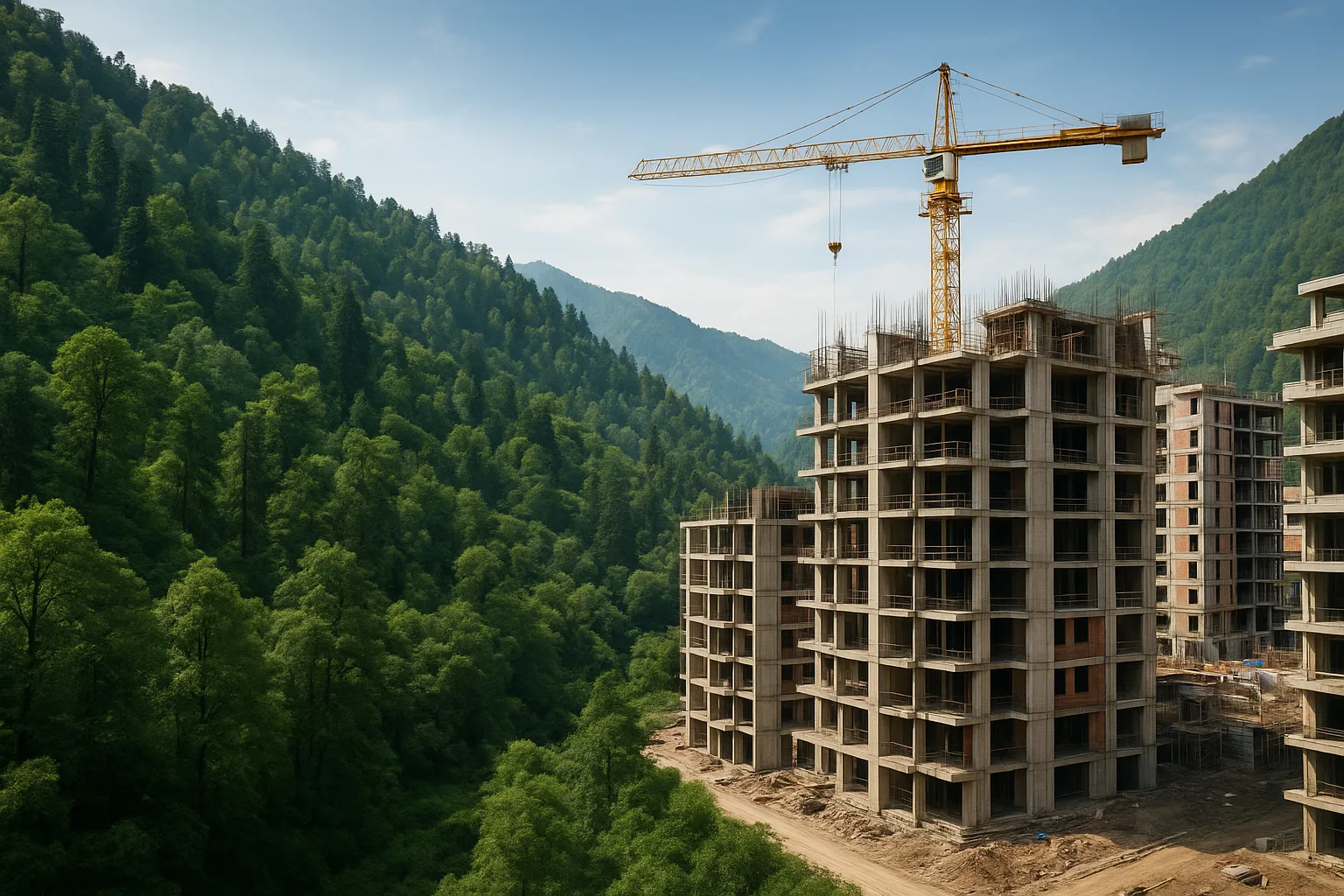
In the late summer of 1976, a monsoon dusk settles over the Beas River near Kullu town. The mist crawls low, veiling terraced fields and ancient deodar groves. Above the riverbank, the first concrete pillars of a new road bridge pierce the landscape—a sign of progress, but also of irreversible change. The air is thick with the scent of pine resin and wet earth, as villagers gather to discuss the future. Some voice hope for new opportunities, others warn of floods and vanished orchards. The valley, so long shaped by the rhythms of mountain life, stands at the threshold of a new era: development racing against the imperatives of ecology.
From Ancient Crossroads to Modern Crosscurrents
Kullu has never been isolated, though its high passes and deep forests once conspired to keep the outside world at bay. For centuries, the valley’s communities—Kullvi, Thakuri, and Rajput, among others—thrived on a delicate balance with their environment. Oral traditions and Puranic myth recall the arrival of Manu and the great flood, a story woven into local identity but grounded less in historical certainty than in the need for belonging and explanation.
Historically, Kullu’s significance emerged from its location on Himalayan trade routes linking Punjab, Ladakh, and Tibet. Early settlements clustered near the Beas, their economies rooted in terraced agriculture, transhumant pastoralism, and riverine barter. The rise of the Kullu kingdom in the medieval period drew power from both political acumen and an ability to harness the valley’s resources without depleting them—a principle embedded in customary law and seasonal migration patterns.
Colonial Gaze and Early Modern Pressures
The 19th century brought the British, whose gazetteers and settlement reports described Kullu’s abundant forests and mineral springs with the curiosity of surveyors and the acquisitiveness of empire. Timber extraction and the mapping of resources accelerated, but the remoteness of the valley delayed the most intensive disruptions seen elsewhere in Himachal Pradesh.
Still, change crept in. By the early 20th century, apple cultivation—imported and popularized by missionaries and enterprising locals—began to transform the landscape. Orchards replaced traditional crops, and cash economies slowly edged out barter. Yet, the valley’s rivers, forests, and mountain gods remained central to daily life. Development, for now, moved cautiously, shadowed by the memory of landslides and the wisdom of elders who read the signs of monsoon and drought in the color of the clouds.
The Post-Independence Surge: Roads, Dams, and New Aspirations
After 1947, Himachal Pradesh’s statehood and subsequent Five-Year Plans ushered in an era of unprecedented infrastructural ambition. Roads snaked up the valley, linking Kullu to Manali, and on to the Rohtang Pass. The Beas River, once a meandering lifeline, became the site of hydroelectric projects and irrigation schemes. The state’s modernizing impulse was driven by the need to reduce poverty, provide electricity, and integrate remote regions into the national economy.
Yet, the costs were immediate. Forests, once managed by village panchayats and sacred groves, fell to logging to make way for roads and power lines. The construction of the Pandoh Dam in the 1970s, a marvel of engineering by any measure, also altered the valley’s hydrology, impacting fish migration and the seasonal rhythms of farming communities. Oral accounts from the time recount villagers’ anxiety over vanishing springs and unpredictable floods, even as new markets and schools promised a brighter future for their children.
Tourism’s Double-Edged Promise
By the late twentieth century, Kullu and its twin, Manali, had joined the pantheon of India’s most beloved hill stations. The once-quiet trails of the Parvati and Tirthan valleys filled with trekkers, backpackers, and seekers of mountain solace. Tourism brought prosperity, new hotels, and jobs for many. But it also strained the fragile ecology: new construction encroached on riversides, waste management lagged behind the influx of visitors, and once-pristine woodlands receded under pressure from both demand and neglect.
The local communities again found themselves negotiating between economic opportunity and ecological responsibility. The apple trade, now a pillar of the regional economy, faced its own challenges—pesticide use, monoculture risks, and the impact of changing weather patterns due to global climate shifts.
Modern Environmental Movements and Community Resilience
The 1990s and early 2000s saw the emergence of local environmental activism. Influenced by the Chipko movement in neighboring Uttarakhand, villagers and youth groups in Kullu organized to protect sacred groves, resist over-logging, and campaign for sustainable tourism. The Great Himalayan National Park, declared a UNESCO World Heritage Site in 2014, became a symbol of both hope and controversy—preserving biodiversity but also restricting traditional forest access for some communities.
New collaborations took root: community-based conservation, eco-tourism cooperatives, and efforts to revive heirloom crops. The push and pull between development and ecology played out in panchayat meetings, courtrooms, and, most poignantly, in the daily choices of farmers, hoteliers, and schoolchildren. The valley’s old belief in the power of local deities found a modern echo in the assertion of local stewardship over land and water.
Striking the Balance: Lessons and Legacies
Kullu’s 21st-century story is one of negotiation and adaptation. The legacy of ancient trade routes and sacred landscapes persists, even as the valley’s youth aspire to digital futures and global networks. The challenge remains: to build a future where roads, dams, and orchards coexist with rivers, forests, and mountain spirits—not as relics of the past, but as living partners in the valley’s ongoing saga.
Today, a new generation looks out over the Beas at dusk, weighing the same questions their ancestors once did—how much to build, how much to preserve, and how to ensure that progress does not come at the cost of the valley’s soul.
Looking Ahead
As we move to the final part of this series, the narrative will turn to the contemporary challenges and innovations that define Kullu’s present moment—where tradition, modernity, and the environment intersect in ever more complex ways.
Previous: Oral Histories and Folklore of the Kullu Valley
Next: Kullu’s Past, Present, and Future