
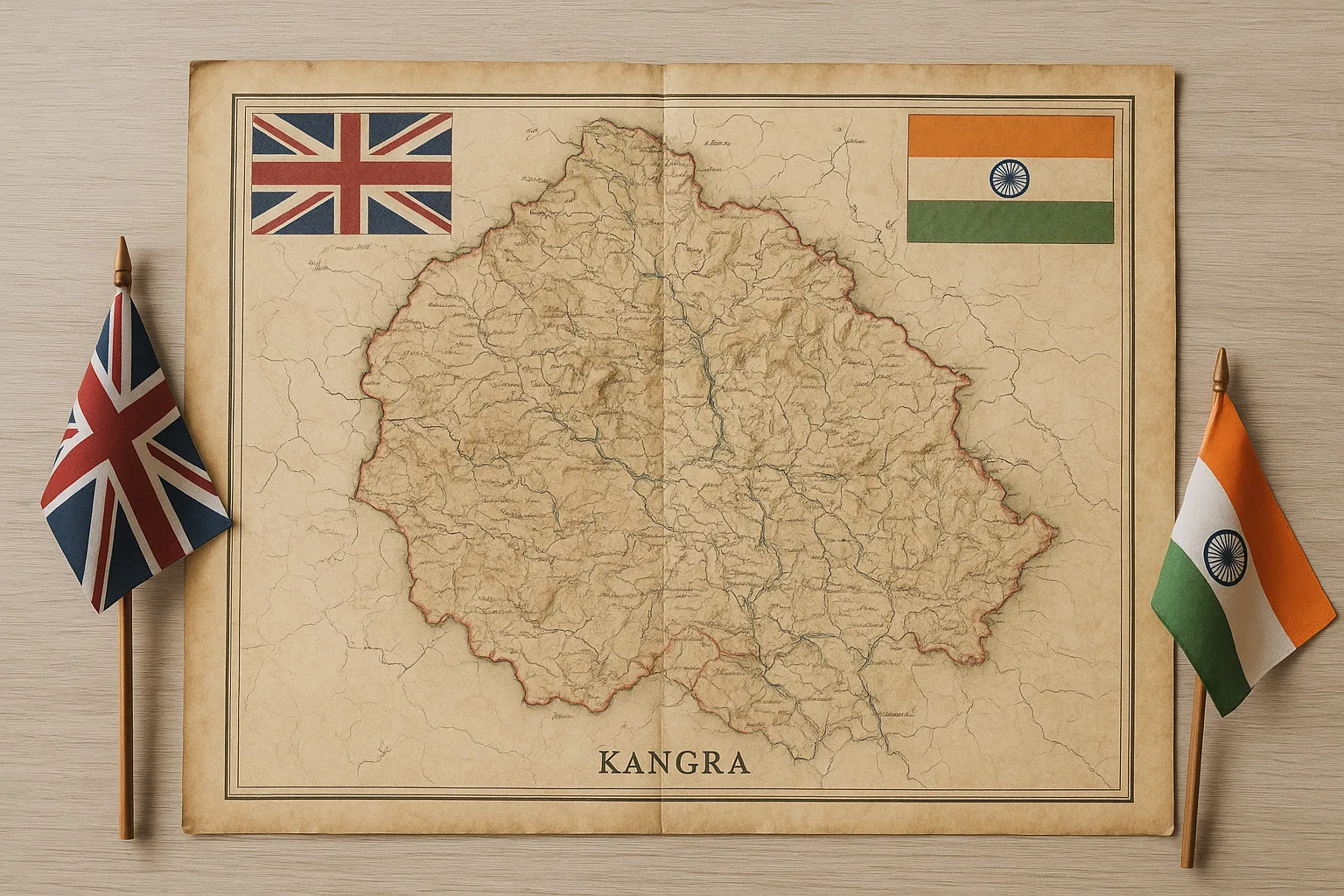
Series: History of Kangra, Himachal Pradesh, India
Phase 4: British Period — Part 16 of 30
This article is part of a wider series tracing the transformation of the western Himalayas under colonial influence. As British authority extended into the hills, existing political systems were restructured through treaties, administration, and new forms of governance. This phase considers how colonial rule reshaped society, economy, and space while leaving lasting imprints on local identity.
Shadow of the Empire: Spring of 1846 in Kangra
The chill of early spring lingered in Kangra’s stone-paved bazaars, the Dhauladhar’s snowy peaks glinting over the valley’s terraced fields. Yet beneath this timeless landscape, an unfamiliar unease threaded through the air. Rumors of distant battles and foreign armies crept up the Beas River, unsettling local chieftains and villagers alike. The British, until now a shadow on the periphery of the hills, were marching ever closer. The year was 1846, and the fate of Kangra was about to be rewritten.
Roots Beneath the Citadel: Kangra’s Ancient Foundations
Kangra’s story stretches back far beyond the arrival of the British, its roots tangled in both legend and record. The valley’s famed fort, perched dramatically above the Banganga river, was already renowned in ancient Sanskrit chronicles—mentioned in the Puranas and whispered about in the epic cycles. Oral traditions speak of the Trigarta kingdom, associated with the Katoch dynasty, whose lineage claimed a place among the oldest Rajput houses in the subcontinent. While such tales are embroidered with myth, regional gazetteers and chronicles like the Kangra Itihas confirm the valley’s prominence as a center of power, art, and worship over centuries.
Long before colonial ambitions, Kangra’s valleys were a crossroads for traders and pilgrims. The town’s temples, especially the ancient Jwalamukhi and Brajeshwari shrines, drew devotees from far and wide. Prosperity flowed in along old trade routes linking Punjab’s plains with Tibet and the wider Himalayan world. Rajput clans, shepherd communities like the Gaddis, and itinerant traders all left their mark on Kangra’s social fabric. By the early 19th century, the region’s mosaic of hill states—each with its own fort and fealty—stood as a testament to centuries of negotiation, rivalry, and resilience.
The Great Game Arrives: The First Anglo-Sikh War
The early 1800s brought turbulence to Kangra’s political landscape. The rise of Maharaja Ranjit Singh’s Sikh Empire saw much of the Punjab and adjoining hill territories drawn into a new orbit. The Katoch rulers, once masters of their domain, found themselves vassals to Lahore’s court after a protracted struggle for the fort in 1809. The Sikh garrison’s presence was a daily reminder that Kangra’s autonomy was now conditional, its fate entwined with larger regional currents.
Yet the Sikh Empire’s expansionist momentum would soon meet the inexorable advance of British power. The First Anglo-Sikh War erupted in late 1845, its battles raging across the Sutlej and beyond. As British columns pressed northward, alliances shifted and anxieties deepened in Kangra. The local ruling elite—caught between Sikh overlords and the encroaching British—watched the unfolding conflict with a mixture of hope and dread. The valley’s fields, temples, and forts stood poised on the edge of transformation.
Annexation Unfolds: The Treaty of Lahore and Its Aftermath
March 1846 brought the Treaty of Lahore, a document whose ink scarcely dried before its consequences rippled through Kangra. Under the terms, the British annexed not only the fertile plains of the Punjab but also the hill territories “between the rivers Beas and Ravi”—a phrase that sealed Kangra’s new status as a colonial possession. The Katoch raja, Sansar Chand’s heir, was left with only jagir rights and ceremonial titles. The fort, long a symbol of resilience, passed definitively into British hands after a brief but decisive siege.
British administrators moved swiftly to impose new systems. The once-autonomous rajas and thakurs found their powers sharply curtailed. English officers, accompanied by surveyors and interpreters, set about mapping the land, cataloguing revenue, and reorganizing governance. The colonial state’s appetite for order meant new taxes, regulations, and bureaucratic oversight. For Kangra’s villages, old rhythms of authority and custom gave way to a more impersonal, distant regime.
Communities in Flux: Hill Societies Under Colonial Rule
The annexation did not simply redraw political boundaries—it unsettled the valley’s social landscape. Local elites, some of whom had aligned themselves with the British during the Sikh wars, hoped to secure favor and posts under the new rulers. Others, stripped of ancestral privileges, retreated into the shadows of memory and resentment.
For ordinary people—farmers, artisans, shepherds—the British were often a remote presence. Yet the new land revenue settlements, inspired by colonial models from Bengal and the Punjab plains, reshaped everyday life. Disputes over land and forests intensified as British authorities imposed clearer boundaries and property rights, sometimes ignoring local customs. Old networks of patronage and obligation frayed. At the same time, the colonial period saw the growth of new towns and roads, connecting Kangra’s markets more closely to the wider world, but also exposing them to new vulnerabilities.
Faith and Identity: Temples, Pilgrims, and the Colonial Gaze
Kangra’s temples and shrines, long at the heart of communal identity, found themselves under new scrutiny as well. The British, wary of religious unrest yet keen to regulate, began supervising temple management—sometimes appointing committees to oversee finances and rituals. The famous Brajeshwari and Jwalamukhi temples continued to attract pilgrims, but donations and festivals were now subject to official oversight.
Missionary activity, though less intense than in the plains, introduced new religious currents to the hills. Some communities viewed these changes with suspicion, others with curiosity. Yet even as colonial modernity arrived, Kangra’s deep-rooted traditions proved resilient—festivals, oral epics, and local religious practices persisted, sometimes subtly adapting to the changing times.
Echoes of Resistance and Accommodation
Not all responded to the British presence with resignation. Small acts of resistance—petitions, tax protests, and local refusals—dot the administrative records. The memory of earlier struggles against outsiders, whether Sikh or Mughal, animated local storytelling. Yet open rebellion was rare, at least in these early years. Most communities, wary of the new power’s reach, sought ways to accommodate and endure.
Hill society’s intricate hierarchies—of caste, clan, and occupation—were neither erased nor entirely preserved under colonial rule. Some groups, such as the Gaddis, adapted by negotiating new grazing rights, while others found themselves squeezed by shifting land and forest policies. The British, for their part, documented, classified, and sometimes misunderstood these social arrangements in their quest for efficient governance.
From Annexation to New Horizons
The annexation of 1846 set Kangra on a path that would unfold over decades, linking its destiny to the wider story of British India. The valleys and hills that once echoed with the footfalls of Rajput warriors and Sikh soldiery now resonated with the measured march of colonial administration. Yet beneath the surface, the ancient roots of Kangra’s identity endured. Festivals continued, oral traditions adapted, and the temple bells rang out across the terraced slopes.
Today, Kangra’s landscapes still bear the imprint of these 19th-century transformations—visible in the ruins of the fort, the grid of colonial-era roads, and the living memories of its people. The next chapter of this series will trace how Kangra’s society responded to the challenges and opportunities of colonial rule in the decades that followed, and how this period set the stage for resistance and renewal in the shadow of empire.
Previous: Transition from Sikh to British Control
Next: Colonial Administration in Kangra