
Series: History of Lahaul & Spiti, Himachal Pradesh, India
Phase 5: Modern Era — Part 28 of 30
This article appears within a continuing historical series that follows the western Himalayas into the modern era. With the end of princely rule and the integration into independent India, long-standing social and political patterns were reconfigured. This phase examines how development, state formation, and memory interact with inherited landscapes, shaping contemporary life while carrying forward echoes of the past.
Whispers Across the Valleys
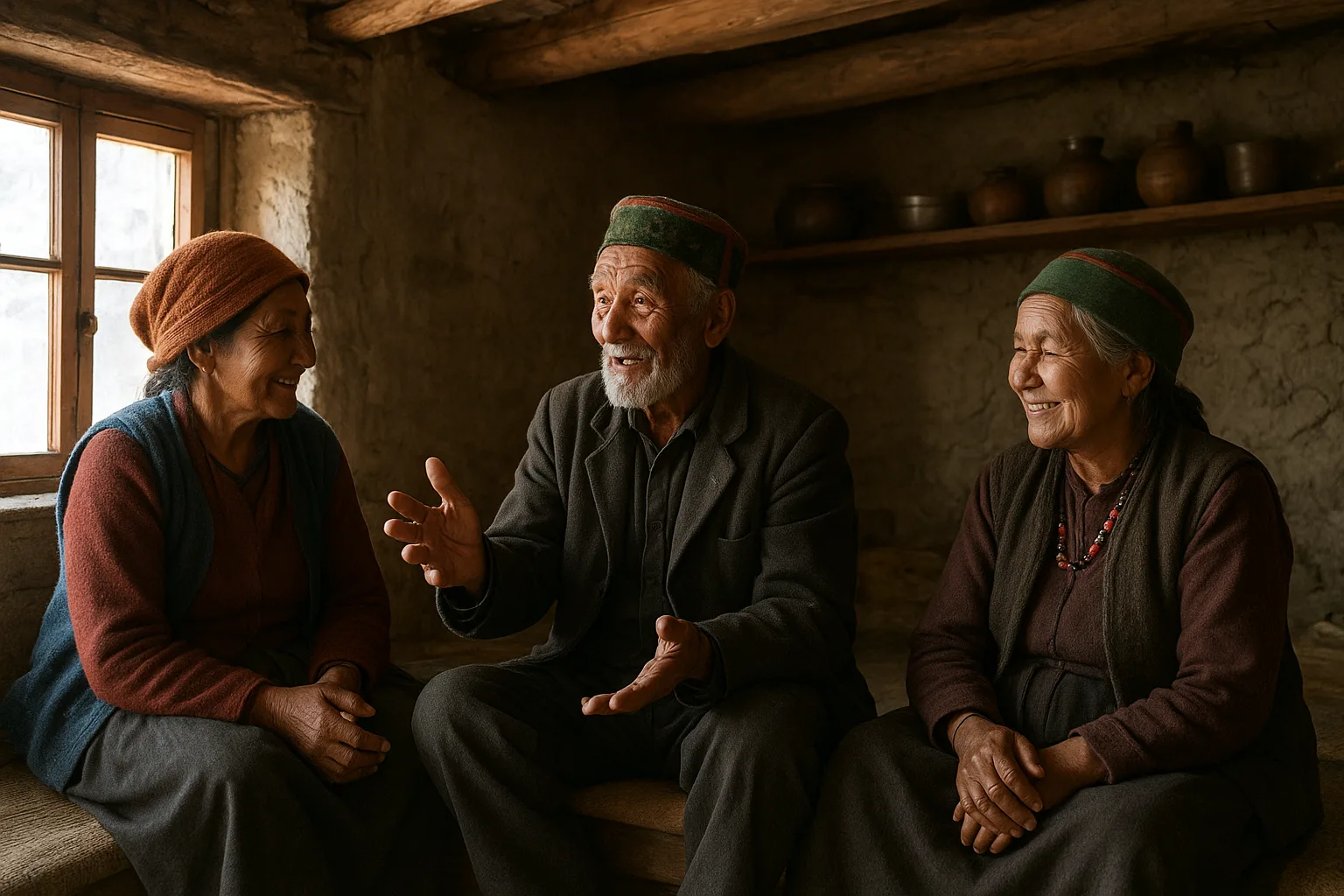
A hush settles at dusk in the high, wind-scoured hamlets of Lahaul and Spiti. Fires flicker inside whitewashed stone homes, and families gather—elders poised to speak, children wide-eyed. With each story, the ancient mountains seem to draw closer, as if listening too. Here, in this stark landscape where the Himalayas merge with the Tibetan plateau, the spoken word has always been more than entertainment. It is memory, law, and lifeblood.
For centuries, long before roads or written records, this region survived and thrived through tales passed from lip to ear. Lahaul and Spiti’s oral traditions—myths, songs, riddles, and historical recountings—remain a living chronicle of a place shaped by isolation and exchange alike.
The Land Between: A Factual Anchor
Tucked between Kashmir to the north and Kullu to the south, Lahaul and Spiti have long straddled the cultural boundaries of South and Central Asia. Archaeological traces and early accounts suggest that this region, once known as Garsha (the land of cows), was inhabited by indigenous hill communities well before the first millennium CE. Pastoralists and traders moved along winding passes, linking the fertile Indus with the sacred Ganges, and—most crucially—India with Tibet.
These valleys became crossroads for Buddhist monks, Zanskari traders, and itinerant bards. Yet, despite centuries of outside influence, Lahaul and Spiti preserved a unique narrative tradition. Here, the spoken word was not merely a bridge to the past; it was a shield against the erasure of memory.
Myths and Memory: The World Through Story
To the people of Lahaul and Spiti, the line between myth and history is often a gentle blur. Oral traditions—such as the epic tales of the demi-god Gyephang or the fierce serpent deities of the Chandra and Bhaga rivers—do more than explain the world; they anchor communities to place. These stories are recited in dialects that shift from valley to valley, each variation a testament to centuries of adaptation and survival.
Gyephang, venerated as the tutelary deity of Lahaul, is at the heart of countless legends. He is said to have tamed both storms and invaders, his exploits recounted during festivals and rites of passage. Such narratives, while not verifiable as literal history, reveal how communities understood power, landscape, and kinship. They also serve as codes of conduct—oral laws embedded in story, governing everything from marriage alliances to water rights.
Historical Inference Amidst the Folklore
Beyond the realm of gods and spirits, Lahaul and Spiti’s oral history preserves echoes of real encounters: migrations, feuds, and shifting allegiances. For example, songs recounting the arrival of Buddhist preceptors from Tibet parallel what is known from early chronicles and regional gazetteers. These traditions speak of the spread of Buddhism in the 10th and 11th centuries, marking a profound transformation in both belief and political alignment.
Similarly, accounts of ancient battles with Ladakhi raiders or the forging of trade treaties with Kullu and Zanskar are preserved in ballads sung during communal gatherings. While these stories are embroidered with exaggeration—heroes with supernatural strength, armies crossing impassable passes in a single night—they nonetheless provide historians with valuable clues. They hint at the ebb and flow of local power, the rise of early hill states, and the porousness of borders in this mountain world.
Emergence of Hill States and Political Memory
By the late medieval period, the oral traditions of Lahaul and Spiti began to reflect the emergence of more formalized political structures. Legends of the Thakurs—hereditary chiefs who ruled over clusters of villages—reveal a society in flux. Oral genealogies, meticulously memorized, were recited to legitimize land claims and alliances. These accounts often blended fact and fable: a Thakur might trace his lineage to a mountain spirit, or claim descent from a famous Buddhist sage.
As recorded in the early 20th-century gazetteers, these oral traditions often formed the backbone of local administration. Disputes were settled not by written contracts, but by recourse to remembered precedent—an elder’s recitation of a past judgment, a story that everyone in the valley had heard since childhood. In this way, folklore became the region’s unwritten constitution.
Trade, Pilgrimage, and the Circulation of Stories
Lahaul and Spiti’s position along ancient trade routes ensured that their oral traditions were never static. Pilgrims and traders brought news, songs, and even new deities. The story of the Padmasambhava’s journey through Spiti, for example, weaves together elements from Indian, Tibetan, and local traditions. Such tales highlight the syncretic nature of belief in these valleys, where a Buddhist mantra might be invoked alongside an animist prayer for rain.
Winter, when the passes closed and villages were cut off for months, was when these stories thrived. Epic performances—sometimes lasting several nights—bound communities together. Riddles and proverbs, recited by firelight, became a form of socialization and education. Even today, elders recall the contests of memory, where young and old would vie to see who could recite the longest lineage or the most intricate myth.
The Endurance of the Spoken Word
In the last century, the arrival of roads, schools, and outside media has begun to erode the dominance of oral tradition in Lahaul and Spiti. Yet, the stories remain a touchstone—invoked during weddings, festivals, and village councils. Some have been committed to writing, others adapted for new forms of performance. The folkloric imagination still shapes how these communities see themselves, and how they are seen by outsiders.
As we move forward in this series, the next chapter will trace how these ancient voices have adapted to the challenges of modernity—how memory, myth, and history continue to weave together in the evolving life of Lahaul and Spiti.
Previous: Preserving Monastic and Tribal Heritage
Next: Balancing Development and Tradition in the High Himalayas