
Series: History of Kullu, Himachal Pradesh, India
Phase 5: Modern Era — Part 28 of 30
This article appears within a continuing historical series that follows the western Himalayas into the modern era. With the end of princely rule and the integration into independent India, long-standing social and political patterns were reconfigured. This phase examines how development, state formation, and memory interact with inherited landscapes, shaping contemporary life while carrying forward echoes of the past.
Nightfall in the Valley: Where Stories Begin
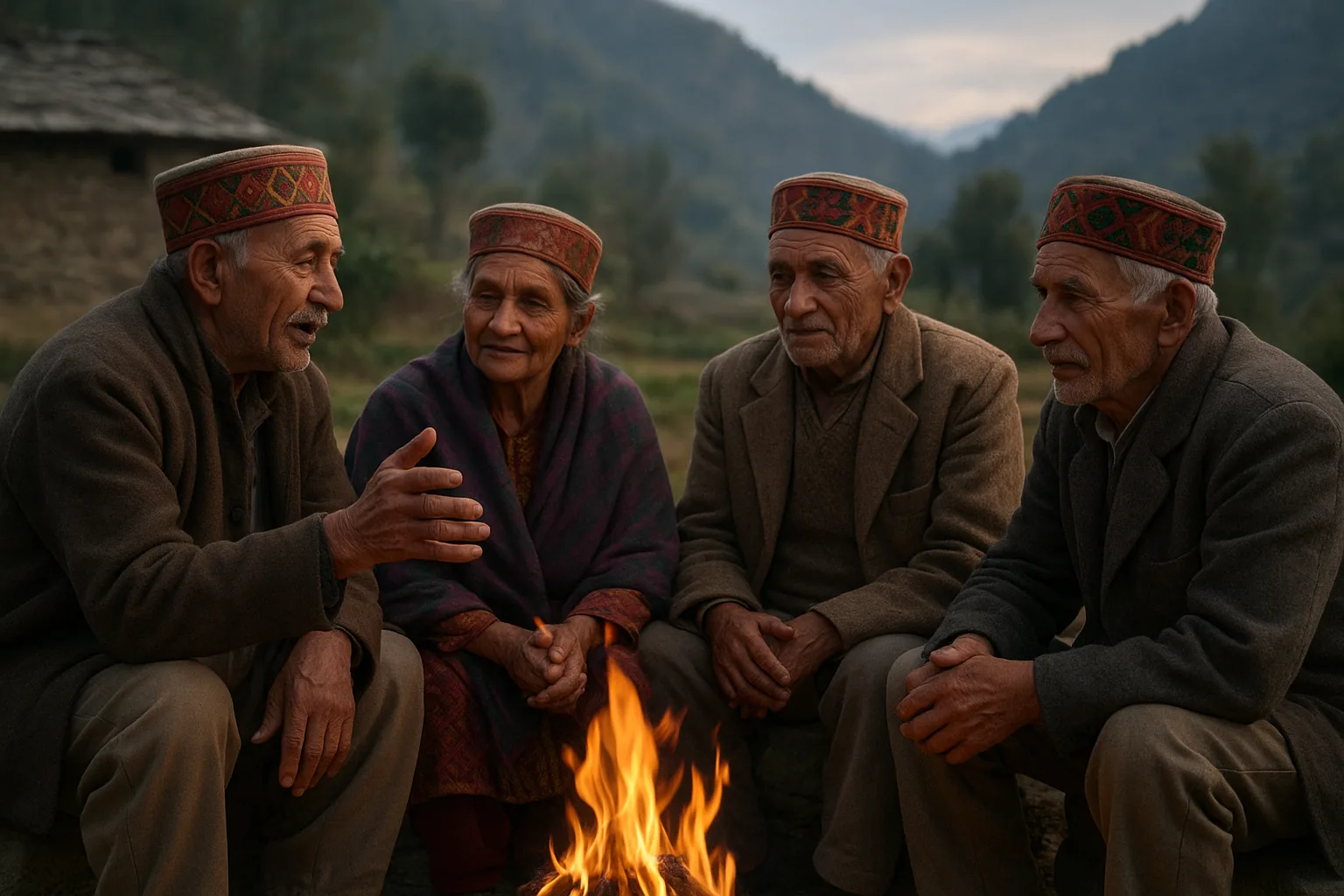
On a windless evening in the upper reaches of the Kullu Valley, the faint smell of pine and woodsmoke drifts through terraced fields. Villagers gather around flickering hearths, their faces illuminated by firelight more ancient than the script of any chronicle. In these moments, the valley’s past is not a matter of dusty tomes, but of living voices. Here, history is recited, sung, and debated—woven into the steady rhythm of daily life.
Kullu, cradled between the dizzying heights of the Greater Himalayas and the gentler slopes of the outer hills, has always been a meeting ground: of cultures, gods, and tribes. Long before written records, its people mapped the world with stories. If you listen, you hear not just entertainment, but the valley’s collective memory—its struggles, migrations, and delicate negotiations with the land and its spirits.
The Ancient Setting: Kullu’s Historical Foundations
Before Kullu became a princely state or a destination for seekers and trekkers, it was a crossroads. Archaeological finds and early regional accounts, such as those referenced in the Kullu Gazetteer and the Rajatarangini, place organized settlements here by the early centuries CE. The valley’s strategic location along trade arteries linking Ladakh, Spiti, and the plains fostered both commerce and cultural exchange. Early inhabitants—predominantly pastoral and agrarian—were shaped by an unpredictable river, steep terrain, and thick forests.
But in the absence of abundant written records for the earliest centuries, it is oral tradition—passed from grandmother to grandson, priest to pilgrim—that preserves the memory of migrations, tribal conflicts, and the slow emergence of village polities. These stories, while not always verifiable, form the substrate of Kullu’s historical consciousness.
Myth, Memory, and the Gods of Kullu
It is impossible to separate Kullu’s history from its mythology. Here, the line between legend and fact is intentionally blurred. Local lore claims that the valley was once a forbidding wilderness, the haunt of demons and restless spirits, until the sage Manu—forefather of mankind—descended after a cataclysmic flood to re-establish order. This myth, echoed in many Himalayan communities, is more than a tale of divine intervention: it encodes early memories of migration and the taming of new land.
Distinct local deities—each with a unique personality, retinue, and jurisdiction—populate the oral histories. From the powerful goddess Hidimba in Manali, said to have been a forest spirit before becoming a consort of the Pandava Bhima, to the revered Raghunathji, whose arrival marked the valley’s gradual integration into the larger Hindu world, these figures anchor communities. Processions, festivals, and even political decisions have long been justified through consultation with oracles and the will of these gods, whose stories were shaped and reshaped to fit changing times.
From Tribes to Kingdoms: Early Communities and Emerging States
Early Kullu was a tapestry of shifting tribes and clans. Oral genealogies—painstakingly maintained by village bards and priestly families—trace the descent of present-day groups back to ancient Rajput, Khasa, and even aboriginal Himalayan roots. These accounts often blend remembered history with mythic embellishment, describing migrations from the west, intermarriage with local spirits or yakshas, and the slow expansion of terraced agriculture.
By the early medieval period, as suggested by regional chronicles and the traditions of neighboring hill states, Kullu’s clans began forming more stable chieftaincies. The rise of the Pal dynasty, established according to oral tradition by Visudh Pal sometime between the 6th and 8th centuries CE, is remembered as a turning point. Though the details are obscured by time, the stories recall a period of consolidation—forts built atop ridges, alliances sealed by marriage, and the negotiation of tribute between valley lords and more powerful neighbors.
Trade, Pilgrimage, and the Making of Memory
The old caravan trails that wound through Kullu did more than carry salt, wool, and grain: they brought stories. Travelers from Kashmir, Tibet, and the Gangetic plains exchanged news, beliefs, and technologies. Local bards absorbed these influences, weaving them into the valley’s oral literature. Hymns to Himalayan gods blend seamlessly with tales of distant kings. Pilgrimage sites such as Manikaran and Bijli Mahadev became not just religious centers but nodes in a network of shared memory, where myths were told, retold, and quietly adapted to new realities.
Oral histories also preserve memories of disaster: years of famine, devastating floods, and the arrival of foreign armies. Each event, filtered through song and story, is both a warning and a lesson. Even the arrival of the British, later chronicled in colonial gazetteers, first entered local consciousness as rumor and allegory—British officers recast as demonic or divine figures in the valley’s ongoing drama.
The Role of Folklore in Social Order
Folklore in Kullu has never been a mere entertainment. Stories establish norms and boundaries: who may marry whom, which lands are sacred, and how disputes must be resolved. The institution of the devta (local deity) council—where oracles speak for the gods—draws its legitimacy from centuries of oral tradition. These gatherings, described in both oral and written sources, have historically functioned as both spiritual and political assemblies, arbitrating everything from water rights to inter-village conflicts.
Even today, the memory of old feuds, alliances, and betrayals is kept alive in the valley’s collective storytelling. The recitation of genealogies and heroic epics at festivals or funerals reinforces a sense of belonging and continuity, binding each generation to the valley’s enduring narrative.
From Story to History: The Shifting Terrain of Memory
As the series has traced, the arrival of new powers—Mughal, Sikh, and eventually British—brought with it written records, new administrative boundaries, and a slow shift in how history itself was remembered. Yet, even as gazetteers and revenue surveys catalogued the valley’s villages and customs, the oral tradition continued to thrive, sometimes in defiance, sometimes in tandem with official histories.
Modern ethnographers and historians have come to recognize the value—and the limitations—of these oral sources. While they may not always align with documentary evidence, they offer insight into how the people of Kullu have understood themselves and their place in a changing world. The interplay between myth, memory, and political history remains a defining feature of the region’s identity.
Echoes of the Past: Folklore’s Enduring Power
Today, the valley’s ancient stories are threatened by migration, media, and the pressures of modernity. Yet, the call of the devtas still gathers villagers at festival time. Farmers still invoke ancestral spirits before planting. Children still learn the old tales—of heroes, gods, and the ever-watchful river—from elders whose own memories stretch back to a world before roads and electricity.
Kullu’s oral histories and folklore are more than relics; they are the living roots of a culture that has endured and adapted over centuries. As we look ahead to the next chapter—when the valley’s traditions confronted the sweeping changes of the twentieth century—these ancient narratives remain a touchstone, quietly shaping the choices and identities of those who call Kullu home.
Previous: Preserving Kullu’s Cultural Traditions Today
Next: Balancing Development and Ecology in Kullu