
Series: History of Kinnaur, Himachal Pradesh, India
Phase 5: Modern Era — Part 27 of 30
This article appears within a continuing historical series that follows the western Himalayas into the modern era. With the end of princely rule and the integration into independent India, long-standing social and political patterns were reconfigured. This phase examines how development, state formation, and memory interact with inherited landscapes, shaping contemporary life while carrying forward echoes of the past.
Monsoon Clouds Gather Over Kalpa
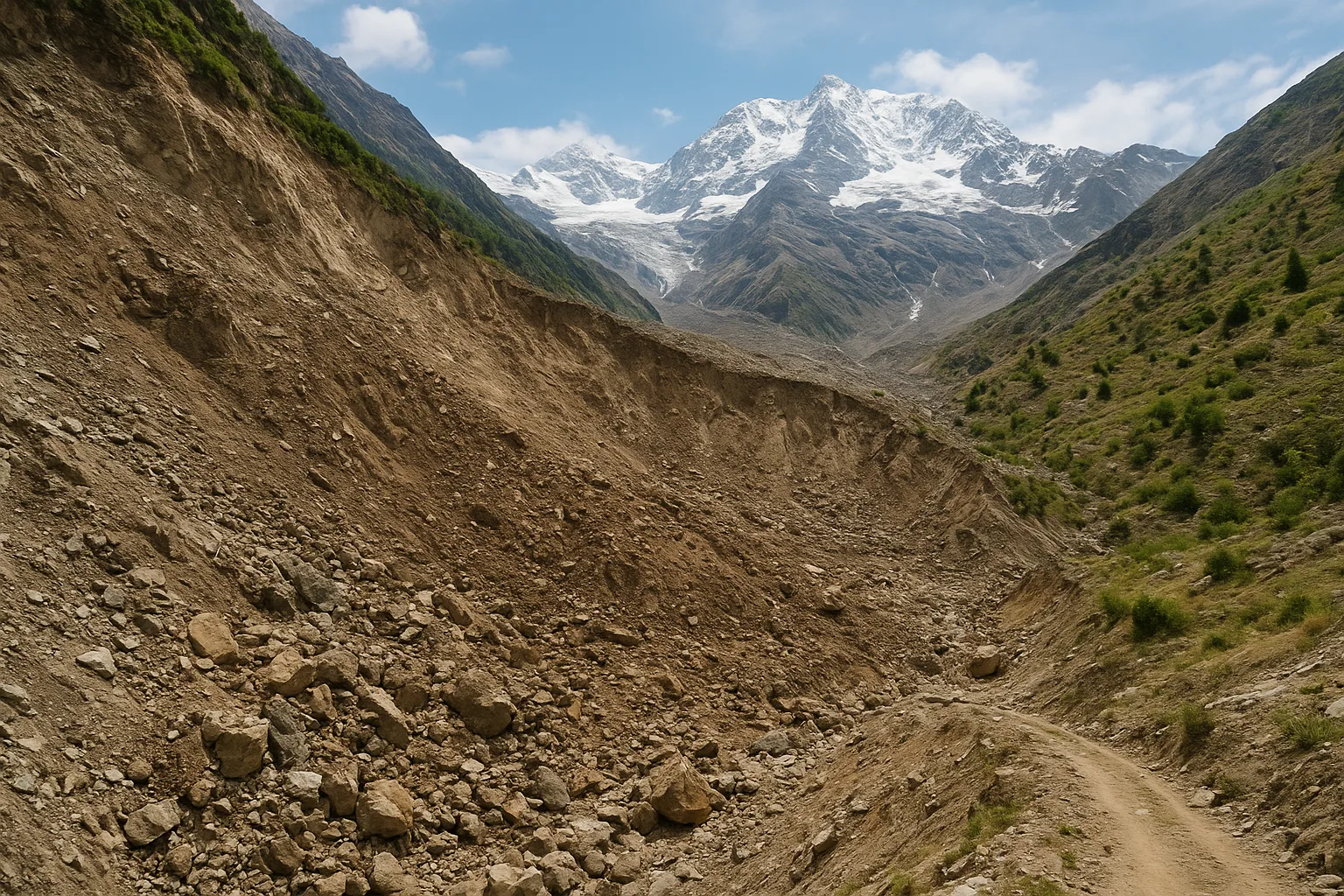
In the summer of 2013, villagers in Kalpa watched as the sky darkened and the Sutlej river began to churn. The monsoon had arrived early, pounding the slopes of Kinnaur with relentless rain. Centuries-old houses perched on terraces seemed to shiver as the land beneath them trembled. Landslides and flash floods tore through valleys, severing the old trade road, swallowing orchards, and leaving entire hamlets isolated. This was not the first time the mountains had reminded the people of their fragility—but the scale and frequency felt different. Kinnaur, a land of myth and memory, stood on the front line of environmental upheaval.
The High Valleys: Place and People
Kinnaur’s story begins with its landscape. Hemmed in by the Greater Himalaya and the Zanskar Range, the district’s valleys fan out from the Sutlej, Spiti, and Baspa rivers. Ancient oral traditions, passed from grandparent to child, speak of land and deity as inseparable: the powerful Kinnauri gods, such as Maheshwar and Chitkul Devi, are said to inhabit peaks and groves. The people—Kinnauras—trace their roots to these very mountains, their customs shaped by a climate of severe winters and short, lush summers.
Archaeological finds near Morang and Ribba suggest human habitation as early as the first millennium BCE. Early Kinnauri communities, according to regional gazetteers, were semi-nomadic, tending sheep and yaks, gathering wild grains, and later, cultivating barley and buckwheat on laboriously carved terraces. Their society revolved around clan, kinship, and a ritual calendar designed to appease both visible and invisible spirits of the land.
Myths, Memory, and Historical Inference
Oral traditions in Kinnaur often blur the line between history and legend. Local bards recount tales of the Pandavas’ sojourn in the high valleys, or of a time when gods and mortals mingled freely. Yet, beneath the poetic embellishments, there remains a historical core: the region’s remoteness fostered a unique blend of animist, Buddhist, and Hindu beliefs, visible in its temples and festivals.
Written records, though scarce before the 16th century, offer glimpses into Kinnaur’s integration with the wider Himalayan world. Early chronicles mention the valley as part of the ancient trade route connecting India with Tibet and Central Asia—a corridor for salt, wool, and ideas. The rhythms of environmental adaptation, from transhumance to the construction of stone irrigation channels, were responses to the land’s gifts and hazards.
Political Change and the Landscape’s Shifting Fate
By the late medieval period, Kinnaur came under the influence of neighboring hill states such as Bushahr. The Rajput rulers, whose seat at Rampur grew wealthy from trade taxes, introduced new agricultural practices and enforced forest rights. The region’s forests—home to deodar, pine, and wild apricot—became both a resource and a point of contention. British colonial officers, mapping and surveying the region in the 19th century, noted its precarious slopes and the delicate balance of water, soil, and forest that sustained life here.
Gazetteers from the late 1800s describe how local communities practiced rotational grazing and sacred groves protected by taboo. Yet, even then, deforestation, overgrazing, and the demands of expanding orchards began to fray old ecological arrangements. Infrastructure—bridges, roads, and the first hydropower projects—brought new risks and opportunities, binding Kinnaur ever more tightly to the plains below.
Environmental Strain in the Age of Development
After India’s independence, Kinnaur was thrust into the spotlight as a border district. The 1962 Sino-Indian conflict led to the construction of new roads and military outposts. With these came migration, market integration, and the proliferation of apple orchards that transformed both economy and landscape. Local elders recall how, within a generation, forests receded and traditional water sources diminished. The hydrological cycle, once carefully managed by generations of Kinnauri farmers, faced disruption from larger, centralized interventions.
By the late 20th century, the environmental challenges had become acute. Large-scale hydropower projects, such as the Nathpa Jhakri dam, altered the flow of the Sutlej and triggered frequent landslides. Climate change has since added unpredictability: snowlines retreat, glaciers shrink, and monsoon patterns grow erratic. Old trade routes, once arteries of commerce and culture, are now periodically blocked by rockfall and flood. The region’s famed apples and chilgoza pines—symbols of prosperity—suffer as pests and weather extremes intensify.
Belief, Adaptation, and Resistance
Despite mounting pressures, Kinnaur’s communities draw on deep reservoirs of resilience. The old belief systems—worship of local gods, the sanctity of sacred groves, the annual rituals of water management—have not disappeared. Instead, they coexist with modern activism and environmental awareness. Local councils, panchayats, and women’s groups have mobilized to oppose unregulated mining, campaign for reforestation, and demand fair compensation for disaster losses.
In times of crisis, villagers often recall the ancient wisdom encoded in their oral traditions: “The mountain gives, but the mountain also takes.” This humility before nature, combined with a new vocabulary of rights and responsibility, defines Kinnaur’s present struggle.
From Past to Present: Old Roots, New Realities
Today, as the Sutlej carves its restless path and the high peaks stand sentinel, Kinnaur continues to navigate its fragile inheritance. The environmental challenges faced here are not merely technical—they are entwined with memory, faith, and identity. Each landslide or flood is a reminder of the region’s deep history: how ancient adaptation, political change, and sacred tradition shaped a society always in conversation with its landscape.
The next part of our series will move deeper into Kinnaur’s recent past, exploring how the 21st century has brought new forms of resilience and renewal—stories of innovation, migration, and the ongoing quest for harmony in the shadow of the Himalayas.
Previous: Tourism and Cultural Exposure in Modern Kinnaur
Next: Preserving Tribal Identity in a Changing World