
Series: History of Kangra, Himachal Pradesh, India
Phase 5: Modern Era — Part 26 of 30
This article appears within a continuing historical series that follows the western Himalayas into the modern era. With the end of princely rule and the integration into independent India, long-standing social and political patterns were reconfigured. This phase examines how development, state formation, and memory interact with inherited landscapes, shaping contemporary life while carrying forward echoes of the past.
At Dawn in the Kangra Valley
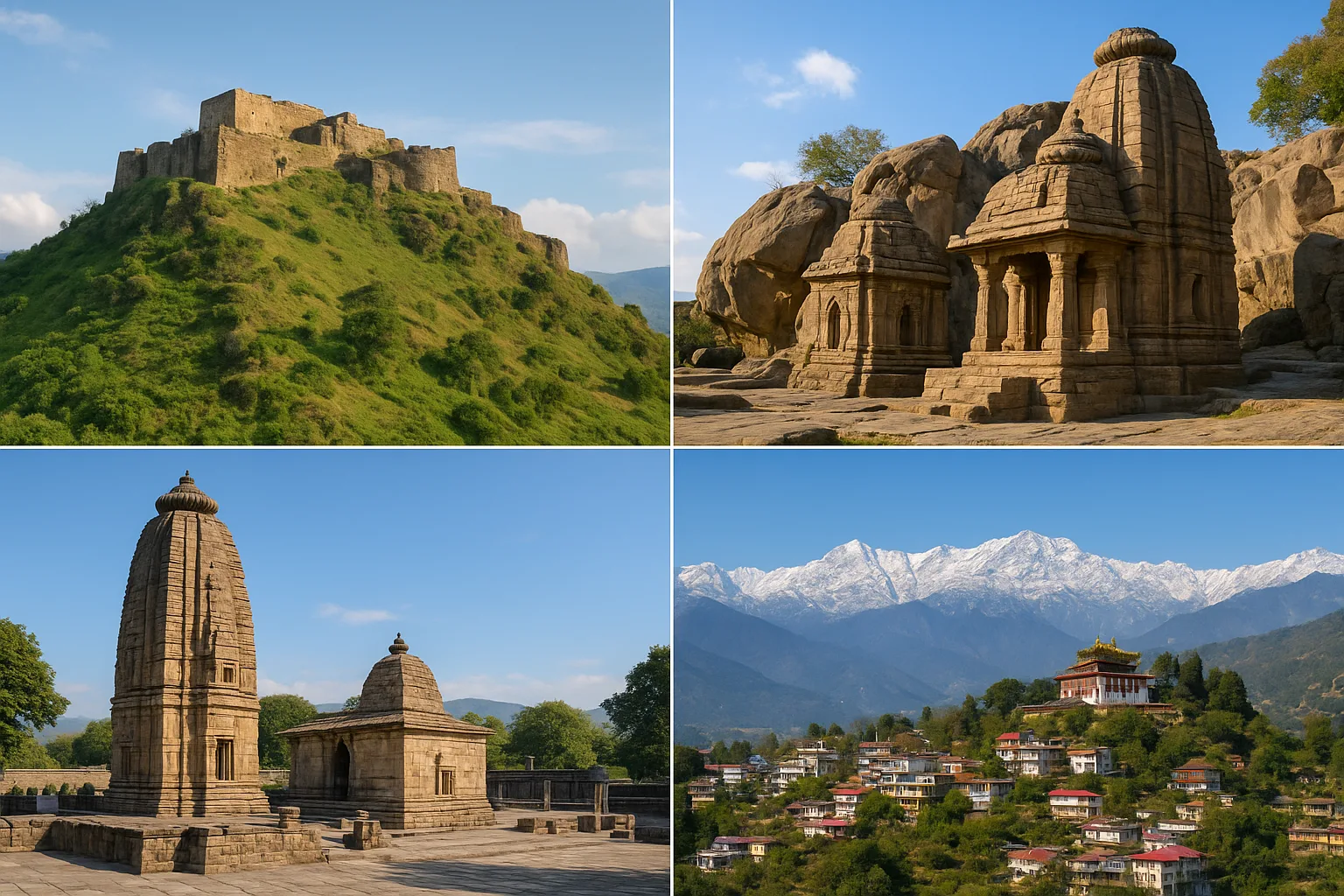
The first rays of sun slip over the Dhauladhar range, bathing the Kangra valley in a golden hush. A gentle mist clings to the terraced fields and ancient stone shrines, as villagers begin their day with low-voiced prayers and the aroma of woodsmoke. The land, with its lush forests and winding rivers, feels old — older even than the stones that crown the famed Nagarkot fort. In this landscape, past and present meet not as contrasts, but as companions. Tourists arrive in search of beauty, but soon find themselves walking through layers of memory, legend, and living heritage.
Ancient Roots: The Cradle of a Civilization
Long before Kangra became a name on tourist maps, it was a crossroads of peoples and ideas. Archaeological evidence, unearthed south of the Beas river, points to settlements as early as the protohistoric era. Pottery fragments and megalithic remains suggest trading links with neighboring valleys and the wider plains beyond. Oral traditions — still sung by local bards — speak of sages, serpent-kings, and hidden treasures beneath the earth. While such tales offer poetic truth, they are best read alongside the more sober accounts of regional gazetteers and early chroniclers, who describe the emergence of small agrarian communities and fortified villages along strategic ridges.
By the time of the Mahabharata’s composition, Kangra (then known as Trigarta) was already woven into India’s mythic tapestry. Local belief holds that the land was shaped by the goddess Ambika, whose temple at Jwalamukhi remains a living center of pilgrimage. Yet the historical record also notes the rise of indigenous clans — the Katoch Rajputs chief among them — who began to assert authority over these valleys, laying the groundwork for what would become one of North India’s oldest surviving dynasties.
Hill States and the Dance of Dynasties
The early medieval period saw Kangra’s fortunes rise and fall with the tides of power sweeping across the subcontinent. Chroniclers from the courts of Delhi and Lahore mention Kangra as a fortified principality, its rulers balancing tribute, autonomy, and resistance. The famed Kangra fort, perched on a rocky outcrop, became both a symbol of resilience and a magnet for invaders. Inscriptions at the site — some dating to the 9th century — speak of sieges, alliances, and the ceaseless negotiation of borders.
Yet, between the battles, life thrived. Buddhist monasteries, such as those at Tira Sujanpur and Baijnath, flourished alongside Shaivite and Vaishnavite shrines. Artisans carved intricate wooden temples, and traders from the plains brought silks and spices along winding mountain routes. The valleys echoed with diverse languages and faiths, from the Indo-Aryan dialects of the Katoch clans to the Pahari idioms of shepherds and farmers.
Folklore, Faith, and Living Traditions
To travel through Kangra is to move between worlds: the tangible and the imagined, the documented and the mythic. Local folklore abounds with stories of shape-shifting yogis, miraculous springs, and lost palaces beneath the riverbed. While historians distinguish carefully between oral tradition and evidence, it is clear that these tales have shaped the region’s sense of place. The annual fairs at Chamunda, Bajreshwari, and Jawalamukhi draw thousands, their rituals echoing customs older than written record.
Belief systems here are syncretic. Buddhist, Hindu, and indigenous animist practices intermingle in daily life and festival. The Kangra school of miniature painting, which flourished under Rajput patronage, drew inspiration from both local landscapes and distant Mughal ateliers. Each brushstroke, each temple bell, tells a story of encounter and adaptation.
The Colonial Encounter and the Making of Modern Tourism
With the arrival of the British in the mid-19th century, Kangra’s heritage entered a new phase. Administrators catalogued its monuments and recorded its customs in district gazetteers, sometimes with a mixture of fascination and misunderstanding. The great earthquake of 1905 devastated Kangra town and its fort, but also prompted early efforts at preservation. British travelers — and later Indian nationalists — began to see the valley not just as a strategic outpost, but as a treasure of art, architecture, and spiritual vitality.
The colonial era also brought the first wave of outsiders seeking the valley’s “picturesque” beauty. Rest houses and bungalows appeared along forested ridges. The Kangra toy train, completed in 1929, invited travelers deeper into the hills. Yet, for most villagers, daily life retained its familiar rhythms: tending to orchards, weaving wool, and honoring the rites of harvest and ancestors. The contrast between the exoticization of Kangra by visitors and the lived experience of locals has shaped debates about heritage and identity ever since.
Post-Independence: Heritage, Memory, and the Rise of Tourism
After 1947, as Himachal Pradesh emerged as a distinct entity within India, Kangra’s heritage acquired new significance. The restoration of temples and the documentation of oral traditions became part of a broader national project to reclaim and celebrate local histories. The establishment of the Kangra Art Museum in Dharamshala, and the designation of key sites as protected monuments, brought renewed attention to the valley’s artistic and spiritual legacy.
Tourism, once the pursuit of the rare adventurer, became a pillar of the local economy. Pilgrims mix with trekkers, and yoga retreats stand alongside ancient shrines. Yet the question of how to balance preservation with progress remains urgent. Earthquakes, deforestation, and the pressures of mass tourism threaten both tangible and intangible heritage. Local communities, custodians of story and stone alike, continue to debate how best to honor the past while building a future.
Heritage in the Present: Kangra’s Living Legacy
Today, as the valley’s roads wind past tea gardens and ruins, Kangra’s heritage is not confined to museums or monuments. It lives in the rhythm of village life, in the melodies of folk songs echoing off the hills, and in the quiet reverence of pilgrims at dawn. The region’s story — told in chronicles and remembered in myth — remains unfinished, shaped by each generation that calls these valleys home.
In our next installment, we will explore how the modern era has brought both challenges and opportunities, as Kangra navigates its place in an interconnected, rapidly changing India. The valley’s ancient roots continue to guide its journey, inviting all who visit or dwell here to walk thoughtfully between memory and possibility.
Previous: Kangra Painting Tradition Explained
Next: Urbanisation Challenges in Kangra Valley