
Series: History of Kullu, Himachal Pradesh, India
Phase 5: Modern Era — Part 25 of 30
This article appears within a continuing historical series that follows the western Himalayas into the modern era. With the end of princely rule and the integration into independent India, long-standing social and political patterns were reconfigured. This phase examines how development, state formation, and memory interact with inherited landscapes, shaping contemporary life while carrying forward echoes of the past.
Crimson Dawns in the Valley
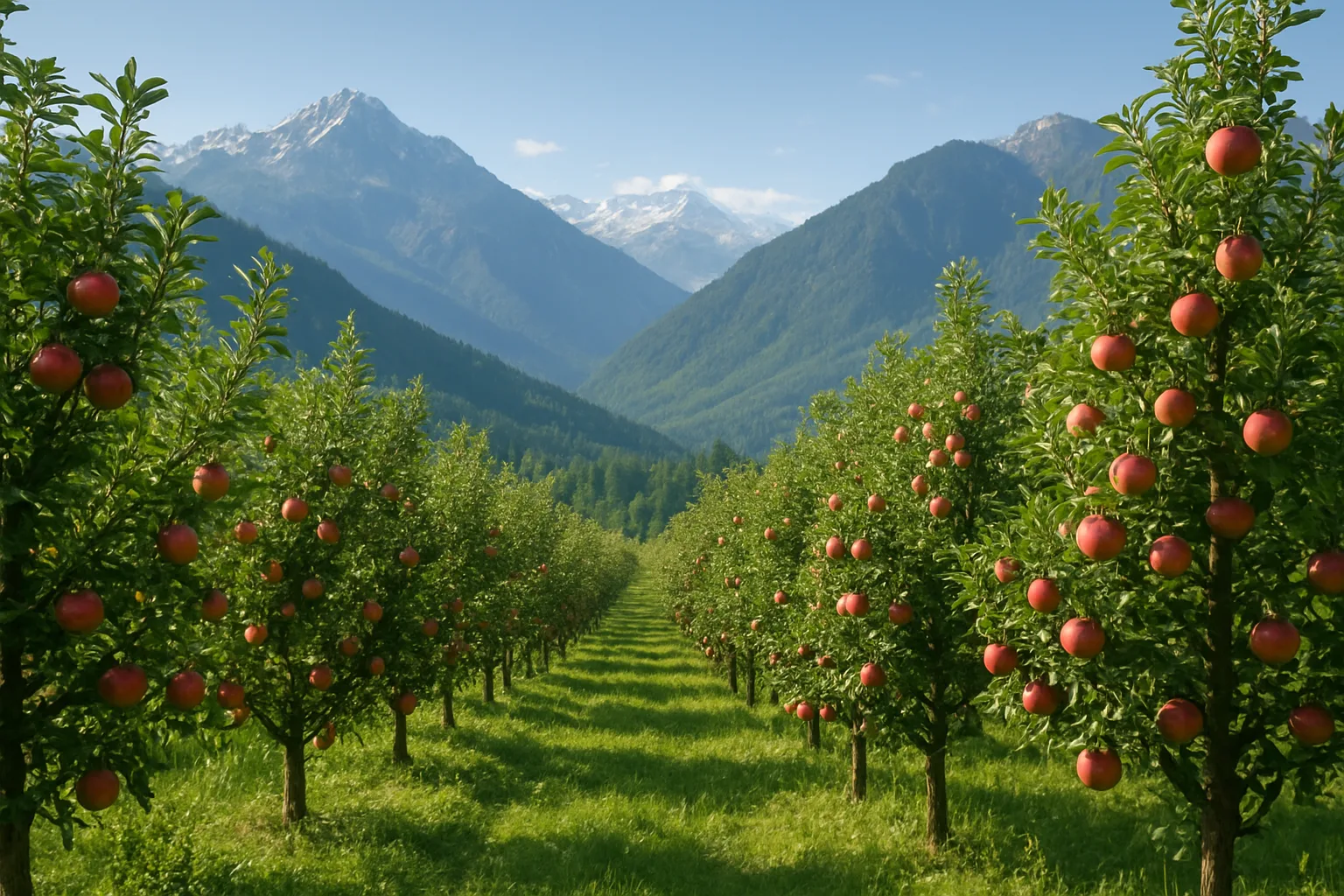
Mist clings stubbornly to the slopes above Kullu town as the first rays of sun ignite the peaks in a brief, golden blaze. Below, the river Beas murmurs past terraced fields, winding between clusters of slate-roofed homes. On a spring morning in the 1930s, villagers gather beneath an ancient deodar tree, voices lively with curiosity. A few days earlier, a new kind of sapling arrived—apple, not native to these hills, but promising something the valley has never known before: a crop that might upend centuries of tradition.
Until this moment, Kullu’s story was written in barley, maize, and the rhythm of livestock herding. But change, like the Himalayan weather, can sweep in swiftly and alter everything.
Rooted in History: Kullu Before the Orchard
Long before the first apple tree took root, Kullu was a crossroads of myth and early settlement. Oral traditions recall the valley’s creation as a sacred refuge, its slopes watched over by local deities—devtas—whose shrines still dot the landscape. The earliest communities here, as described in colonial-era gazetteers and chronicled by traveling scribes, practiced subsistence agriculture and pastoralism. Their belief systems revolved around the cycles of nature, harvest rituals, and ancestral veneration, marking time by the seasons and the shifting snows.
Historians infer from early records and archaeological finds that the Kullu valley, hemmed in by formidable mountains, was nonetheless threaded by trade routes. These ancient paths ferried salt, grain, and wool between Central Asia and the Indian plains, making Kullu both isolated and unexpectedly cosmopolitan. Over centuries, small hill states emerged, each ruled by local rajas whose fortunes rose and fell with control over these vital routes. The valley’s economy, however, remained stubbornly tied to the land: wheat, barley, amaranth, and the hardiness of sheep and goats.
The Arrival of the Apple
Modernity crept in on soft feet. In the early 20th century, after the British annexed the region, new influences followed the colonial administrators and missionaries. Among them was Samuel Evans Stokes, an American who—drawn by the Himalayan quiet—settled in nearby Kotgarh and planted the first apple trees in 1916. The experiment soon reached Kullu. Local landholders, curious but skeptical, watched as the saplings took hold in the valley’s cool, temperate climate.
By the 1930s, a trickle of apple cultivation began to reshape the hillsides. Oral accounts recall the first harvests: small, tart fruit, but enough to stir excitement. Apples thrived where grain struggled, and the promise of cash income—unheard of in the old subsistence system—transformed local aspirations. The Himachal Gazetteer of the mid-20th century documents the swift expansion of orchards, especially after independence, as agricultural officers promoted apple farming with new enthusiasm.
Economic Upheaval: Orchard to Market
With apples came profound economic change. Where once the valley’s wealth was measured in livestock or stored grain, now it was counted in crates and weighed in rupees. Markets, both local and distant, began to beckon. The government built roads to connect remote villages to Kullu town and beyond, and soon trucks—loaded with apples—rattled down from the hills to the plains below.
The social fabric shifted as well. Traditional caste roles, long tied to land and labor, began to blur. Women, who had always worked the fields, now became key players in orchard management and market negotiations. Cooperative societies sprang up, pooling resources and knowledge, and young people—from every community—saw new possibilities for prosperity and education.
Yet, the transformation was not without challenges. The old rhythms of crop rotation and communal labor gave way to the demands of orchard care: pruning, pest control, and the ever-present gamble of weather and market price. Oral histories from elder residents recall both the excitement of newfound wealth and the anxieties of debt, crop failure, and fluctuating markets.
Resilience and Reinvention
Through the decades, Kullu’s apple story has been one of adaptation. In the 1960s and 70s, as demand for Himachali apples soared, farmers experimented with new varieties and techniques. Government support brought cold storage facilities and scientific advice, while cooperative marketing helped insulate growers from the worst shocks of price swings.
The rise of apple farming also brought environmental concerns. Intensive cultivation, deforestation for new orchards, and the lure of quick profits sometimes threatened the delicate ecological balance. In recent years, unpredictable weather—linked to global climate patterns—has forced another reckoning. Yet, resilience endures: many families now diversify with horticulture, beekeeping, or even eco-tourism, weaving new threads into the valley’s economic tapestry.
Apples and Identity: The New Kullu
Today, the apple is as much a symbol of Kullu as the sacred deodar or the swirling Beas. Annual harvests bring together entire villages, echoing the communal rituals of older times, even as smartphones and market apps connect the valley to the wider world. Schoolchildren walk to lessons past blooming orchards, their futures tied to both land and global commodity flows.
Yet, the memory of older ways—barley harvest songs, tales of trade caravans, the slow drift of sheep across alpine meadows—lingers in the stories elders tell. The apple has not erased Kullu’s past but layered new meaning atop ancient roots.
From Orchard Shadows to Tomorrow’s Valleys
The transformation of Kullu’s economy—from subsistence farming and barter to the cash crop revolution of apple orchards—has been nothing short of remarkable. It is a story woven from local ingenuity, outside influence, and the enduring interplay of tradition and change. The valley’s journey, from the era of rajas and wandering traders to crates of apples bound for distant markets, is both uniquely Kullu’s and part of a wider Himalayan tale.
As Kullu looks to the future—balancing prosperity, sustainability, and cultural identity—the legacy of the apple remains a living testament to the valley’s capacity for reinvention. In the next post, we will explore how tourism and the arts began to reshape Kullu’s landscape, further entwining the region’s destiny with the wider world.
Previous: Environmental Challenges Facing Modern Kullu
Next: Urbanisation and Changing Lifestyles in Kullu Town