
Series: History of Solan, Himachal Pradesh, India
Phase 5: Modern Era — Part 26 of 30
This article appears within a continuing historical series that follows the western Himalayas into the modern era. With the end of princely rule and the integration into independent India, long-standing social and political patterns were reconfigured. This phase examines how development, state formation, and memory interact with inherited landscapes, shaping contemporary life while carrying forward echoes of the past.
Monsoon Mist and Silent Stones: A Visitor Arrives in Solan
The train from Kalka clatters through the Shivalik foothills, rounding a final bend as the mist lifts from the valley below. It is 1910, and a British civil servant gazes out, notebook in hand, entranced by the neat lines of Solan’s new railway station. Around him, porters chatter in Pahari dialect and the scent of pine mingles with fresh rain. The town is not yet a century old, yet its hills hold memories far older. For every newcomer—be they British administrator, Sikh pilgrim, or tea planter—Solan’s slopes have always promised more than a mere stopover. This is a place where history is layered, each era echoing in stone, shrine, and street.
Roots Beneath the Pines: Solan’s Ancient Heritage
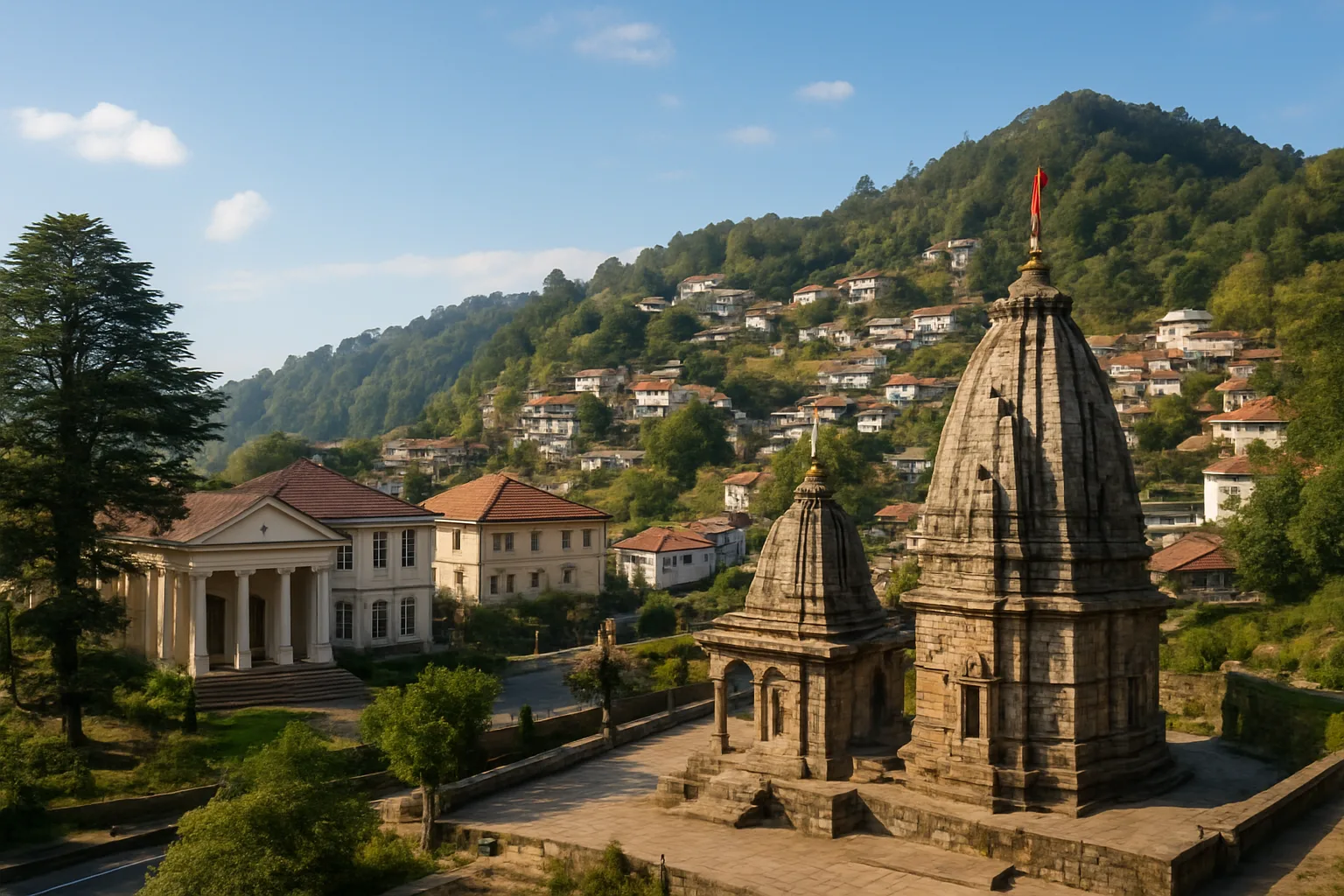
Well before the arrival of the railway, the land that would become Solan was a tapestry of small Rajput estates and sacred groves. Oral traditions recall early settlements as outposts for the Baghat princely state. The slopes were dotted with shrines to Shoolini Devi, the town’s tutelary goddess, whose legend shaped the valley’s destiny. The Shoolini Mata Temple, perched on a gentle knoll south of town, is the oldest enduring landmark. For centuries, it drew villagers from across the region, especially during the annual Shoolini Mela. This festival, dating back at least to the 18th century, mingled spiritual devotion with commerce, as traders and pilgrims crowded the bazaar. The temple’s stone sanctum, bearing the patina of countless monsoons, remains at the heart of Solan’s identity—both sacred site and communal anchor.
Colonial Imprints: The Railway, Breweries, and a Hill Station’s Rise
The late 19th century brought a transformation that would chart Solan’s modern course. In 1857, the British Raj, seeking strategic hill stations and sanatoria, identified Solan’s airy climate as ideal. The Kalka–Shimla Railway, completed in 1903, was a marvel of engineering, its narrow-gauge line threading through tunnels and across viaducts. The arrival of the railway reshaped Solan: colonial bungalows rose alongside local hamlets, and the rhythm of life shifted to the whistle of passing trains.
Among the most enduring colonial legacies is the Mohan Meakin Brewery, founded in 1855 at Kasauli and later shifting operations to Solan. Here, British officers and Indian entrepreneurs collaborated in an unlikely partnership that would birth Solan No. 1 whisky and the legendary Old Monk rum. The brewery’s red-brick chimneys and wood-paneled tasting rooms still stand, testaments to an era when Solan’s name was known far beyond the Himalayas.
Throughout the early 20th century, Solan blossomed as a hill station. The Mall Road, lined with shops and deodar trees, became the social heart of the town. The Christ Church, built in 1870, and the stately District Court House spoke of administrative ambition. Yet, even as the British left their mark, local traditions endured, blending with new influences in unexpected ways.
Sacred Sites and Living Traditions
Beyond its colonial relics, Solan is defined by its ancient temples and vibrant festivals. The Jatoli Shiv Temple, a short drive from town, rises dramatically above the pine forests. Its stone shikhara and intricate carvings evoke centuries of devotion. Legends claim the sage Jagat Guru Shankaracharya once meditated here, and today, pilgrims ascend its steps seeking blessings and panoramic views.
Equally significant is the Menri Monastery at nearby Dolanji, home to the Bon tradition of Tibetan Buddhism. Established in 1969 by spiritual leader Lopon Tenzin Namdak, Menri became a haven for exiled monks and a center for cultural preservation. Visitors are welcomed with the scent of juniper incense and the rhythmic chanting of prayers—a living bridge between Solan’s past and its cosmopolitan present.
Each summer, the Shoolini Mela transforms the town: streets bloom with color, and processions snake from temple to bazaar. The festival, rooted in centuries-old rites, features folk music, local cuisine, and heartfelt rituals that bind old and new generations.
Nature’s Gift: Botanical Heritage and Hill Walks
Solan’s natural beauty has always been its most enduring attraction. The Dr. Yashwant Singh Parmar University of Horticulture and Forestry, established in 1985, stands as a modern monument to the region’s agricultural ingenuity. Its lush campus, brimming with apple orchards and rare Himalayan flora, draws scientists and tourists alike. Botanical trails wind through oak and cedar, alive with birdsong and the distant hum of village life.
For generations, locals and visitors have trekked the ridge paths to Karol Tibba and Meteol Tibba. These hills, steeped in myth, are said to have sheltered the Pandavas during their exile. The Karol Cave, hidden among boulders, is revered as one of the longest cave systems in the Himalayas. Each ascent is a journey through living history—past shepherds’ huts, wildflowers, and the silent watch of ancient stones.
Architectural Echoes: From Colonial Grandeur to Modern Landmarks
Strolling Solan’s avenues, one encounters a dialogue between old and new. The District Library, with its timbered eaves, preserves rare manuscripts and British-era records. Nearby, the stately Town Hall hosts debates, theatre, and civic gatherings—a legacy of community spirit fostered during the Raj.
Modern Solan is not frozen in time. The bustling market, with its spice stalls and sweet shops, pulses with contemporary energy. Yet even here, echoes of the past linger—whether in the colonial-era clocktower or the ornate facades of shopfronts built by early traders from Punjab and Rajasthan.
The Spiritual and the Everyday: People, Pilgrims, and Festivals
Solan’s story is ultimately a story of people—of families who have lived here for centuries, of migrants who arrived with the railway, of seekers drawn by sacred sites. Through regime changes and shifting borders, the town has maintained a spirit of welcome. The Sikh Gurdwara at Barog, the Presbyterian church by the railway, and the numerous Hindu shrines bear witness to the town’s pluralism.
Local legends, such as the tale of the snake goddess Shoolini protecting the valley, are retold each year at family gatherings. These stories, as much as any monument, are the true heritage of Solan—a living archive passed from one generation to the next.
Past in the Present: How Heritage Shapes Solan Today
Today, Solan stands at a crossroads of history and modernity. Its heritage attractions draw thousands each year: pilgrims climbing temple steps, families exploring the railway’s tunnels, travelers savoring old-world brews. The town’s past is not just preserved in stone and story—it is lived daily, in festival rhythms and quiet rituals, in the interplay of old bungalows and new hotels, in the laughter of children at the Shoolini Mela.
As Solan looks to the future, its greatest strength is the seamless weaving of tradition and change. The echoes of colonial footsteps and ancient prayers ring out in the hills, inviting all who visit to become part of this unfolding story. For those who pause to listen, Solan offers not just attractions, but a sense of belonging—a heritage that endures, vibrant as ever.
Previous: Urban Growth and Changing Lifestyles in Solan Town
Next: Environmental Challenges Facing Solan District