
Series: History of Shimla, Himachal Pradesh, India
Phase 5: Modern Era — Part 26 of 30
This article appears within a continuing historical series that follows the western Himalayas into the modern era. With the end of princely rule and the integration into independent India, long-standing social and political patterns were reconfigured. This phase examines how development, state formation, and memory interact with inherited landscapes, shaping contemporary life while carrying forward echoes of the past.
The Quiet Watch of the Town Hall
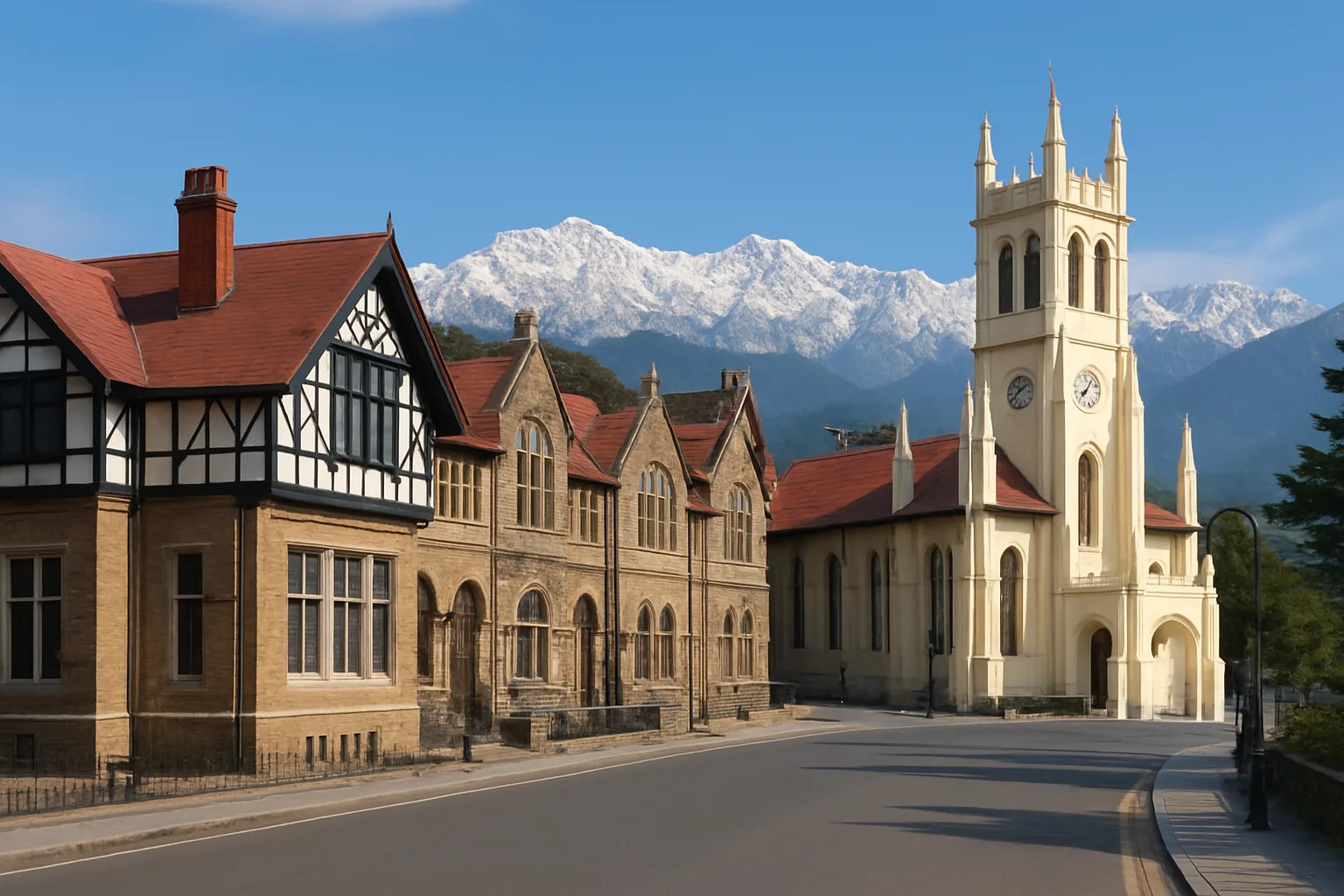
On a mist-bound morning, as the Ridge stands sentinel above the awakening town, the silhouette of Shimla’s Town Hall emerges—a brooding vestige of the colonial past. Its sandstone arches and clock tower, built in 1910, speak not only to the ambitions of British administrators but to the generations who have since called the city home. This structure, like many others along the Mall, faces a daily tension: the push and pull between the city’s inherited identity and the inexorable demands of a rapidly growing urban center.
From Hill Station to State Capital: A Region Anchored in History
Shimla’s place on the map is no accident. Perched at 2,200 meters in the middle Himalayas, its strategic location drew the attention of the British East India Company in the early 19th century. Yet, the city’s roots run deeper. Before the advent of British rule, the forested ridge and surrounding valleys were part of the small hill state of Keonthal, ruled by local chieftains whose authority was recognized in regional gazetteers and chronicles of the time. Oral traditions among Pahari communities still recall the ancient deities of Jakhu and Tara Devi, whose shrines long predated colonial arrival.
The British, seeking a salubrious summer capital, saw in Shimla both a retreat and a symbol—a place where imperial vision could be etched in stone and timber. By the 1860s, the town’s architectural landscape began to transform, layering over earlier patterns of settlement and belief systems. The Mall, Christ Church, and the Viceregal Lodge became new anchors in the city’s identity.
Colonial Constructions and Early Preservation Efforts
With the consolidation of British administration, Shimla’s built environment became a microcosm of imperial aspiration. Grand buildings rose in the Gothic and Tudor styles, their steep roofs and wooden facades adapted to the monsoon climate and seismic risks of the region. The Ridge and Mall Road, laid out for promenades and public gatherings, became the symbolic heart of the colonial city.
Even before independence, there were murmurs about the need to maintain the city’s distinctive character. By the 1920s, conservation-minded officials and residents voiced concern over the haphazard growth of bazaars and the encroachment of new construction upon historic precincts. Minutes from the Simla Municipal Committee, preserved in the Himachal State Archives, record debates about preserving the “aesthetic unity” of the core town and protecting its iconic viewsheds.
Negotiating Heritage in Postcolonial Shimla
The departure of the British in 1947 marked a decisive shift. Shimla, now the capital of Himachal Pradesh, was swept by waves of migration and development. Administrative needs, growing population, and the pressures of tourism began to strain the city’s infrastructure. The colonial legacy—once a symbol of imperial power—became a subject of debate: Should these buildings be preserved as relics, repurposed for new functions, or swept aside for the practicalities of a modern Indian city?
Throughout the 1960s and ’70s, new state offices, hotels, and residential blocks crept up the hillsides, often at odds with the proportions and materials of the colonial core. Yet, certain landmarks remained protected by inertia, public sentiment, or official decree. Christ Church continued to serve as a religious and cultural touchstone, while the Viceregal Lodge found new life as the Indian Institute of Advanced Study.
Policy, Advocacy, and the Struggle for Balance
By the late 20th century, national and local authorities began to formalize the protection of Shimla’s built heritage. The 1977 Himachal Pradesh Town and Country Planning Act introduced more stringent controls on construction and land use in the historic center. The Archaeological Survey of India and the Indian National Trust for Art and Cultural Heritage (INTACH) undertook surveys to document and prioritize key buildings for conservation.
Heritage walks, local history societies, and academic studies contributed to a growing awareness of the city’s architectural legacy. Community advocacy played a pivotal role in halting the demolition of certain landmarks and promoting restoration projects. The Town Hall underwent a major conservation effort in the 2010s, restoring its timber beams and stained glass with painstaking attention to original detail. The Ridge, meanwhile, became the stage for both official ceremonies and everyday gatherings, its open space fiercely defended against encroachment.
Challenges of Urban Growth and Cultural Continuity
The preservation of Shimla’s colonial heritage has never been a simple matter of freezing the past in time. The city’s population, now exceeding 170,000, strains networks designed for a fraction of that number. Traffic congestion, environmental pressures, and the commercial imperatives of a tourist economy all test the limits of heritage protection. New construction, often in glass and concrete, rises in uneasy juxtaposition with the timbered facades of older neighborhoods.
Yet, the dialogue between past and present continues. Local artisans are still called upon to replicate the intricate woodwork and stone masonry of the colonial era. Schoolchildren gather on the steps of the Gaiety Theatre, their lessons layered with stories of the city’s earlier days. The annual Summer Festival, begun in the colonial period, now blends British-era brass bands with Himachali folk performances, a living testament to the city’s evolving identity.
Continuity and the Shape of Things to Come
Shimla’s colonial heritage endures not as a static tableau, but as a living presence—adapted, contested, and reimagined by each generation. The city’s historic buildings, promenades, and public spaces offer both a framework for memory and a stage for new cultural expressions. As Shimla grapples with the twin imperatives of growth and preservation, its landscape remains a palimpsest: British, Pahari, and modern Indian influences entwined in stone, wood, and human aspiration.
In the next part of this series, we will turn to the contemporary debates surrounding sustainable development and the future of tourism in Shimla, exploring how the city balances its storied past with the demands of the present and the promises of tomorrow.
Previous: Tourism: Blessing and Burden for Shimla
Next: Environmental Challenges Facing Shimla Today