
Series: History of Kangra, Himachal Pradesh, India
Phase 5: Modern Era — Part 22 of 30
This article appears within a continuing historical series that follows the western Himalayas into the modern era. With the end of princely rule and the integration into independent India, long-standing social and political patterns were reconfigured. This phase examines how development, state formation, and memory interact with inherited landscapes, shaping contemporary life while carrying forward echoes of the past.
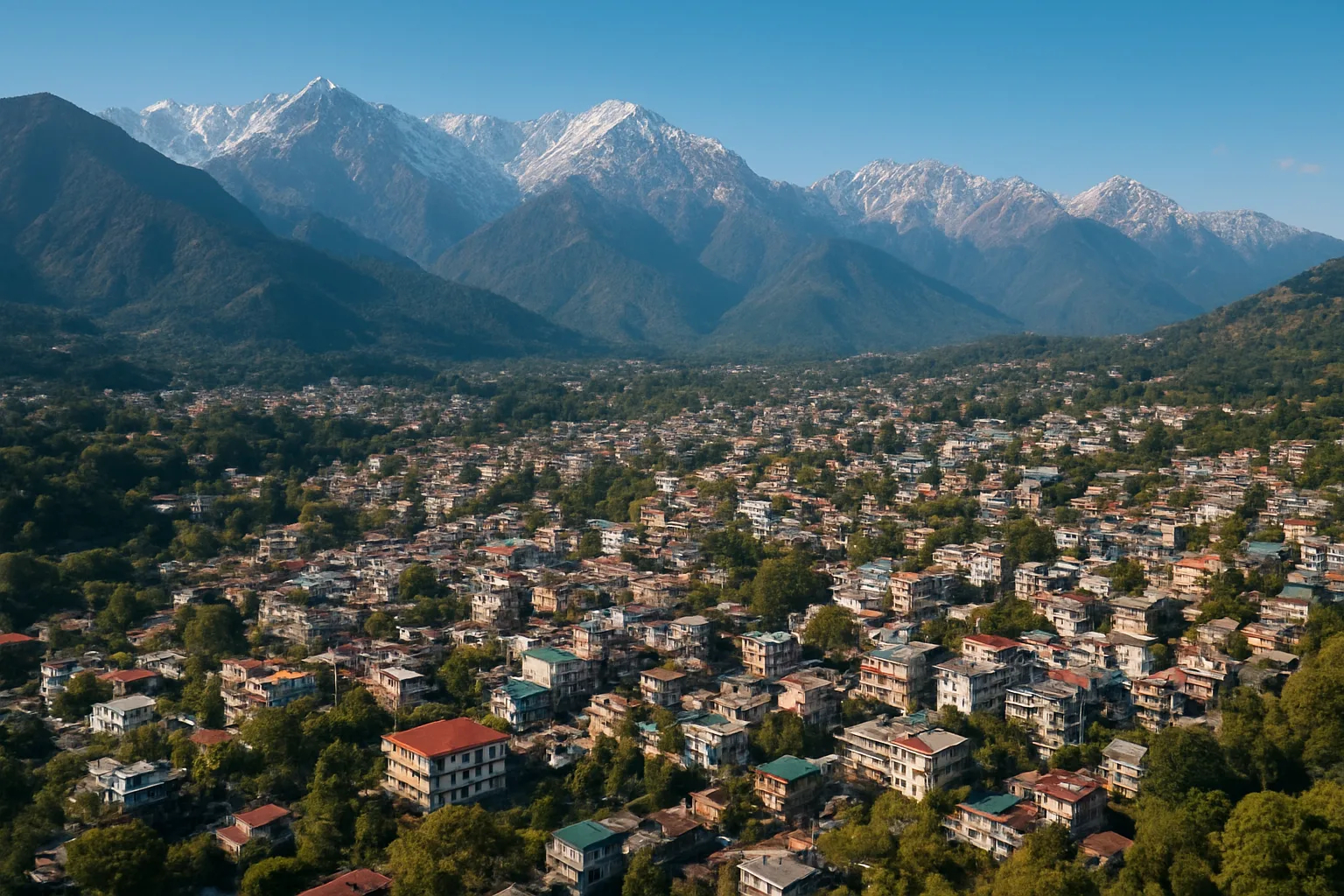
Under the Dhauladhar: Dawn in Dharamshala, 1840s
The first rays of sun slice across the snowy ramparts of the Dhauladhar range, spilling gold over the pine-clad hills and deep valleys. In the mists below, a handful of British tents dot a forested ridge — the faint beginnings of a cantonment that would soon be known as Dharamshala. Here, at the crossroads of the old and new, the story of a modest settlement’s transformation into Kangra’s regional heart quietly unfolds, shaped by imperial ambitions, ancient traditions, and the enduring spirit of the hills.
From Ancient Pathways to Colonial Outpost
Long before the British surveyed these slopes, the valleys of Kangra echoed with the footsteps of traders, pilgrims, and warriors. Oral traditions in local Gaddi and Kangri communities tell of ancient routes winding from the plains up to Lahaul, Spiti, and Tibet. While mythology provides a poetic backdrop — with tales of sages meditating in these forests — regional gazetteers like the 1883 Kangra District Gazetteer confirm that the area’s strategic location was no accident. Dharamshala’s ridge overlooked age-old passes and the beehive of activity below, yet remained tucked away from the main thoroughfares, a place of both seclusion and potential.
Colonial Ambitions and Early Foundations
The 1846 Treaty of Lahore, following the First Anglo-Sikh War, brought the Kangra region under British control. The British, seeking a cooler and healthier alternative to the fever-ridden plains, soon established a military station on the forested slopes above Kangra town. They called it “Dharamshala,” echoing the Sanskrit term for a spiritual rest house, perhaps inspired by an existing pilgrim shelter nearby.
Initially, the settlement’s growth was slow. The cantonment’s population was a mosaic: British officers and their families, Gurkha and Dogra soldiers, local artisans, and traders drawn by opportunity. The officers built bungalows with broad verandas, while local communities constructed temples and shrines along the wooded paths. The British presence brought new roads, schools, and administrative offices, nudging Dharamshala into the regional consciousness.
Shifting Social Landscapes: Communities and Belief Systems
Even as the British stamped their authority, the enduring presence of Gaddi shepherds, Rajput landholders, Brahmin priests, and artisan castes shaped Dharamshala’s daily life. The settlement’s character was never purely colonial; it was, from the outset, a meeting point for diverse communities.
Hindu temples dotted the hills, while the annual Shivratri mela in nearby Baijnath drew crowds from across the valley. Oral histories recall that the British, wary of interfering with local belief systems, often supported temple endowments to win over the populace. Sufi shrines and small Christian chapels soon joined the religious mosaic, reflecting the region’s layered spirituality.
Disaster and Renewal: The 1905 Kangra Earthquake
At dawn on April 4, 1905, the earth convulsed beneath Kangra, reducing centuries-old stone temples and bustling bazaars to rubble. Dharamshala, perched precariously on the hillside, suffered devastating losses. The British cantonment, local homes, and even the sacred temples of the valley were shattered. The official records recount the tragedy in numbers — over 20,000 dead across the region — but survivor accounts capture the trauma and resilience that followed.
The quake, however, did not spell the end for Dharamshala. Instead, it marked a turning point. Relief camps brought together British administrators, Indian doctors, and local volunteers. Reconstruction efforts spurred new building codes and the expansion of stone and timber architecture. The bazaar grew around the lower town, and new administrative offices rose on the ridge, reinforcing Dharamshala’s role as the regional headquarters.
Emergence as a Regional Nerve Centre
By the early twentieth century, Dharamshala had outgrown its beginnings as a colonial cantonment. Its location — accessible to the plains yet sheltered by the mountains — made it a natural hub for administration, education, and commerce. Schools, missionary hospitals, and printing presses took root, attracting students and professionals from across the hills.
Trade flourished through the bazaar, with hill farmers, Tibetan traders, and Punjabi merchants exchanging goods beneath the eaves of new shopfronts. The arrival of the narrow-gauge railway in the Kangra Valley, though never reaching Dharamshala itself, further integrated the region into wider networks. By the eve of independence, Dharamshala had become the de facto centre for Kangra’s politics, economy, and public life.
Post-Independence Transformations
The partition of India in 1947 brought waves of refugees and new tensions to the hills. Yet it was the arrival of the Dalai Lama and Tibetan government-in-exile in 1960 that would most dramatically alter Dharamshala’s destiny. The upper settlement of McLeodganj became a Tibetan enclave, its streets alive with the sound of prayer wheels and the scent of butter lamps. The town’s population swelled, and its cultural landscape became even more cosmopolitan.
As the seat of the Kangra district and a spiritual centre for exiled Tibetans, Dharamshala grew ever more prominent. The region’s diverse communities — Gaddis, Punjabis, Tibetans, and others — forged new bonds, turning the town into a microcosm of modern Himachal Pradesh’s pluralism.
Legacy and Living Heritage
Standing today on the ridge above Dharamshala, with prayer flags fluttering against colonial stonework and the Himalayas brooding beyond, it is impossible not to sense the layers of history beneath one’s feet. The town’s ascent from remote outpost to regional centre is not simply a tale of political decisions or geographic luck. It is the story of communities adapting, surviving disaster, and reinventing themselves in the face of change.
These ancient roots — the trade paths, belief systems, and resilience passed down through generations — continue to shape Kangra’s identity. In our next post, we will journey into the cultural renaissance of the late twentieth century, exploring how Dharamshala became a beacon for art, activism, and dialogue in the Himalayan region.
Previous: Kangra After Independence
Next: Arrival of the Tibetan Government-in-Exile