
Series: History of Kangra, Himachal Pradesh, India
Phase 5: Modern Era — Part 21 of 30
This article appears within a continuing historical series that follows the western Himalayas into the modern era. With the end of princely rule and the integration into independent India, long-standing social and political patterns were reconfigured. This phase examines how development, state formation, and memory interact with inherited landscapes, shaping contemporary life while carrying forward echoes of the past.
Midnight in the Valleys: Kangra’s First Dawn of Freedom
As the night of August 14, 1947, gave way to the first sunrise of independent India, Kangra’s landscape, ringed by the silent Dhauladhar mountains, waited in a hush. In the villages of Palampur, Dharamshala, and the ancient town of Kangra itself, radios crackled with distant speeches from Delhi, their static-laced Hindi and Urdu carrying the promise of a new era. For most, the rhythm of life—cattle bells, temple conches, the drone of spinning wheels—carried on as it had for centuries. Yet beneath the surface, a tide of change had begun to swell, carrying with it memories of princely rule, colonial administrators, and the ancient Rajput dynasties whose echoes still lingered in every stone fort and village legend.
From Princely State to Provincial District
Kangra’s place in India’s independence story is shaped by its complicated political heritage. Once ruled by the Katoch dynasty—one of the oldest surviving royal families in the world—Kangra had endured centuries of shifting overlords including Mughals, Sikhs, and finally the British. At the time of independence, Kangra was not a sovereign princely state in its own right, but a district within the British Punjab Province, having been annexed by the British after the Anglo-Sikh wars in 1846.
This distinction was crucial. Unlike neighboring hill states such as Chamba or Mandi, Kangra did not have the option (or burden) of choosing between accession to India or Pakistan. With the boundary lines drawn by the Radcliffe Commission and the Punjab province being split, Kangra, with its Hindu-majority population and deep Himalayan roots, became part of the newly formed Indian state of East Punjab. The transition, though relatively bloodless in Kangra compared to the horrors of Partition that swept across the plains, was not without its uncertainties. Questions of identity, administration, and land began to surface, foreshadowing the reforms and struggles to come.
Social Transformation in the Wake of Reform
The years immediately following independence were marked by an intense period of social and economic change. Land reform, a pillar of Nehruvian policy, arrived swiftly in the Kangra hills. The abolition of the zamindari system—where large landowners collected rent from tenant farmers—upended longstanding relationships of power. Oral traditions recall the anxieties and hopes of this tumultuous time: elders recount heated debates in village panchayats, the nervous anticipation of land allotment, and the first taste of real ownership for many tenant families.
Education became another frontier of transformation. Government schools, once few and far between, began to dot the valleys and ridges. The founding of institutions such as the Government Post Graduate College in Dharamshala (established in 1956) was emblematic of the region’s efforts to cultivate a new class of educated citizens. Yet, these reforms were not uniform in their impact. Historical inference, based on colonial gazetteers and post-independence surveys, reveals that while some communities—particularly those close to roads and market towns—advanced swiftly, more remote villages struggled with the inertia of geography and tradition.
The Emergence of a New Himachal: Kangra’s Integration
Perhaps the most profound political change came with the reorganization of states. In 1966, following the Punjab Reorganisation Act, Kangra was transferred from Punjab to the newly enlarged Union Territory of Himachal Pradesh. This event, often recounted in both government records and local oral histories, was met with a mixture of trepidation and pride. For many Kangris, the shift brought a renewed sense of belonging to the hills, away from the administrative and cultural dominance of the Punjab plains.
The creation of Himachal Pradesh as a full-fledged state in 1971 further cemented Kangra’s identity as a cornerstone of the hill state. The region’s voice grew in political significance, producing several key leaders and contributing to the shape of Himachal’s unique blend of hill autonomy, tradition, and modernity. Yet, these transitions were not seamless. Local newspapers and early chronicles from the time document debates over infrastructure, language policy (Hindi versus Punjabi and Pahari dialects), and the allocation of development funds.
Communities, Belief Systems, and the Persistence of Tradition
Through all these changes, Kangra’s social fabric remained deeply rooted in its historic communities: Rajputs, Brahmins, Gaddis, and Scheduled Caste groups, whose oral traditions and local customs continued to guide daily life. Religious and spiritual life centered around ancient temples such as Bajreshwari Devi and the monasteries near McLeod Ganj, the latter transformed in 1960 by the arrival of the Dalai Lama and the Tibetan exile community. This sudden encounter with a global diaspora brought new layers to Kangra’s identity, transforming Dharamshala into a crossroads of Himalayan and international culture.
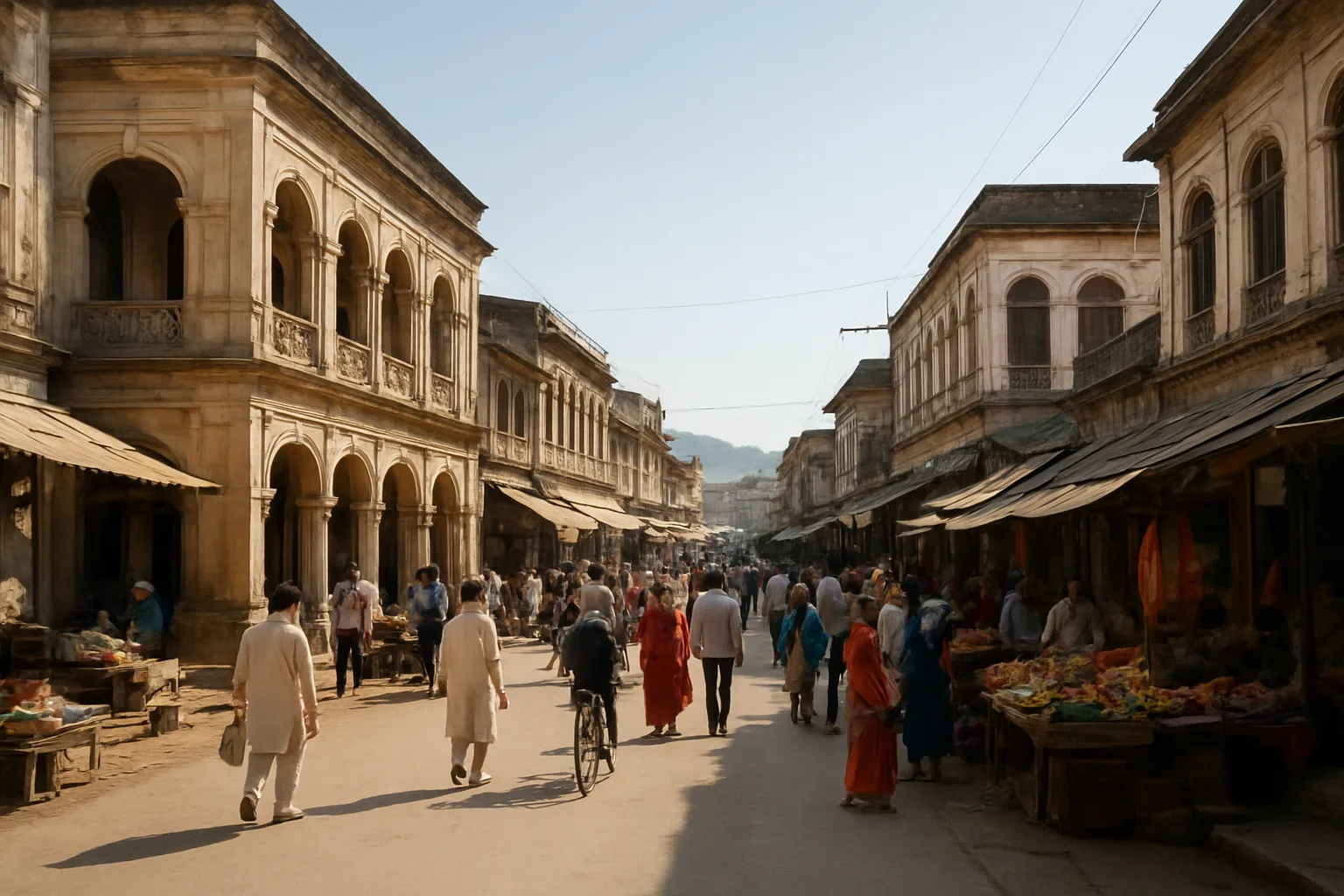
Trade routes, once the arteries of salt and wool caravans, shifted their character, as roads and buses replaced the traditional mule tracks. Markets in Kangra and Palampur hummed with produce and textiles, reflecting both the persistence of old crafts—such as the famed Kangra miniature paintings—and the new economic realities of post-independence India.
Modern Kangra: Memory, Change, and Enduring Identity
By the late twentieth century, Kangra had become emblematic of Himachal’s broader journey: a region negotiating the tension between tradition and progress. The rise of tourism, the spread of education, and the influx of new communities all left their mark. Yet the region’s ancient roots—visible in its terraced fields, temple rituals, and the stories recounted by elders—remained a vital thread connecting past and present.
Documented history and living memory intertwine in Kangra’s ongoing narrative. The region’s people, shaped by centuries of adaptation and resilience, continue to draw on both the wisdom of the hills and the aspirations of a new India. The echoes of independence—of hope, reform, and the search for identity—still resound in today’s Kangra, shaping its future even as it honors its deep past.
Looking Ahead: Kangra’s Next Chapter
As this series continues, we turn to the challenges and opportunities of the late twentieth and early twenty-first centuries: migration, environmental change, and the global connections that have come to define modern Kangra. The legacy of independence endures, not as a distant memory, but as the living foundation of a region still in motion—still telling its story, one generation at a time.
Previous: Freedom Movement in Kangra
Next: Growth of Dharamshala as a Regional Centre