
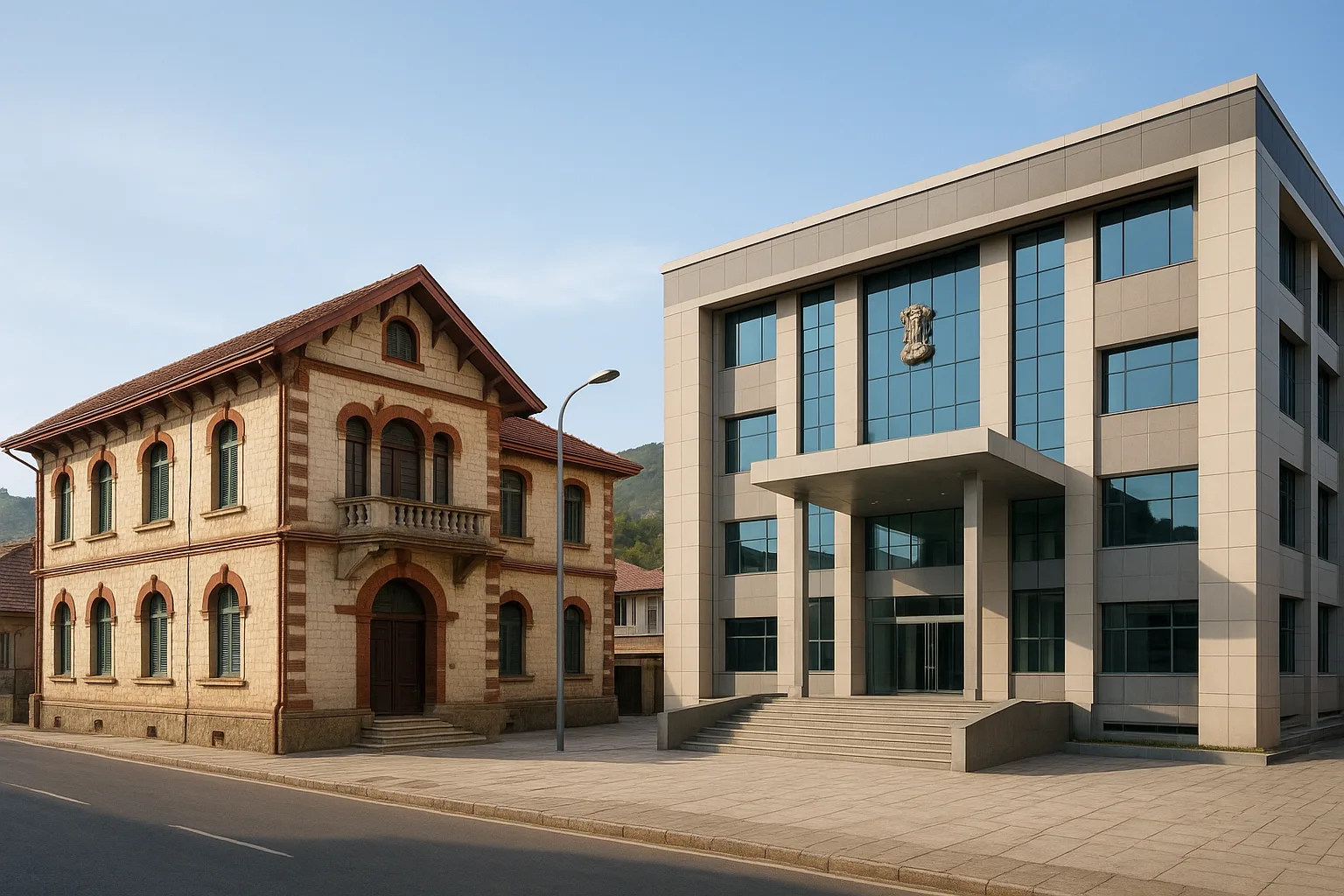
Series: History of Solan, Himachal Pradesh, India
Phase 5: Modern Era — Part 21 of 30
This article appears within a continuing historical series that follows the western Himalayas into the modern era. With the end of princely rule and the integration into independent India, long-standing social and political patterns were reconfigured. This phase examines how development, state formation, and memory interact with inherited landscapes, shaping contemporary life while carrying forward echoes of the past.
The Midnight Churn: A Town on the Cusp of Change
It was the summer of 1947. Solan’s quiet hills, usually punctuated only by the distant echo of train whistles and the laughter of market vendors, hummed with anticipation and uncertainty. News of India’s impending independence fluttered through the bazaar, carried by travelers from Shimla and Kalka. In the colonial-era rest house, British officers and local princelings met over anxious cups of tea, weighing the future of their roles—and the fate of Solan. By August 15th, the Union Jack came down from the district office for the final time, and the tricolor rose with a mixture of hope and trepidation. Few could have predicted just how profoundly Solan’s administrative landscape would be transformed in the years to follow.
Unraveling the Princely Ties
For decades, Solan had existed at the juncture of princely states and British colonial authority. The town was administered under the princely state of Baghat, a small but influential entity whose raja maintained cordial ties with the British. The Baghat rulers, headquartered in the nearby village of Arki, governed with a blend of tradition and colonial bureaucratic practices. The Raja’s court, a mix of hereditary nobles and British-trained officials, dispensed justice and managed tax collection from the pine-clad hills to the fertile valleys.
Independence was both liberation and upheaval. The princely states, including Baghat, faced a stark choice: accede to India or Pakistan, or risk political isolation. Under the steady persuasion of Sardar Vallabhbhai Patel and V.P. Menon, Baghat’s rulers signed the Instrument of Accession to the Indian Union in 1948. The event, largely ceremonial yet charged with emotion, marked the end of an era. The administrative powers that had once flowed from the raja’s durbar now shifted inexorably to the new Indian state.
Integration into Himachal Pradesh
The immediate aftermath saw confusion and contestation, as the Indian government set about reorganizing the patchwork of princely and colonial territories in the Himalayas. Solan, along with Baghat and neighboring princely states like Kuthar and Bhagat, was first merged into the newly formed Himachal Pradesh Chief Commissioner’s Province in April 1948. This was not merely a change of nomenclature. It signaled the arrival of a new bureaucracy—one that owed allegiance to the central government in Delhi rather than distant palaces or the colonial administration in Shimla.
Public notices in Solan’s bazaars and schools announced new administrative appointments. The local tehsildar, once deferential to the raja, now reported to a district magistrate appointed by the Indian government. For many, the change was bewildering; for others, especially young freedom fighters and teachers, it was a moment of possibility. The Himachal Pradesh Administrative Service, modeled on the Indian Administrative Service, began recruiting local talent, slowly replacing hereditary officeholders with university-educated civil servants.
The Birth of Solan District
The 1970s marked a watershed. As India matured as a republic, the demand for more efficient governance and local representation led to the reorganization of districts. Solan, long considered an important market town and railway junction, was carved out as a separate district in September 1972. This administrative elevation was both symbolic and practical. With district status came greater autonomy, a dedicated district collectorate, and new government offices. The old colonial buildings were repurposed; some became the headquarters for the district police, others housed the nascent district education board.
Figures like S.P. Verma, the first District Collector of Solan, became household names. Verma’s tenure is still remembered for his insistence on transparent land records and his campaign to expand rural primary schools. The district’s boundaries were drawn to include not only Solan town but also the surrounding areas of Kasauli, Nalagarh, and Arki—each with its own intricate history and administrative traditions.
Transforming Governance: Panchayats and Representation
With the district formation came a concerted push for grassroots democracy. The 73rd Amendment to the Indian Constitution in 1992, which mandated the creation and empowerment of local panchayati raj institutions, found fertile ground in Solan. Village councils—panchayats—took on new responsibilities, from managing water resources to overseeing primary health centers. Women and members of Scheduled Castes gained unprecedented representation through electoral quotas, reshaping the social fabric of rural Solan.
The administrative map was redrawn again and again, as new tehsils and development blocks were created to better address the region’s needs. Government-appointed block development officers, or BDOs, became familiar figures in remote hamlets, mediating disputes and facilitating access to welfare schemes. The once-distant world of government now moved closer to the daily lives of Solan’s residents.
Solan’s Bureaucratic Identity: Balancing Tradition and Modernity
Throughout these decades, the challenge for Solan’s administrators was to balance the legacy of its princely and colonial past with the demands of a modern federal republic. The landscape of the town changed: old rest houses were joined by glass-and-concrete government offices; the files moved from handwritten ledgers to computer databases. Yet, echoes of the past lingered. Some families still recalled when their ancestors were tax collectors under the Baghat raja or clerks in the British railways.
Not all changes were smooth. Land reforms, intended to break up large estates and distribute land to the tillers, sparked court battles and family feuds. The implementation of national schemes—such as the Green Revolution’s high-yield crops or the expansion of public health clinics—required administrators to mediate between tradition and innovation, often navigating resistance and forging unlikely partnerships with local leaders.
Key Figures and Local Heroes
The administrative transformation of Solan was not merely the work of faceless bureaucrats. Figures like Smt. Leela Sharma, who became one of Solan’s first women block officers in the 1980s, inspired a generation of young women to enter public service. Local politicians—such as Dr. Y.S. Parmar, who, though hailing from Sirmaur, was a vocal advocate for Himachal’s hill districts—championed the cause of statehood and equitable development. Teachers like Pandit Ram Dutt, who served as a village headman before being elected to the panchayat, bridged the old and new worlds, ensuring that administrative changes translated into real benefits for ordinary people.
The town’s identity as an administrative hub grew stronger with the arrival of regional offices of the Himachal Pradesh Police, Forest Department, and Public Works Department. The establishment of Solan Municipal Council in the late 20th century brought urban governance into sharper focus, with elected councillors debating everything from sanitation to urban planning in the shadow of the Shoolini Temple.
Enduring Impact: The Administrative Spirit of Solan
As Solan entered the 21st century, the echoes of its post-independence administrative revolution remained vivid. The town’s embrace of democratic governance, local representation, and bureaucratic modernization set the stage for its emergence as an educational, commercial, and agro-industrial hub. The administrative changes of the past are etched not only in government buildings and public parks but in the civic consciousness of Solan’s people—where the legacy of princely statecraft and colonial order meets the dynamic, sometimes chaotic, promise of modern India.
Today, when a young civil servant walks through the old bazaar, or a panchayat head resolves a land dispute beneath a deodar tree, they carry forward a tradition shaped by decades of administrative evolution. Solan’s journey since independence is a testament to the enduring power of governance to shape identity, opportunity, and community—reminding us that history is, above all, lived in the decisions made by ordinary people in extraordinary times.
Previous: Solan’s Role in the Indian Freedom Movement
Next: Emergence of Solan as an Industrial Hub of Himachal