
Series: History of Shimla, Himachal Pradesh, India
Phase 5: Modern Era — Part 23 of 30
This article appears within a continuing historical series that follows the western Himalayas into the modern era. With the end of princely rule and the integration into independent India, long-standing social and political patterns were reconfigured. This phase examines how development, state formation, and memory interact with inherited landscapes, shaping contemporary life while carrying forward echoes of the past.
Twilight on the Mall: A City at the Crest
The sun dips behind the jagged horizon of the Shivalik hills, and the Mall Road—Shimla’s famed artery—hums with the footfall of evening crowds. Here, colonial-era facades cast long shadows over lines of new apartments, their silhouettes a living palimpsest of the city’s layered history. At nearly 2,200 metres above sea level, Shimla—once the tranquil summer seat of empire—today bears the complex imprint of decades of urban ambition, demographic pressure, and cultural transformation. Its present bustle is no accident of geography, but the result of choices, migrations, and policies stretching back through the modern era.
From Hill Hamlet to Colonial Capital
Before the mid-19th century, the ridges and forests that now cradle Shimla’s urban core were home to scattered hamlets, with oral traditions recalling settlements of shepherds, cultivators, and artisans. Early British records, such as the gazetteers of the Simla district, note that the region’s earliest named settlement was ‘Shyamala’—a name believed rooted in local devotion to the goddess Kali. These settlements, though modest in scale, were linked by footpaths to the wider trade and pilgrimage routes of the western Himalayas.
Shimla’s dramatic transformation began in 1819, when British officers, drawn by the climate and strategic location, established the first permanent bungalow. By the 1830s, the settlement had become a seasonal seat of British administration. The colonial government’s decision in 1864 to designate Shimla the summer capital of British India set in motion a wave of urban planning, infrastructure building, and population movement unprecedented in the region’s history.
Colonial Urban Imprints and Early Municipal Life
Shimla’s urban core took shape along the natural contours of the hills, with planners carving out the Mall, the Ridge, and a series of terraces for administrative buildings, churches, and residences. Early municipal records from the 1850s and 1860s reflect a rapidly diversifying population, as Pahari laborers, artisans from the plains, and traders from Punjab and beyond arrived to serve the needs of the new capital. The municipality, formally constituted in 1851, soon faced the challenges of sanitation, water supply, and housing shortages as the town’s population swelled seasonally to accommodate officials, their families, and an expanding service class.
British sources describe the bifurcated character of urban life: the Ridge and Mall reserved for Europeans, while Indian workers and migrants clustered in denser, less regulated settlements like Lower Bazaar and Sanjauli. The city’s population, according to the 1881 census, stood at just over 13,000—a figure that would more than double by the turn of the 20th century, straining the town’s limited infrastructure.
Migration, Diversity, and Cultural Encounter
As the colonial administration expanded its presence, Shimla became a magnet for communities from across the northwestern subcontinent. Oral traditions among local Rajput and Brahmin families recall the arrival of skilled masons from Kangra, carpenters from Garhwal, and traders from Sirmaur and Punjab. The Gurkha presence, initially as soldiers and later as settlers, added a further layer to the city’s social fabric.
Religious and cultural diversity flourished alongside urban growth. Hindu temples, Sikh gurdwaras, Christian churches, and a handful of mosques rose to serve the city’s mixed population. The bustling Lower Bazaar emerged as a hub of commerce and everyday negotiation between these communities, its narrow lanes echoing with the languages and dialects of the hills and plains alike. This heterogeneity, chronicled in both colonial memoirs and regional gazetteers, would become a defining feature of Shimla’s urban identity.
Population Pressure in the Post-Independence Era
The departure of the British in 1947 did not diminish Shimla’s urban pull. As the capital of the newly created state of Himachal Pradesh, the city’s administrative importance was reaffirmed. Post-independence decades saw sustained migration from rural districts, with families seeking education, healthcare, and employment in the growing service sector. Census data from the 1960s and 1970s record a marked uptick in population growth, especially in peripheral neighborhoods such as Sanjauli, Chhota Shimla, and Kasumpti.
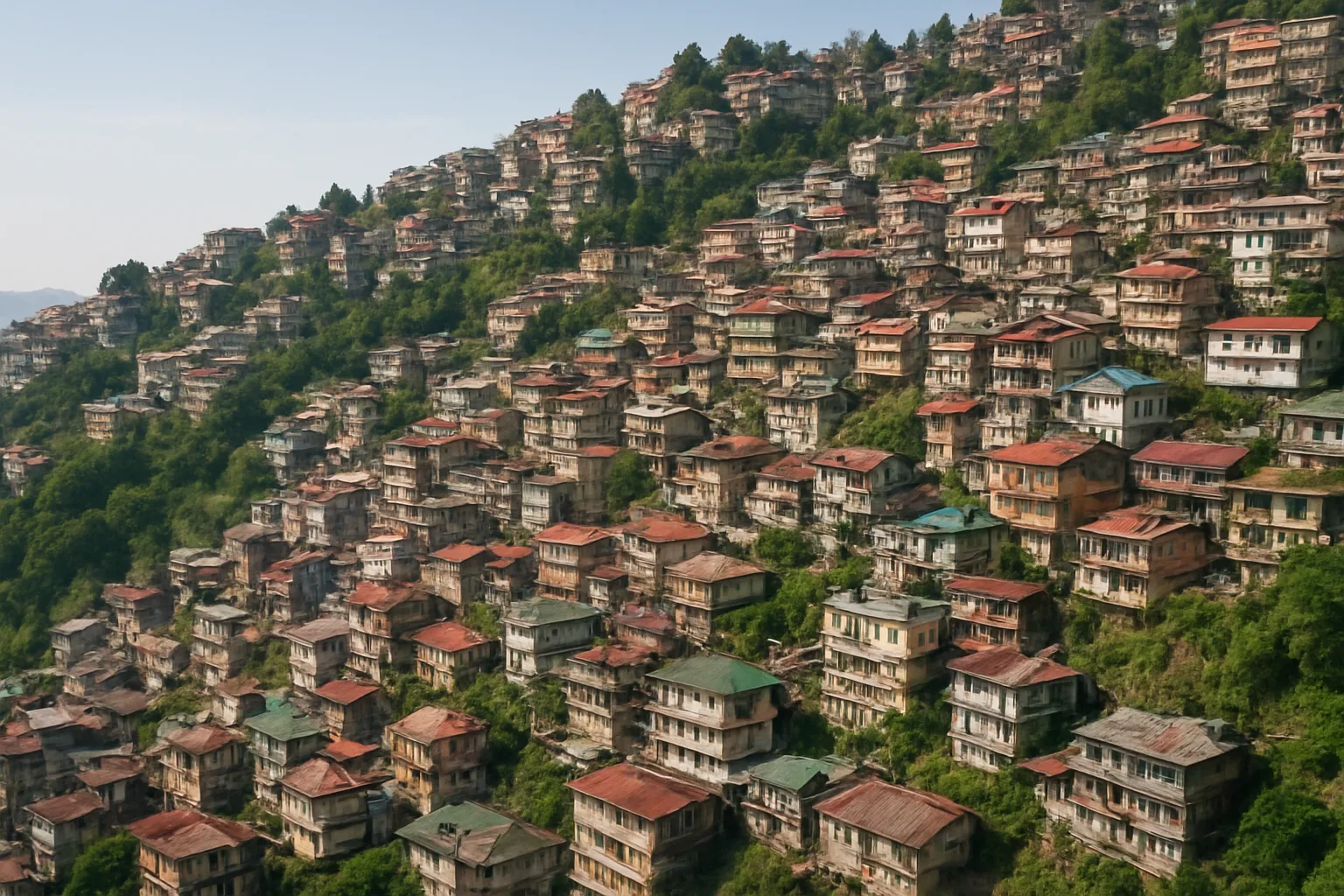
Urban planning struggled to keep pace. The city’s hilly terrain constrained expansion, forcing new housing into steep, landslide-prone slopes. Water scarcity, traffic congestion, and periodic outbreaks of disease revealed the limits of colonial-era infrastructure. Successive municipal governments attempted to regulate building activity and expand services, but population pressure continued to test Shimla’s resilience.
Modern Expansion and Environmental Challenges
By the late 20th century, Shimla’s population had surpassed 100,000, with the 2011 Census recording nearly 170,000 residents in the urban agglomeration. The city’s physical footprint expanded along the winding ridges and valleys, swallowing outlying villages and forests. Multi-storey concrete buildings replaced many of the old timber-and-stone structures, while new roads and flyovers cut through slopes once considered too unstable for development.
Environmental concerns grew acute. Chronic water shortages—exacerbated by climate change and deforestation—became a perennial feature of urban life, particularly during the summer tourist season. Landslides, often triggered by unregulated construction, periodically disrupted neighborhoods and threatened lives. Civic debates over the city’s carrying capacity, ecological balance, and heritage conservation became central to Shimla’s self-understanding in the 21st century.
Continuity and Identity Amidst Change
Despite these pressures, Shimla retains a distinctive sense of place, shaped by the echoes of its colonial past, the persistence of neighborhood identities, and the mingling of cultures old and new. The annual processions at Jakhu temple, the Friday prayers at the Ridge mosque, and the gentle bustle of the Lakkar Bazaar all speak to the city’s ongoing negotiation between continuity and transformation.
Today, Shimla stands as both a symbol and a laboratory of hill urbanization in the Indian Himalayas—a city where population pressure and environmental limits prompt difficult questions about the future, even as the old rhythms of bazaar and festival endure in the shadow of modernity. As this series continues, we will move from the streets and neighborhoods of Shimla to the institutions and policies that have shaped its evolution, exploring the governance, planning, and civic struggles that define its contemporary life.
Previous: Shimla as the Capital of Himachal Pradesh
Next: Challenges of Infrastructure in a Hill Capital