
Series: History of Kangra, Himachal Pradesh, India
Phase 4: British Period — Part 19 of 30
This article is part of a wider series tracing the transformation of the western Himalayas under colonial influence. As British authority extended into the hills, existing political systems were restructured through treaties, administration, and new forms of governance. This phase considers how colonial rule reshaped society, economy, and space while leaving lasting imprints on local identity.
An Early Morning in Colonial Kangra
The foothills of the Dhauladhar range lay shrouded in mist as the year 1856 dawned over the valleys of Kangra. The air was thick with whispers—of new rulers, changing customs, and the slow, unfamiliar echo of English lessons drifting through temple courtyards. The British had entrenched themselves in the region only decades before, but already, the patterns of daily life were shifting with a quiet, inexorable force.
From Ancient Traditions to Colonial Realities
Kangra’s history is layered: oral traditions celebrate its ancient hill chieftains and temples, while early chronicles—like the imperial Gazetteers of the Punjab Hill States—record a region fiercely independent, steeped in ritual, and defined by its rugged terrain. Before the British arrival in the early 19th century, Kangra’s society revolved around kinship ties, village councils, and the rhythms of agricultural life. Education was informal, often bound to the oral transmission of knowledge in family lineages, priestly classes, or Buddhist monastic circles northward.
The Gurkha occupation (1806–1809) and subsequent annexation by the East India Company in 1846 marked a watershed. The region was drawn, sometimes unwillingly, into the administrative and ideological orbit of the British Raj. This moment set the stage for profound changes—especially in the social and educational landscape—that would ripple through Kangra for generations.
Communities, Custom, and the British Gaze
Kangra’s population in the mid-1800s comprised Rajput landholders, Brahmin priests, artisan castes (such as the Chamaars and Tarkhans), and a scattering of traders and pastoralists. Each community held tightly to inherited customs, with religious rituals and oral epics shaping village identity. The British, however, arrived with an outsider’s curiosity and a bureaucrat’s need to classify. Early district reports make clear their intent: to map, categorize, and, ultimately, reform local society.
While many British officials admired Kangra’s temples and scenic grandeur, they also saw its customs—especially regarding women, education, and caste—as points for “improvement.” Missionaries arrived, too, offering a new creed and an alternative to traditional learning. Yet, in these early years, most Kangri families remained wary, reluctant to send their children to foreign-run schools or to challenge the authority of local panchayats (village councils).
The First Schools: Experiment and Encounter
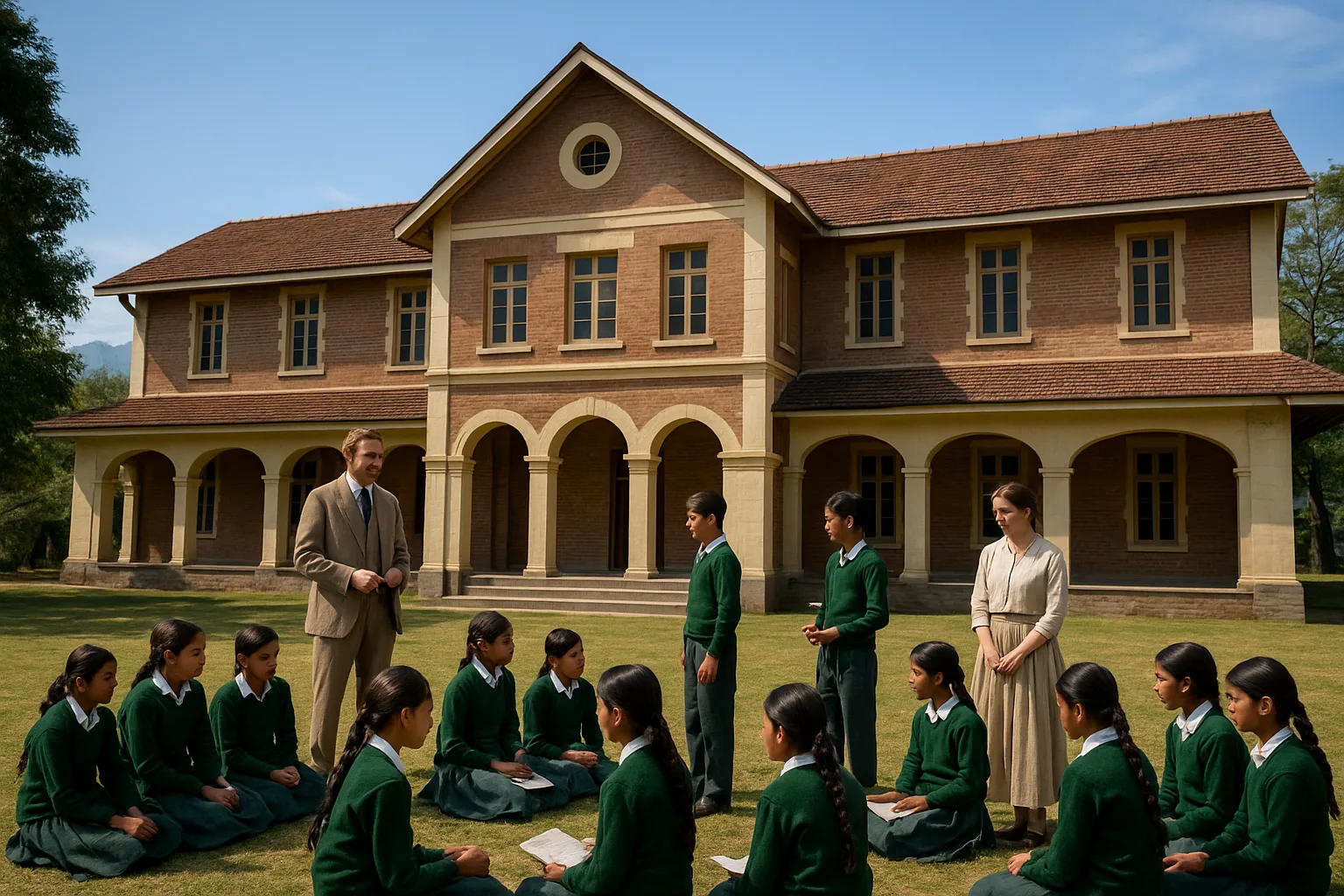
The introduction of Western-style education in Kangra was cautious, uneven, and at first deeply contested. The earliest schools, founded in the 1850s and 1860s, were limited to the district headquarters and a handful of larger towns such as Dharamshala and Palampur. These institutions taught reading, arithmetic, and—most controversially—the English language. The curriculum, modeled on the schools of Lahore and Calcutta, often seemed alien to both students and their parents.
Official records detail the skepticism of Kangra’s elders, who feared that English education would estrange the young from ancestral faith and duty. Yet a few families, especially among the Rajputs and trading castes, sent sons to these new institutions, enticed by the prospect of employment in the colonial bureaucracy. For the first time, social mobility was tied not to lineage or landholding alone, but to a mastery of unfamiliar books and rules.
Women, Caste, and the Question of Access
The social reforms championed by the British—abolition of sati, legal protection for widows, and a nominal push for girls’ education—arrived in Kangra slowly, filtered through layers of tradition and resistance. While the colonial administration established a handful of girls’ primary schools by the late 19th century, societal change lagged behind policy. Most girls continued to learn at home, if at all, their education limited to domestic skills and religious instruction.
Caste also shaped the new educational order. Although British administrators called for “universal” education, in practice, lower-caste children often faced exclusion or ridicule in the earliest government schools. Some missionary schools offered an alternative, but at the cost of conversion—a dilemma that fractured families and communities. Oral histories from Kangra’s villages recall these tensions, as some parents saw opportunity while others clung to custom.
Hill States, Trade, and the Modern World
The British period saw a reconfiguration of Kangra’s ancient hill states. Princely families, once rulers of independent fiefdoms, now found themselves minor landlords, their authority circumscribed by colonial law. Trade routes, once vital arteries for salt, grain, and wool between Tibet, Punjab, and the plains, were redirected or taxed under British oversight. The newly educated elite—products of government schools—began to staff courts, offices, and police posts, bridging the old world and the new.
This era also saw the rise of print culture. Local presses published tracts in Hindi, Urdu, and Gurmukhi, carrying news and ideas beyond the reach of oral tradition. The first local newspapers appeared in the early 20th century, their pages filled with debates over reform, identity, and the future of Himachal’s hill peoples. Through these channels, the seeds of modernity—skepticism, aspiration, dissent—took root in Kangra’s soil.
Memory, Identity, and the Living Past
Today, traces of this colonial transformation persist in Kangra’s landscape: in schoolyards echoing with morning prayers, in the persistence of caste and kinship, and in the tension between tradition and change. The British period did not simply replace the old order; it layered new institutions and values atop centuries of myth, memory, and local resilience. Villages that once gathered around temple courtyards now send children to government schools, yet their festivals, beliefs, and stories remain rooted in a much older world.
As we follow the story through the tumultuous decades of the 20th century, the next chapter in our series will trace how Kangra’s people responded to the call of independence, and how the legacy of colonial education shaped new visions of freedom and self-rule.
Previous: The 1905 Kangra Earthquake
Next: Freedom Movement in Kangra