
Series: History of Una, Himachal Pradesh, India
Phase 4: British Period — Part 19 of 30
This article is part of a wider series tracing the transformation of the western Himalayas under colonial influence. As British authority extended into the hills, existing political systems were restructured through treaties, administration, and new forms of governance. This phase considers how colonial rule reshaped society, economy, and space while leaving lasting imprints on local identity.
A School Bell Rings in Una
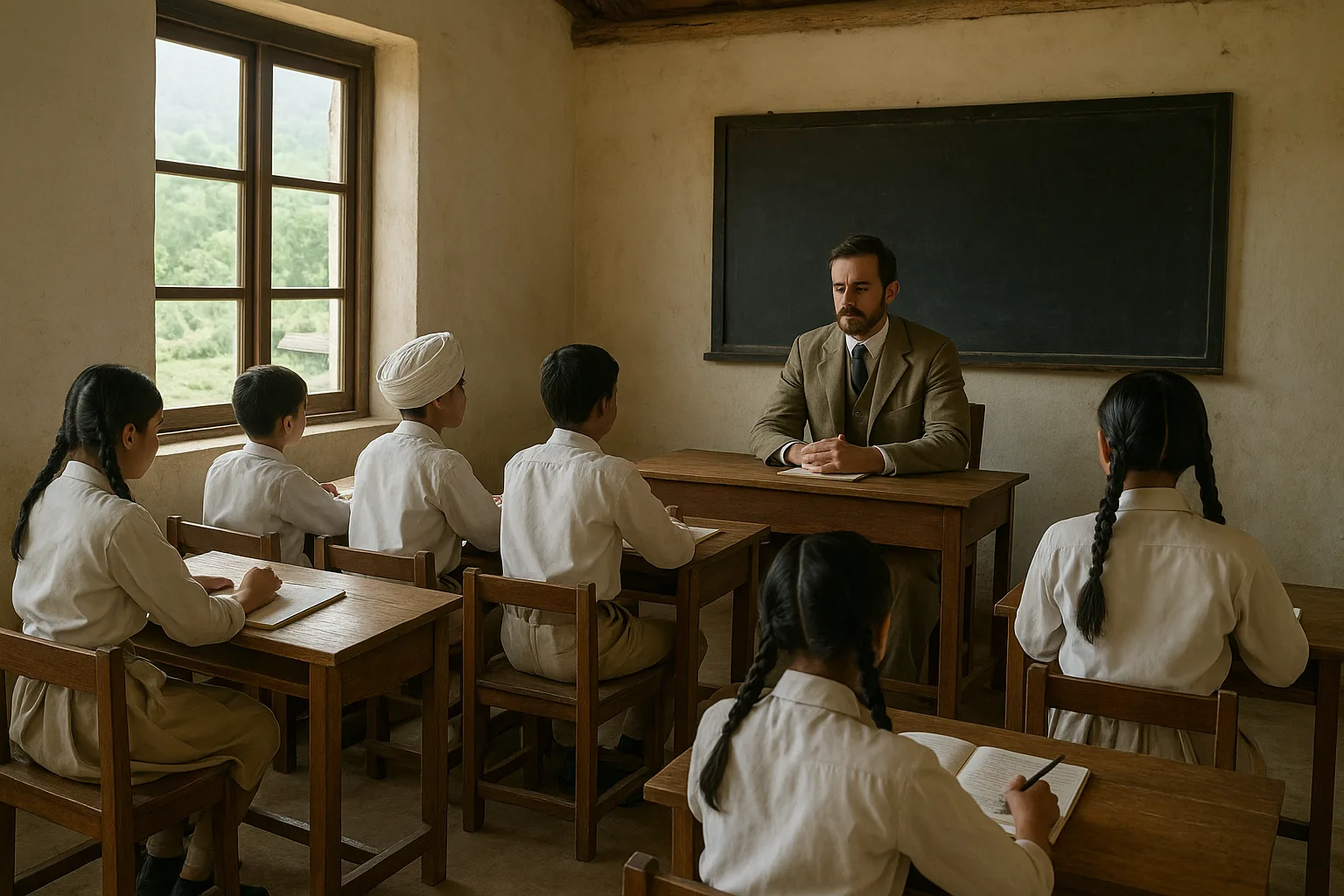
On a cool morning in the late 1860s, the first clear ring of a school bell echoed through the narrow lanes of Una. Children—some barefoot, others in threadbare tunics—gathered before a low-roofed building, faces shining with anticipation and apprehension. For centuries, learning here followed patterns set by tradition: knowledge passed quietly from elders, or taught in the corners of temples and private homes. But this was different. British officials and Indian reformers had joined hands to open the first government-aided school in Una, a symbol of change that would ripple through the region for generations.
Colonial Footprints: The Arrival of British Rule
When Una and the surrounding hills came under the expanding control of the British East India Company in the early 19th century, the region’s rhythms began to shift. For generations, education was limited to the privileged, with rare exceptions among the merchant and priestly classes. The colonial administration, in their drive for order and revenue, established new systems of governance that unsettled the old hierarchies. But perhaps the most radical change came quietly, in ink and chalk, as the British promoted new forms of education and social reform.
Missionaries from the plains, especially from Punjab and Delhi, began to visit Una by the 1840s, drawn by the area’s reputation for learning and its strategic location near the new roads and railways that British engineers were carving through the hills. Their arrival was met with suspicion—and sometimes outright hostility—from both local rulers and villagers, who feared the erosion of tradition. Yet, curiosity proved difficult to contain.
Opening the Classroom Doors
In 1854, the Wood’s Despatch—the British government’s blueprint for education in India—reached the hill stations and valleys of Himachal. Its call for state-sponsored education, teacher training, and curriculum reform gradually filtered into Una. By the 1860s, the first primary schools were established here, often in borrowed rooms of temples or dharamshalas before moving to their own humble buildings.
For many in Una, the new schools promised more than literacy. They offered a bridge to employment in the growing colonial bureaucracy—the offices, railways, and courts that now dotted the region. Children of shopkeepers, artisans, and even some farmers began to attend, sitting side by side on rough-hewn benches. Textbooks, printed in Urdu, Persian, and later, Hindi and English, introduced new worlds: arithmetic, geography, and the laws of the empire.
Education for girls was a more delicate matter. Social norms dictated that girls rarely left their homes for formal study. Yet, in the 1880s, a handful of missionary and government schools began to admit girls, leading to quiet but significant change in the decades to come.
Seeds of Reform: New Ideas in Old Soil
As the decades passed, the educational transformation in Una did not remain confined to the classroom. Exposure to new texts and teachers sparked debates about caste, gender, and custom. Reformers—some inspired by the Brahmo Samaj and Arya Samaj movements, others by local traditions of justice—began to question child marriage, dowry, and untouchability.
One early reformer, Pandit Ram Narayan, a teacher in the Una bazaar school, became known for his impassioned lectures on the importance of female education and social equality. His efforts, though resisted by some elders, found supporters among younger generations who saw education as a ladder to dignity and self-reliance.
By the turn of the 20th century, Una’s schools became informal centers of debate. Young men, influenced by reformist journals and the growing nationalist movement, discussed not only the wisdom of the Vedas but also the rights of women and the need for social mobility. The walls of the town’s first high school, built in 1902 with both British and local funds, echoed with these new arguments.
The Challenge of Identity: Tradition vs. Modernity
Not all welcomed these changes. Village councils and religious leaders sometimes pushed back, warning that Western education would breed disrespect and undermine established authority. Fears of conversion—stoked by the presence of Christian missionaries—added to the tensions.
Still, the tide was difficult to turn. The British administration, eager to create a class of clerks and intermediaries, offered scholarships and jobs to those who completed their schooling. Over time, even skeptical families began to see the practical value of sending children to school, if only for a few years.
This uneasy dance between tradition and modernity played out in countless homes and gatherings. Some youths, emboldened by their studies, joined reformist societies or even traveled to Lahore and Delhi to participate in larger debates about India’s future. Letters and newspapers—circulating thanks to new postal routes—connected Una to the intellectual ferment of the wider world.
Women Step Forward
The quietest yet most profound revolution unfolded in the lives of Una’s women. By the 1910s, a handful of educated women emerged as teachers and nurses, serving as role models in their communities. Prominent among them was Shakuntala Devi, whose work at the Una Girls’ School inspired a generation of girls to pursue learning despite social obstacles.
Education opened new possibilities: the chance to read, to write letters, to earn a living, or simply to make informed choices about marriage and family. Although progress was slow—many girls still left school after a few years, and higher education remained rare—these early gains planted seeds that would flourish after independence.
Social reform, too, gained a female face. Women’s groups, sometimes supported by local wives of British officials, organized literacy drives and health campaigns. The annual gatherings at Una’s town hall, where educated women spoke on issues from hygiene to the perils of child marriage, became a fixture by the 1930s.
Nationalism and the Education Movement
As the independence movement swept across India, the schools of Una became crucibles of political awakening. Teachers and students read newspapers reporting strikes in Calcutta, protests in Lahore, and the speeches of Gandhi and Nehru. In the 1920s and 1930s, the call for Swadeshi and boycott of British goods reached even these foothills.
Several Una teachers, including the respected Master Mangal Singh, risked their jobs by organizing meetings and distributing pamphlets calling for self-rule. The British authorities, wary of unrest, kept a close eye on these activities but could not silence the growing sense of purpose among the educated youth.
Education became both a tool of colonial control and a weapon of resistance. While British-designed curricula emphasized loyalty to the empire, Indian teachers and reformers used the same classrooms to foster critical thinking and pride in local traditions.
Aftermath: The Enduring Legacy in Una
By the time the British departed in 1947, Una had been transformed in ways that would have astonished an earlier generation. Literacy rates, though still modest, had climbed steadily. A network of primary and secondary schools, some founded by reformers and others by the state, now dotted the landscape. The children of farmers, traders, and artisans sat together, learning not only to read and write but to imagine futures once closed to them.
The reforms born in the colonial era—debates over caste, the slow but steady progress of girls’ education, the rise of new professions—did not vanish after independence. Instead, they formed the backbone of Una’s post-1947 development. The tensions between old and new, between faith and reason, continue to shape community life today.
Walking through Una’s bustling markets or past its modern schools, it is still possible to hear echoes of those first lessons under British rule. The questions once whispered in the corners of village schools—about justice, equality, and the value of learning—have become part of the town’s identity. Education, reform, and the courage to change remain at the heart of Una’s story, a legacy that guides its path into the future.
Previous: Impact of Railways and Roads on Una’s Economy
Next: Una’s Contribution to India’s Freedom Movement