
Series: History of Kullu, Himachal Pradesh, India
Phase 3: Religion & Culture — Part 15 of 30
This article belongs to a historical series examining how expanding empires and regional powers reshaped life in the western Himalayan hills. As external influences pressed into the mountains, local rulers navigated diplomacy, resistance, and accommodation. This phase explores how wider political currents intersected with entrenched hill traditions, altering governance without entirely displacing older structures.
Echoes from the Valley: Kullu at First Light
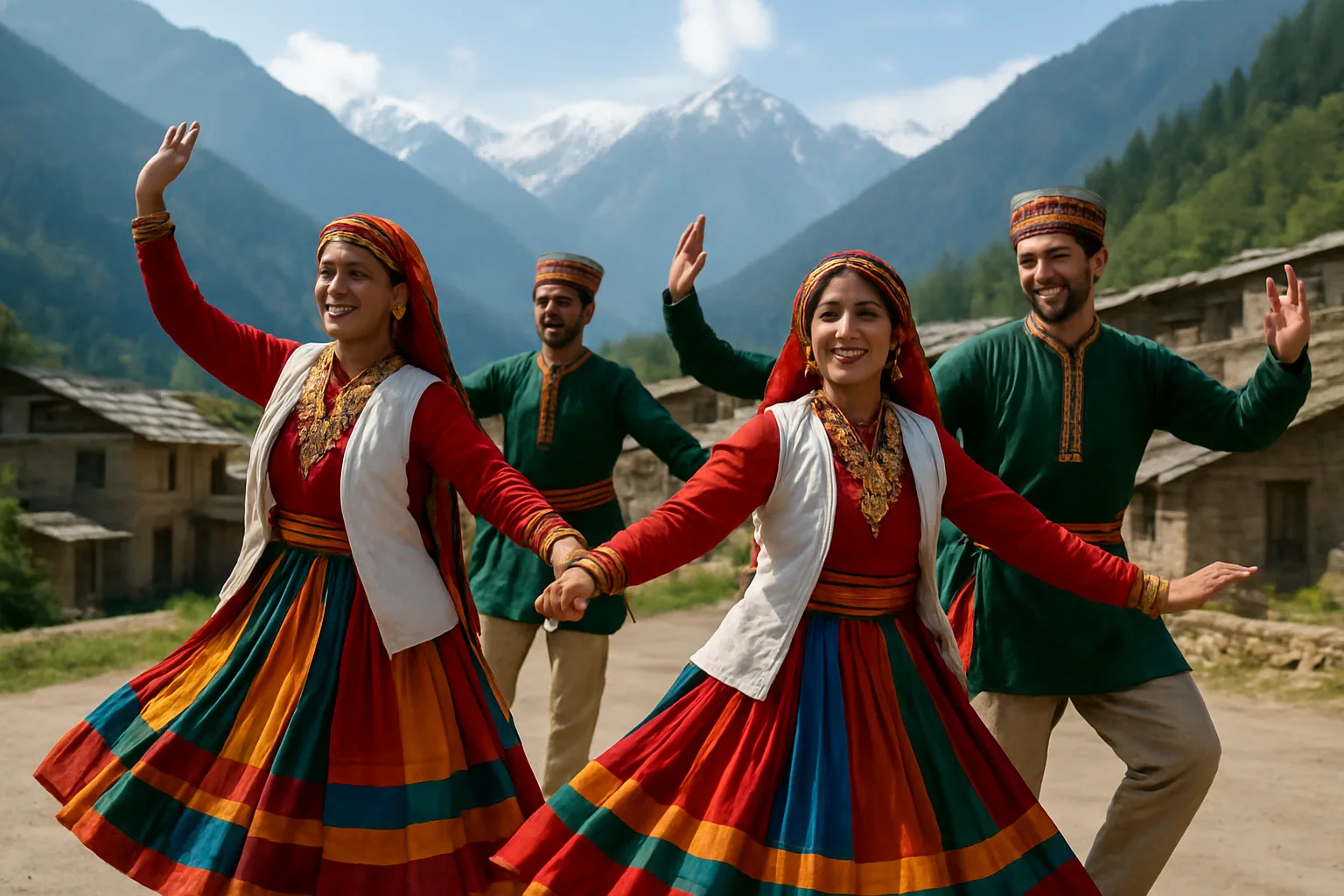
The sky above the Kullu valley blushes gently as dawn breaks, casting a pale light across the apple orchards and terraced fields. From a distance, the sound of the dhol rises—a steady, ancient heartbeat that has summoned villagers for generations. In the crisp air, voices join in song, and a circle of dancers step out, their movements both ritual and celebration. For as long as memory stretches, music and dance have been more than entertainment in Kullu: they are living expressions of identity, faith, and belonging, echoing down from a time when these valleys were first settled.
Land of Myth and Memory: Early Communities and Belief Systems
Kullu’s people trace their roots to a tapestry of migrations and conquests, woven across centuries. Early chronicles, such as the Kullu Gazetteer of 1917, describe a land once called Kulanthapitha—the ‘end of the habitable world’. Oral traditions, shaped by the river Beas and rimmed by snow-peaks, tell of sages and gods who walked these hills. Yet beneath the mythology, archaeology and historical inference suggest a region shaped by small, kin-based communities, their livelihoods entwined with the rhythms of nature.
Long before written records, the valley’s inhabitants marked the seasons with festival and song. Animistic beliefs, later entwined with Hindu practices, pervaded daily life; the gods of Kullu—each village with its own deity—were honored in communal gatherings, their stories preserved in song and performed with dance. The oral tradition served as both memory and law, carrying forward histories of migration, conflict, and alliance.
Trade Routes, Hill States, and the Flow of Culture
From the early centuries CE, Kullu’s strategic position along Himalayan trade routes brought not only merchants but music, instruments, and new customs. While the valley was relatively isolated, passes like Rohtang and Jalori linked it to Tibet, Ladakh, and the plains of Punjab. Through these corridors, Buddhist chants mingled with Vedic hymns, and the folk traditions of Kullu absorbed new rhythms and instruments.
The rise of hill states, beginning with the legendary Raja Bahadur Singh in the 16th century, brought greater political coherence and, with it, royal patronage of the arts. Yet the core of Kullu’s cultural identity remained defiantly local. Court musicians played alongside village gosains and jagaris, whose ballads chronicled the deeds of gods and heroes, blending fact and legend into a shared public memory.
Oral Traditions and the Power of Story
In Kullu, the dividing line between myth and history blurs with each performance. The Jagars, ritual ballads performed during village festivals, recount tales of deities like Raghunathji and Hadimba. These performances are not mere relics of the past—they are legal, spiritual, and social acts, settling disputes, invoking blessings, and transmitting collective memory.
Unlike written chronicles, these oral traditions adapt with each telling. A Jagari might add local events or reinterpret old tales to speak to new circumstances. The music itself, led by the dholak, nagada, and flute, is inseparable from the dance: men and women, young and old, move in prescribed patterns, reinforcing social bonds and village hierarchies.
Diverse Communities, Shared Festivals
Over the centuries, Kullu became home to a mosaic of communities—Rajputs, Brahmins, Kanets, Gaddis, and more. Each group brought its own melodies and steps, but it was in the great festivals, like Dussehra, that the valley’s cultural synthesis became most vivid. During these gatherings, village gods are borne in procession, accompanied by musicians and dancers from every corner of the district.
The Kullu Dussehra, documented by British administrators and regional chroniclers alike, transforms the valley into a stage. Over a hundred deities descend to the Dhalpur Maidan, their retinues singing, drumming, and dancing. Here, the sacred and the secular, the ancient and the new, intermingle in a single, overwhelming spectacle—a living archive of the region’s history and identity.
From Ritual to Performance: Evolution of Folk Music and Dance
As colonial rule and later, post-independence India, brought change to the hills, Kullu’s music and dance adapted. Village troupes began to perform for tourists, and once-private rituals moved onto public stages. Yet, even as new genres and instruments entered the repertoire, the heart of Kullu’s tradition endured: music and dance as acts of remembrance, community, and devotion.
Historical records from the late 19th and early 20th centuries speak of the Phagli and Lahauli dances, each with distinct costumes and rhythms, performed at harvest or in honor of local gods. The Chohra dance, with its intricate footwork and striking headgear, still marks the coming of spring in many villages. In these forms, one can trace both the endurance of ancient patterns and the gentle absorption of outside influences.
Living Heritage: Kullu’s Cultural Identity Today
In the present, the valleys and villages of Kullu remain alive with the sound of folk music and the swirl of dance. For many, these traditions are not simply performances but a connection to ancestors, land, and faith. Local schools teach children the songs of their grandparents; at weddings and festivals, the old instruments are dusted off, and the community gathers as it always has.
The threads of Kullu’s history—migration, belief, trade, and adaptation—are woven into every melody and movement. The region’s folk arts continue to shape its sense of self, bridging past and present in a world that is changing faster than ever before. As we move forward in this series, the next chapter will trace how Kullu’s sacred spaces and temple architecture reflect the same enduring interplay between tradition and transformation, offering further insight into the valley’s unique cultural legacy.
Previous: Temples, Rituals, and Faith in Traditional Kullu Society
Next: British Entry into the Kullu Valley