
Series: History of Una, Himachal Pradesh, India
Phase 3: Sikh Period — Part 15 of 30
This article belongs to a historical series examining how expanding empires and regional powers reshaped life in the western Himalayan hills. As external influences pressed into the mountains, local rulers navigated diplomacy, resistance, and accommodation. This phase explores how wider political currents intersected with entrenched hill traditions, altering governance without entirely displacing older structures.
Twilight in the Hills: A Scene from Una’s Past
The autumn air in Una was heavy with uncertainty. In the narrow lanes of the town, rumors traveled faster than the Sutlej’s current—tales of distant battles, broken alliances, and foreign uniforms glimpsed at the horizon. It was the early 1840s, and the Sikh authorities who once commanded respect in the Punjab hills now seemed hesitant, their banners faded, their commands questioned. Local elders recalled the confident stride of Sikh governors, but now, even they spoke in hushed tones, watching the changing world with apprehension.
The Sikh Empire’s Northward Reach
To understand Una’s crossroads, we must first revisit the ambitions of Maharaja Ranjit Singh. After consolidating a vast Sikh Empire, Ranjit Singh’s commanders began extending their influence into the lower hills, including present-day Una. The region, rich in trade and strategically perched along the Punjab-Himachal border, became a coveted prize. Sikh garrisons established outposts, levied taxes, and enforced their codes in alliance—and sometimes in rivalry—with local Rajput chieftains.
For the people of Una, this era brought both stability and new tensions. Sikh administration often respected established customs, but the shadow of Lahore’s court loomed large. The revenue collectors, known as kardars, became familiar figures, and the imposing presence of Sikh cavalry in the markets was a daily reminder of distant authority. Yet, beneath this surface, old alliances with Kangra and Bilaspur simmered, and memories of Mughal and Gorkha incursions lingered in local consciousness.
Cracks in the Empire: Ranjit Singh’s Death and Aftermath
In 1839, the death of Maharaja Ranjit Singh unleashed a storm across the Sikh dominions. Succession disputes and palace intrigues sapped the strength of Lahore. Governors in the hills, including those stationed in Una, found their support wavering. The once-disciplined Sikh armies grew restless, and power struggles between influential families—such as the Dogras and Sandhawalias—cast a long shadow even in remote districts.
The local population felt this unrest acutely. Reports of banditry increased, and tax demands grew erratic as officials scrambled to assert control. Some village headmen in Una quietly renewed ties with older regional powers, hedging their bets as the Sikh grip loosened. For the first time in a generation, the future of the region hung in the balance.
The British Approach: New Forces at the Border
While the Sikh Empire faltered, the British East India Company’s gaze fixed steadily northward. The Company’s administrators, well aware of the hills’ strategic value, initiated negotiations and intelligence-gathering missions. By 1845, British agents were present in neighboring hill states, offering protection and forging alliances with local rulers wary of Sikh instability.
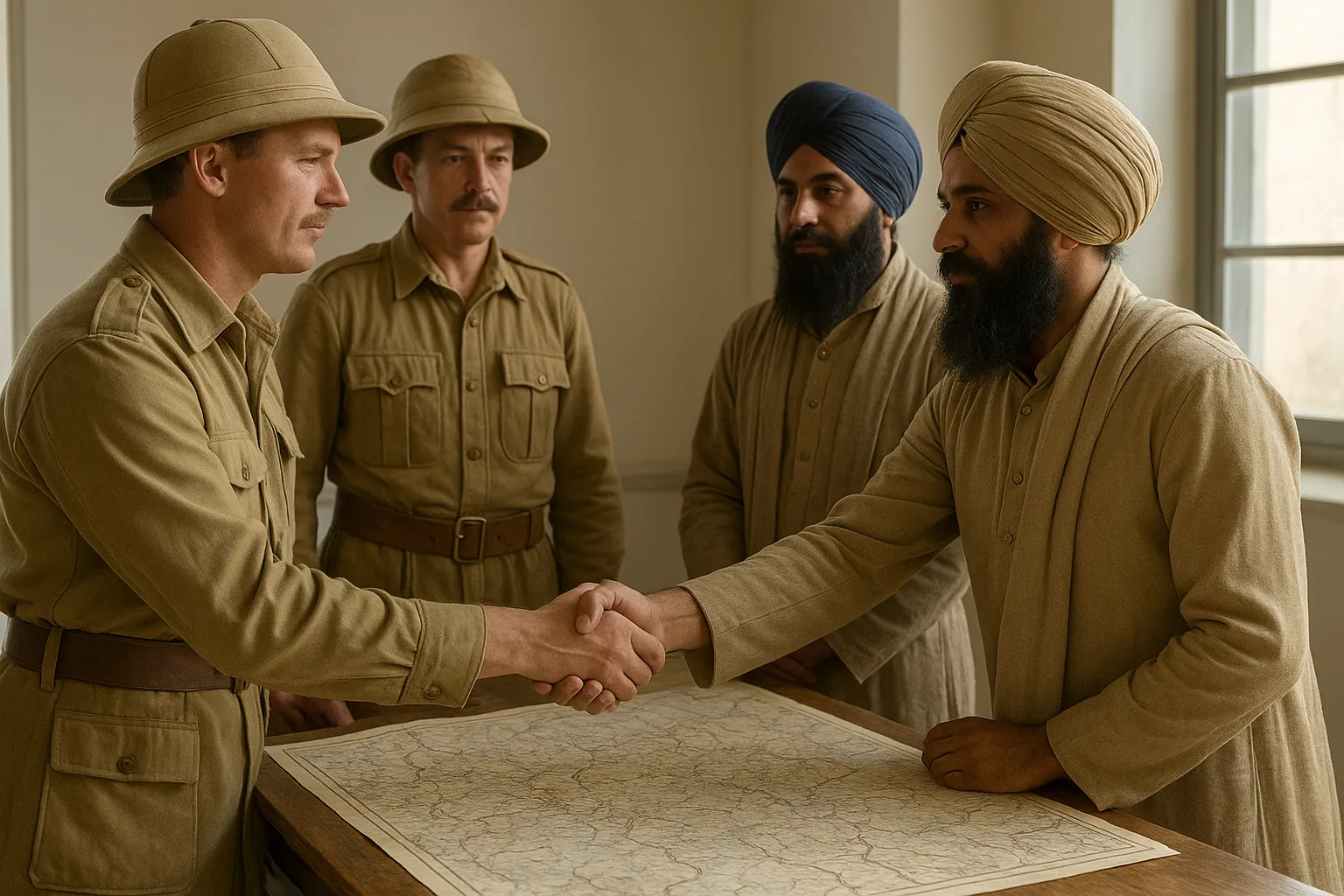
In Una, word spread of British officers in crisp uniforms, speaking unfamiliar tongues and offering silver for loyalty. Some Sikh officers, disheartened by Lahore’s chaos, began informal dialogues with these newcomers. Others clung to their posts, determined to hold back the tide. But the steady advance of British troops across the Sutlej, culminating in the First Anglo-Sikh War (1845–46), made change seem inevitable.
The First Anglo-Sikh War: Una in the Crosshairs
The winter of 1845–46 brought violence and uncertainty. As British and Sikh armies clashed near Ferozeshah and Sobraon, tremors reached Una. Supplies were requisitioned, young men conscripted, and fields left fallow. The Sikh garrison in Una, caught between orders from Lahore and local anxieties, grew wary. The outcome of the war would decide not just the fate of the Sikh Empire, but also the future of every village in the borderlands.
When news of the Sikh defeat and the Treaty of Lahore reached Una, it was met with a mix of relief and dread. The British had promised order, but their reputation for exacting administration—and the unknowns of imperial rule—brought new fears. Some local chieftains welcomed the end of Sikh unpredictability; others mourned the loss of familiar rulers.
The Treaty of Lahore and Annexation of the Hills
The 1846 Treaty of Lahore marked not just the end of Sikh sovereignty but the formal beginning of British control in the hills. While many areas were transferred to the newly created princely state of Jammu and Kashmir, and others to British direct administration, Una found itself under a new regime. The East India Company’s officials, experienced in the delicate art of subjugating frontier regions, moved quickly to establish their authority.
The Company introduced new taxation systems, legal codes, and policing methods. For the farmers and traders of Una, the changes were immediate: grain prices, land records, and even the language of administration shifted. British officials, often aloof and pragmatic, took a keen interest in the region’s resources and its strategic roads, laying the groundwork for future railways and telegraph lines.
Some Sikh officers were retained in administrative roles, but most faded quietly into the background. The era of Sikh banners flying over Una’s forts was over; the Union Jack now fluttered in their place.
Resistance and Adaptation: Local Responses to Imperial Rule
The transition was not smooth. In the years following annexation, small-scale protests and acts of resistance broke out. Traditional leaders, both Rajput and Sikh, sometimes challenged new land settlements or taxation. British administrators responded with a mix of conciliation and force, deploying police detachments and promising reforms to win local support.
Yet, as years passed, many in Una adapted to the new order. Schools teaching English and Hindi opened; merchants found new markets for their goods; and some landowners prospered under the rationalized revenue system. The memory of Sikh rule lingered in folk songs and stories, but for a new generation, the British became the arbiters of fortune and law.
The Legacy of Transition: Una’s Modern Identity
The events of the 1840s and 1850s forever altered Una’s trajectory. The Sikh period—marked by both stability and upheaval—gave way to the relentless efficiency of British administration. Yet, even as imperial structures took root, the region’s people retained their sense of resilience and complexity.
Today, traces of this era can still be found: in the remnants of old Sikh outposts, the colonial-era schools, and the region’s distinctive blend of Punjabi and Pahari culture. The story of Una’s transition from Sikh to British rule is not merely one of conquest and loss, but of adaptation, memory, and the enduring capacity of a community to navigate the tides of history.
As we walk Una’s lanes today, we carry the echoes of those uncertain autumns—reminders that every generation, in its own way, must face the crossroads of change and decide how to shape its future.
Previous: Life of Ordinary People in Sikh-Era Una
Next: British Annexation of Una and Surrounding Areas