
Series: History of Kullu, Himachal Pradesh, India
Phase 3: Religion & Culture — Part 14 of 30
This article belongs to a historical series examining how expanding empires and regional powers reshaped life in the western Himalayan hills. As external influences pressed into the mountains, local rulers navigated diplomacy, resistance, and accommodation. This phase explores how wider political currents intersected with entrenched hill traditions, altering governance without entirely displacing older structures.
Before the Gods Arrived: Kullu’s Sacred Landscape
Mist clings to the deodar forests above the Beas River, where a faint drumbeat echoes through the dawn. Even now, in the quiet moments before sunrise, the soul of Kullu stirs—a place where faith and geography have forever been intertwined. Long before the carved temple spires pierced the sky, these valleys were already hallowed ground. The earliest inhabitants, their names lost to time, watched the river’s moods and the changing shadows on the mountaintops, sensing a spirit in every stone and stream.
Archaeological traces and oral memory indicate that by the first millennium BCE, small tribal settlements had begun to form along Kullu’s riverbanks. These early societies—possibly ancestors of today’s Kanets, Brahmins, and Rajputs—wove together animist beliefs with the rhythms of agriculture. The land itself became a living shrine. The mountains protected, but also demanded respect. This was a world where ritual and survival were inseparable.
Myth, Memory, and Early Kingship
For the people of Kullu, mythology was never mere story—it was social memory, encoded in verse and song. The folk epic of Raja Bahadur Singh, for example, preserves echoes of the region’s early rulers. Yet, separating historical fact from poetic tradition is a task for careful hands. Early gazetteers and travel accounts record that by the 6th or 7th century CE, local chieftaincies had already emerged, many claiming descent from divine or semi-divine forebears. The Mahabharata’s shadow falls here as well: Kullu’s oral traditions sometimes link its ancient kings to the Pandavas, blending pan-Indian myth with local identity.
Political history becomes clearer with the advent of written chronicles in the medieval period, but Kullu’s core remained spiritual. The authority of its rajas was always underpinned by ritual legitimacy and proximity to the gods. To rule in Kullu was to act as custodian of the divine order.
The Emergence of Temples: Stone, Wood, and Legend
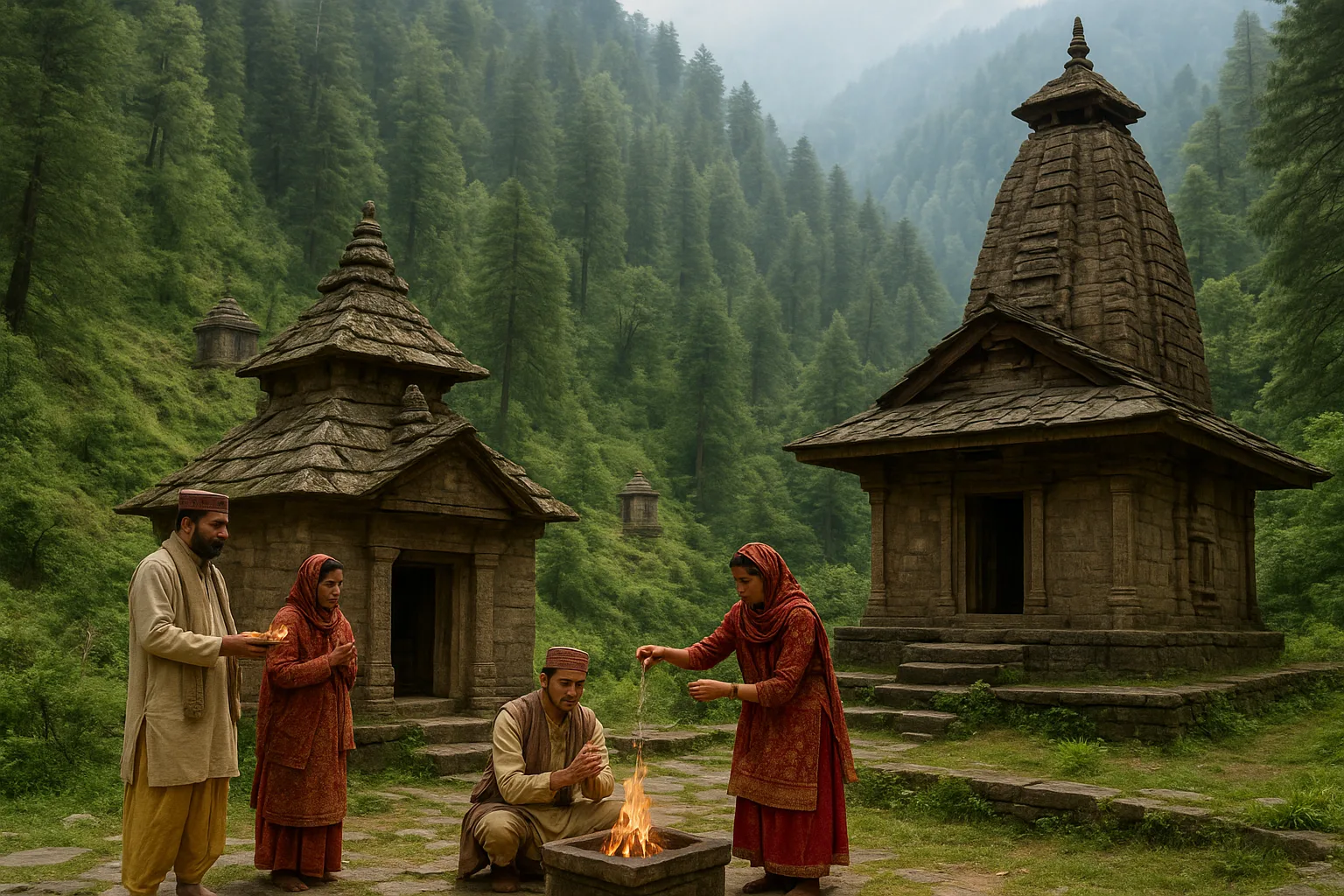
Temples arose gradually, first as humble shrines and later as magnificent wooden structures. By the 8th–10th centuries, as trade routes from Tibet, Ladakh, and the Indian plains crossed the region, Kullu became a vibrant crossroads. New ideas arrived with merchants and monks, yet the valley’s own traditions held strong. The famous Hadimba Devi temple—its architecture a blend of local woodcraft and Himalayan design—anchors one of the oldest ritual centers. Oral tradition claims it was established by the Pandavas themselves, though historical inference suggests a later date, likely early medieval.
Other temples, such as those dedicated to Raghunathji or Jamlu Rishi, showcase the syncretism unique to Kullu: here, local deities coexist alongside pan-Indian gods. The annual processions, or jagars, reveal a living pantheon whose roots stretch deep before the written record. Each village preserves its own guardian spirit, blending Vedic, Buddhist, and indigenous beliefs in a tapestry of faith.
Ritual and Society: The Pulse of the Valley
Rituals shaped daily life as much as the seasons or the harvest. From birth to death, every milestone was marked with prayer, music, and offering. The devta system—the worship of local deities embodied in ornate palanquins—emerged as the central organizing force. Priests and oracles, chosen through hereditary lines or trance, mediated between villagers and their gods. Sacred festivals, whether for Shiva, Hadimba, or local spirits, brought entire communities together in cycles of renewal and reconciliation.
These traditions were not static. The arrival of itinerant yogis, Buddhist monks, and later, Sikh and Islamic influences, left subtle marks on ritual practice. Yet, the valley’s own spiritual grammar remained resilient, adapting rather than simply absorbing these new currents.
Trade, Pilgrimage, and the Wider World
Kullu’s mountains were never impenetrable. Ancient trade routes wound through the Rohtang and Jalori passes, linking Kullu to Spiti, Lahaul, and beyond. Pilgrims and merchants from India, Tibet, and Central Asia brought goods, stories, and new religious currents. The region’s temples doubled as both spiritual and commercial hubs—safe havens for travelers and sites of economic exchange.
Historical records from the Mughal and later the Sikh periods reveal Kullu’s rajas leveraging these networks to enhance their own prestige. Patronage of temples and festivals was both a statement of faith and a practical tool of diplomacy. The annual Kullu Dussehra, still celebrated today, traces its origins to these centuries, when religion, trade, and politics moved together in festival procession.
The Interplay of Faith and Power: Hill States and Devta Authority
By the late medieval period, Kullu had crystallized into a recognized hill state, its rulers balancing autonomy with alliances to larger empires. Yet even in the court, the devtas held sway. Decisions of state were often ratified in the presence of temple idols; disputes between villages were settled through ritual arbitration, not just royal edict. The figure of the gur—the medium of the god—became as influential as any minister.
Regional gazetteers of the British period note the remarkable continuity of these systems, even as colonial rule brought new administrative structures. The resilience of Kullu’s religious institutions, and their ability to adapt, is a testament to the deep roots laid over centuries.
Enduring Faith: Echoes in Modern Kullu
Step into a Kullu village today and the pulse of ancient belief is unmistakable. Wooden temples still shelter the valley’s gods; processions wind through the fields each autumn, just as they have for generations. The rituals and festivals, shaped by centuries of devotion and adaptation, continue to bind community and landscape with threads of memory and meaning.
In the next part of our series, we will journey deeper into Kullu’s living traditions—exploring the dramatic festivals, the role of music and dance, and how the valley’s sacred calendar continues to shape identity in the modern era.
Previous: Local Deities and the Unique Devta System of Kullu
Next: Folk Music, Dance, and Cultural Identity of Kullu