
Series: History of Kinnaur, Himachal Pradesh, India
Phase 3: Religion & Culture — Part 13 of 30
This article belongs to a historical series examining how expanding empires and regional powers reshaped life in the western Himalayan hills. As external influences pressed into the mountains, local rulers navigated diplomacy, resistance, and accommodation. This phase explores how wider political currents intersected with entrenched hill traditions, altering governance without entirely displacing older structures.
Twilight in the Valleys: Echoes of the Sacred
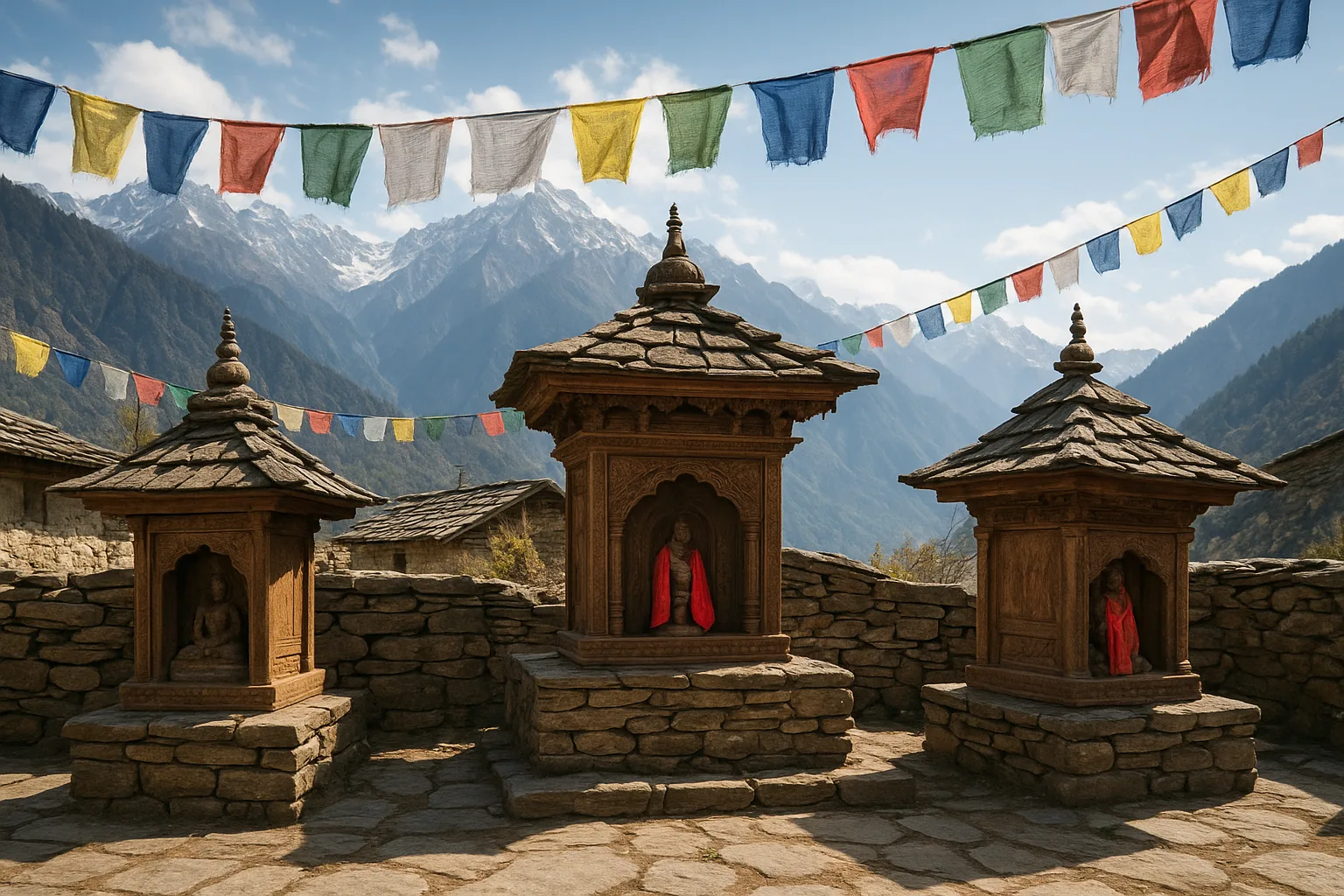
The evening air in Kinnaur thickens with incense and the low hum of drums. In a remote stone temple, villagers gather around a wooden image—its features worn smooth by generations of reverence. The priest’s chant merges with the wind that sweeps down from the snowfields, carrying with it the scent of pine and centuries-old stories. Here, in the shadow of the Greater Himalayas, the sacred and the everyday remain intertwined, and the mountain gods are still present among their people.
The Land and Its People: Ancient Roots
Kinnaur’s remote valleys straddle the divide between the lush Satluj basin and the arid plateaus bordering Tibet. Archaeological traces and oral traditions suggest that settled communities have inhabited these slopes since at least the early centuries of the Common Era—long before Kinnaur’s shifting boundaries became mapped in official gazetteers. Early records, such as those referenced in the Gazetteer of the Simla Hill States (1888), describe a land marked by rugged independence and cultural complexity, shaped by its geography and relentless climate.
The region’s earliest settlers—likely a blend of Indo-Aryan and Tibeto-Burman peoples—found meaning and protection in the world around them. Before the arrival of organized religions, their lives were governed by the rhythms of nature and the spirits believed to animate the rocks, rivers, forests, and storm clouds. The earliest belief systems of Kinnaur took shape not in scripture, but in the living memory of its inhabitants, passed from elder to child beside the hearth.
Oral Tradition and the World of Spirits
For generations, Kinnauris have preserved their history through song, story, and ritual rather than written chronicles. Local bards—paurhis—recount epics of gods, demons, and heroes, blending myth with hints of remembered events. These oral traditions are not merely entertainment; they serve as living archives, encoding the community’s collective memory and moral order.
Animistic beliefs, rooted in such oral histories, remain foundational. The landscape itself is alive, inhabited by a host of invisible beings: devtas (deities), rakshas (demons), fairies, and ancestral spirits. Sacred groves and springs are revered as dwelling places of these powers. According to local myth, the very mountains—such as Kinnaur Kailash—are not only geological features but the abodes of the gods themselves.
Household Gods and Village Deities
Distinct from the pan-Indian pantheon, Kinnaur’s deities are immediate, personal, and local. Each hamlet honors its own guardian spirit, invoked for protection, fertility, and justice. The most prominent among these are the gram devtas—village gods—who are believed to intervene in daily affairs.
- Maheshwar and Chandika, for example, dominate the village temples of Kamru and Kalpa.
- Other revered deities include Badrinath, Usha Devi, and the Shuwang Chandika of the upper valleys.
These gods are not distant abstractions. They are approached through elaborate rituals, processions, and festivals, often led by an oracular priest—known as the guria—who channels the deity’s will. The possession trance, still practiced, is seen as a direct encounter between the spiritual and material worlds. Through these rites, the gods remain active agents in the social and political life of Kinnaur’s villages.
Animism and the Natural World
Animistic beliefs in Kinnaur are more than a set of superstitions; they reflect a worldview where the environment itself is sacred. Rivers are venerated as goddesses, and ancient cedar groves are left untouched, believed to harbor powerful spirits. Even today, construction projects or tree-felling require rituals to appease the local devi or devta.
Such practices reveal an ethical relationship between people and place. They also provide insight into how Kinnauris have survived in a region prone to landslides, avalanches, and droughts. Appeasing the mountain spirits was, and in many ways still is, a strategy for managing the unpredictable forces of nature.
Trade, Contact, and Shifting Beliefs
Kinnaur’s position along ancient trans-Himalayan trade routes—linking India with Tibet—brought new ideas and customs over the centuries. By the early medieval period, elements of Hinduism and Buddhism began to overlay the older animistic practices. Yet, as travelers like the British officer Harcourt observed in the 19th century, the core of local religion remained distinct: a synthesis where local gods, Buddhist lamas, and Hindu sadhus might all find a place in the same procession.
Hill states and petty chieftaincies emerged during the late first millennium CE, each with its own tutelary deity and localized traditions. Political authority was often legitimated through ritual association with these gods. Even the Kinnauri rajas—documented in regional chronicles—sought the approval of village deities before major decisions.
Continuity and Change: The Living Tradition
Despite the spread of mainstream Hinduism and Buddhism, Kinnaur’s animistic and local deity traditions have proven remarkably resilient. Ceremonies honoring the devtas continue to be central to community life, especially during seed-sowing, harvest, and times of crisis. The oral transmission of myth and law remains a pillar of social order, connecting today’s Kinnauris to their ancient past.
Modernity has brought roads, schools, and outside influences—but the heart of Kinnaur still beats in rhythm with its gods and spirits. The tension and blending of old and new beliefs are visible at every festival and family altar, where stories as old as the mountains themselves continue to shape identity, ethics, and belonging.
From Valley Shadows to Tomorrow’s Dawn
As we move forward in this series, the next chapter will explore how Kinnaur’s religious landscape shifted in dialogue with neighboring faiths and empires. The story of its local deities and animistic beliefs is not a relic of the past, but a living force, shaping the way Kinnauris understand their place in the world—yesterday, today, and beyond.
Previous: Hindu–Buddhist Syncretism in Kinnaur Society
Next: Festivals and Rituals Unique to Kinnaur