
Series: History of Kangra, Himachal Pradesh, India
Phase 3: Mughal & Sikh Era — Part 14 of 30
This article belongs to a historical series examining how expanding empires and regional powers reshaped life in the western Himalayan hills. As external influences pressed into the mountains, local rulers navigated diplomacy, resistance, and accommodation. This phase explores how wider political currents intersected with entrenched hill traditions, altering governance without entirely displacing older structures.
The Dawn of Sikh Power in Kangra
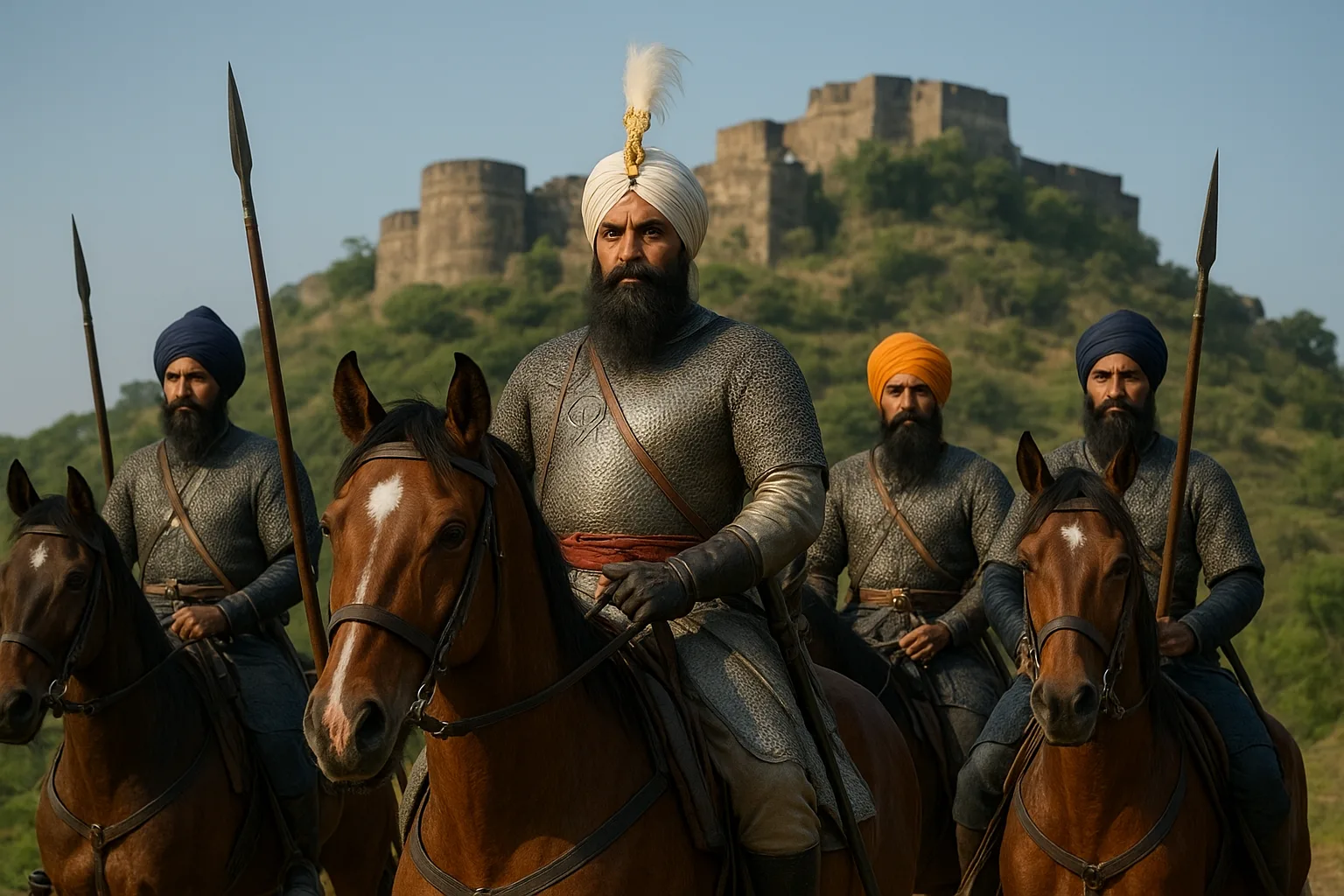
The monsoon clouds gathered thickly above the stony ramparts of Kangra Fort in April 1809. Below, the winding Beas shimmered with the promise of a new era. For centuries, these hills had seen the rise and fall of dynasties—Rajput princelings, Mughal governors, Rohilla invaders—each leaving their mark in stone, story, and scar. Now, the banners of the Sikh Empire flickered atop the battlements, and with them came a new chapter for the region’s people.
By the turn of the nineteenth century, Kangra’s rulers found themselves besieged by shifting allegiances and the ambitions of greater powers. The collapse of Mughal authority had left the region fractured. Into this vacuum stepped Maharaja Ranjit Singh, the “Lion of Punjab,” whose vision of a unified Sikh state would draw Kangra inexorably into its orbit. The Sikh conquest of Kangra was not merely a matter of military might; it was a negotiation between history, faith, and the rugged independence of the hills.
Between Legend and Record: Sources for Kangra’s Sikh Era
Much of what is known about this period emerges from the interplay of oral tradition, regional chronicles such as the Kangra State Gazetteer, and the administrative records of the Sikh Darbar. Local legends, still recounted in villages, speak of Ranjit Singh’s awe at the fort’s impenetrability and the cunning diplomacy that won him the keys. These stories often blend fact and folklore, reflecting the pride of a people who have long resisted subjugation.
Yet, historical inference and documentary evidence tell a more complex tale. The fort at Kangra, one of the oldest in India, had resisted centuries of siege. In 1805, it fell to Gorkha invaders from Nepal, who threatened the established order of the hill states. Raja Sansar Chand, Kangra’s long-reigning monarch and a legendary patron of the arts, found himself beset on all sides. When the Gorkha threat grew intolerable, he appealed to Maharaja Ranjit Singh for aid—a decision that would reshape Kangra’s destiny.
The Siege of Kangra Fort: Power, Faith, and Fortitude
The Sikh army, seasoned in the campaigns of the Punjab plains, marched into the hills in 1809. Their arrival was both a relief and a prelude to upheaval. The siege of the Gorkhas was brutal but brief; the fort’s defenders were starved into submission. According to the Kangra State Gazetteer and Sikh court records, the terms of victory were clear: Kangra Fort would pass to Ranjit Singh, while Raja Sansar Chand retained his ancestral lands in tribute to the Sikh sovereign.
For the first time in recorded history, control of Kangra Fort—long a symbol of regional autonomy—was relinquished to an outside power not through conquest, but through a calculated alliance. The Sikh flag above the fort signaled both triumph and transition. Yet the presence of the Raja within his domain, albeit as a vassal, maintained an uneasy continuity with the past.
Religious Landscape Under Sikh Rule
The Sikh empire’s arrival in Kangra introduced new layers to the region’s religious tapestry. Sikh soldiers brought with them the traditions of Guru Nanak and Guru Gobind Singh, while the hills remained home to ancient Hindu shrines, Jain relics, and the living memory of Buddhist pilgrims. The famous Kangra Devi temple, a site of deep veneration, continued to attract pilgrims from across the subcontinent.
Contrary to the fears of some local elites, Sikh rule was generally tolerant of religious diversity. Ranjit Singh himself was known for his eclectic patronage—supporting Hindu temples, Sufi shrines, and Sikh gurdwaras alike. In Kangra, this syncretic atmosphere encouraged a blending of traditions, visible in both ritual and art. The annual fairs at Jwalamukhi and Chamunda proceeded without interruption, their processions now guarded by Sikh patrols.
Hill States in the Shadow of the Sikh Empire
Kangra’s absorption into the Sikh Empire transformed the political map of the western Himalayas. Other hill states—Chamba, Mandi, Bilaspur—watched the unfolding events with a mixture of apprehension and admiration. Some, like Nurpur, sought alliance with the Sikhs to fend off Gorkha or Afghan threats; others resisted, hoping to preserve their autonomy.
The Sikh administration established a network of thanedars (local governors) and revenue officials, integrating Kangra into the broader imperial apparatus. Trade routes linking the Punjab plains to the hills were fortified, bringing new goods—and new ideas—into Kangra’s bazaars. Wool, ghee, and precious stones flowed southward, while weapons and textiles made their way up the winding mountain roads.
This period also saw the rise of new communities in Kangra’s valleys: artisans and traders from Amritsar and Lahore, Sikh settler families, and even Afghans who had sought refuge from the shifting fortunes of empire. Each group added to the region’s rich cultural mosaic, even as the old Rajput clans negotiated their privileges under Sikh overlordship.
Everyday Life: Continuity and Change
For the ordinary people of Kangra, Sikh rule brought both disruption and opportunity. Taxes, now collected in the name of the Maharaja, were sometimes heavier than before, yet the end of frequent warfare allowed agriculture and crafts to flourish. The famed Kangra school of miniature painting, nurtured under Raja Sansar Chand, continued to attract patrons—some of them Sikh generals who admired its delicate brushwork and bold color.
Oral traditions recall the arrival of Sikh cavalrymen at village fairs, their distinctive blue tunics and plumed turbans an object of fascination. Ballads composed in the Pahari dialect celebrated the exploits of both hill heroes and Sikh commanders, weaving the new rulers into the fabric of Kangra’s collective memory.
Women, Faith, and Social Life
The period also witnessed subtle changes in the status of women and the character of religious life. New Sikh settlements brought with them traditions of langar (community kitchens) and collective worship, which found resonance in the communal ethos of many Kangra villages. Women participated in both Hindu and Sikh rituals, their roles shaped by tradition yet subtly expanded by the new currents of faith.
The Twilight of Sikh Rule and the Coming of the British
The Sikh hold on Kangra, though transformative, was ultimately brief. After the death of Ranjit Singh in 1839, the empire began to fracture under the weight of internal rivalries and external pressures. The British, long covetous of the strategic passes and rich lands of Himachal, advanced steadily from the south. By 1846, in the aftermath of the First Anglo-Sikh War, Kangra was ceded to British control—its fate sealed not in battle, but at the negotiating table.
Yet the memory of Sikh rule endured. In the villages below the fort, elders spoke of the days when Ranjit Singh’s horsemen patrolled the passes, and the fort’s gates opened only at the Maharaja’s command. Traditions of hospitality, martial valor, and religious pluralism—shaped by those years—continued to animate Kangra’s culture long after the Sikh banners had fallen.
Reflections: The Living Legacy of the Sikh Era
Today, the stones of Kangra Fort bear silent witness to the tides of empire. The Sikh period, though only a generation in span, left an imprint visible in architecture, language, and law. The layered identities of Kangra’s people—hill folk, Rajputs, Sikhs, traders—are a testament to centuries of adaptation and resilience. Festivals, oral epics, and even the taste of local food recall the days when the Lion of Punjab presided from afar, and the hills echoed with the clangor of new beginnings.
As our series continues, we will journey into the era of British colonial rule—a time of sweeping change, resistance, and reinvention in Kangra. The echoes of Ranjit Singh’s age remind us that even the briefest empires can leave legacies that outlast their banners.
Previous: Decline of Mughal Influence in Kangra
Next: Transition from Sikh to British Control