
Series: History of Chamba, Himachal Pradesh, India
Phase 3: Culture & Art — Part 14 of 30
This article belongs to a historical series examining how expanding empires and regional powers reshaped life in the western Himalayan hills. As external influences pressed into the mountains, local rulers navigated diplomacy, resistance, and accommodation. This phase explores how wider political currents intersected with entrenched hill traditions, altering governance without entirely displacing older structures.
Horns of the Dhol: A Festival Morning in Old Chamba
The chill of dawn clings to the stone alleys beneath Chamba’s Lakshmi Narayan temple. Drums and dhols echo off the misty slopes, their ancient cadence stirring the town awake. Below the temple, villagers converge, wrapped in homespun wool and anticipation. Their faces—etched by mountain sun and time—carry the memory of countless festival seasons. This is not merely celebration; it is a thread to the beginnings of Chamba itself, a living relic of beliefs and histories that shaped the land long before written records marked its story.
Chamba: A Meeting Point of Peoples and Beliefs
Perched along the Ravi River, Chamba sits at a crossroads of Himalayan trade and migration. Early medieval chronicles, like those referenced in the Chamba State Gazetteer, recall a kingdom founded in the late 10th century CE by Raja Sahil Varman. Yet, the roots of Chamba’s festival culture run deeper—into the oral traditions of Gaddis, Gujjars, and other hill communities who once moved seasonally with their herds across these valleys. These groups brought animist rituals, ancestor veneration, and reverence for the natural world, all of which would find new shape as the region’s first temples rose and royal patronage took hold.
Roots in the Oral and the Mythic
Many of Chamba’s earliest festivals trace their form to the interplay of myth and oral tradition. Local tales speak of the goddess Champavati—believed to watch over the valley—whose legends predate the arrival of the Varmans. It is said that the founding of Chamba town itself was guided by a divine vision, a story still recounted during annual fairs. Such narratives, woven into dance and song, survive in the jataras—village gatherings that blend ritual, storytelling, and communal feasting. While these stories evolved over centuries, their essence remains: a dialogue between earth, spirit, and those who call Chamba home.
Royal Patronage and the Rise of Minjar
Documented political history marks the 10th and 11th centuries as a time of consolidation in Chamba. The Varman rulers, keen to legitimize their reign, began to link local agrarian rites with the grander traditions of the North Indian plains. The Minjar festival, now the crown of Chamba’s calendar, is a product of this synthesis. Official chronicles recount its origins in royal thanksgiving for bountiful harvests—its name, derived from the maize flower (minjar), signals the arrival of the monsoon and the promise of plenty. Over time, processions grew more elaborate, temples became focal points, and the festival itself absorbed influences from neighboring kingdoms, traders, and even distant pilgrims who arrived via the Ravi and Chenab valleys.
Processions and Symbolism
Minjar’s central ritual—the offering of sheaves of maize and silk threads to the river—reflects both the agricultural cycle and the spiritual yearning of the community. The procession, led by the reigning Raja or his surrogate, moves from the palace to the riverbank, accompanied by musicians, dancers, and a swirl of color. Here, the boundaries between royal authority and folk devotion blur, as each participant becomes a bearer of Chamba’s collective memory.
Dussehra: The Epic in the Hills
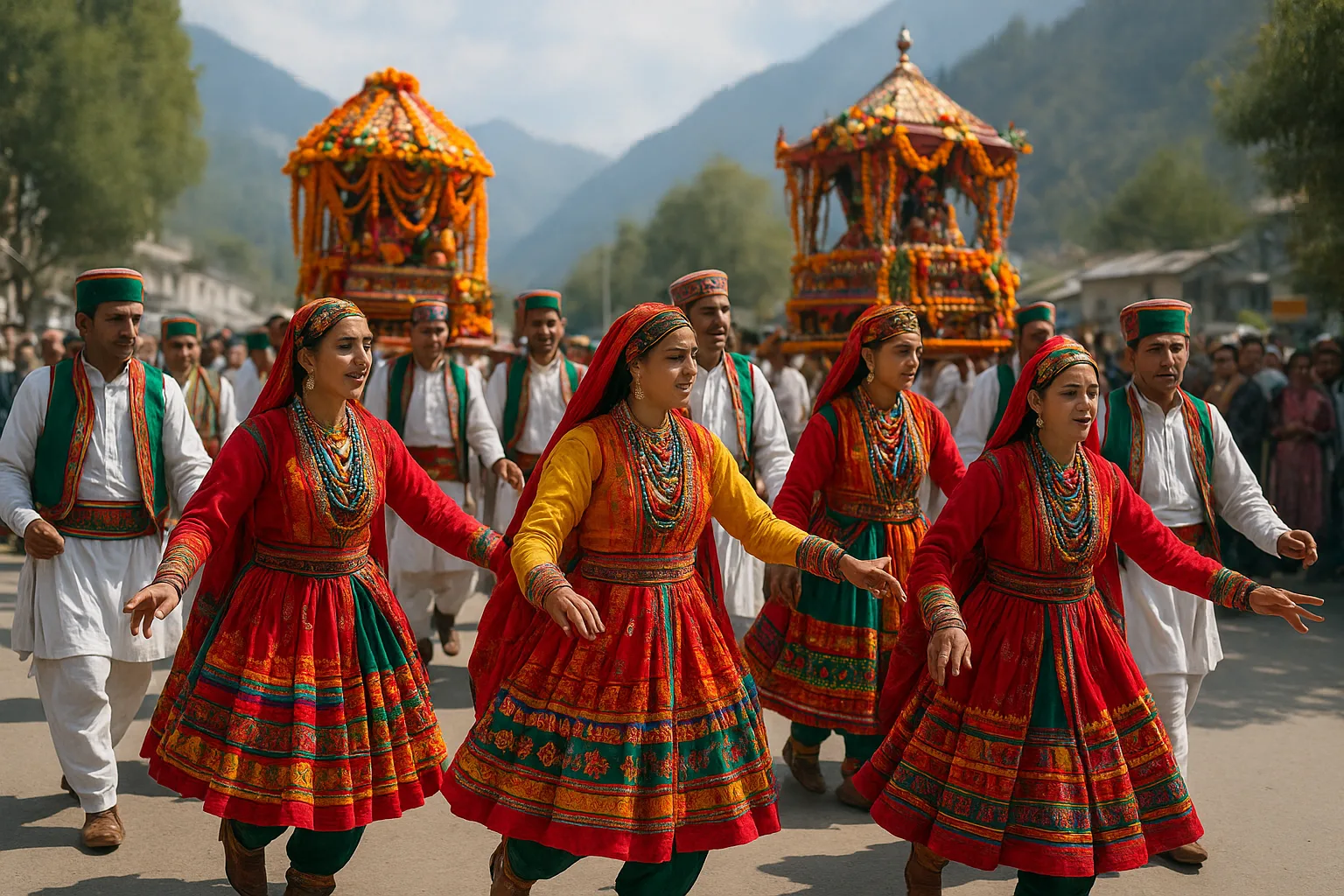
Elsewhere in Himachal, Dussehra is marked by the burning of effigies and the retelling of the Ramayana. In Chamba, the festival carries its own distinct character. Oral histories suggest that, for centuries, Dussehra here has honored not just Rama but also a pantheon of local deities whose processional images—devtas and devis—are paraded through the streets. This intertwining of pan-Indian epic and indigenous belief reveals how Chamba’s festival calendar became a living negotiation between imported ideas and ancestral custom. Early travelers’ accounts from the colonial period note the elaborate pageantry, the overlapping of Hindu and animist motifs, and the role of the Rajput elite in orchestrating these events for both spiritual and political ends.
Fairgrounds of Commerce and Encounter
Festivals in Chamba were never only about the gods. For centuries, the Minjar Mela and smaller fairs such as Suhi Mata and Baisakhi served as vital hubs for trade and social exchange. Merchants from Kangra, Kishtwar, and even as far as Kashmir set up stalls in the shadow of the town’s temples. These gatherings fostered connections across valleys and cultures—exchanging wool, grain, salt, and stories. The blending of dialects, cuisines, and even costume at these fairs is recorded in both British gazetteers and oral memory, underlining how Chamba’s festivals were engines of both cultural continuity and transformation.
Suhi Mata: Sacrifice and the Feminine Divine
Among Chamba’s most poignant festivals is Suhi Mata, commemorating the legendary self-sacrifice of a queen to bring water to the parched town. While the details shift between oral versions, the festival’s essence is one of remembrance and gratitude. Girls dressed in scarlet lead processions to the Suhi Mata temple, singing ballads that evoke both loss and renewal. Unlike the Minjar, Suhi Mata remains a more localized, emotionally charged event—an echo of the intimate, familial rituals that predate the age of palaces and processions. The festival’s endurance into the present underscores the resilience of local memory, especially among women who have long been custodians of Chamba’s narrative heritage.
Continuity and Change: Festivals in Modern Chamba
Today, the festivals of Chamba animate its streets much as they have for centuries, though the world around them has transformed. Modernity, tourism, and migration have brought new faces and new rhythms; yet on festival days, the town’s ancient heart beats strong. The drums and dhols that once summoned villagers from scattered hamlets now draw visitors from across India and beyond. Yet the core of these celebrations—their fusion of ritual, myth, and memory—remains untouched. They are living archives, repositories of a past that is neither static nor forgotten.
The Living Pulse of Chamba’s Festivals
To walk Chamba’s lanes during Minjar, Suhi Mata, or Dussehra is to step into a centuries-old conversation between land, people, and the divine. The customs, songs, and processions that define these festivals are much more than entertainment—they are Chamba’s living claim to its history, its resilience, and its ongoing evolution.
As our series continues, we will explore how these traditions echoed through the region’s renowned arts—especially the miniature painting schools that flourished under royal patronage. The spirit of Chamba’s festivals, it turns out, was as much painted as it was performed.
Previous: Temples and Ritual Life in Medieval Chamba
Next: Language, Dress, and Folk Traditions of Chamba