
Series: History of Lahaul & Spiti, Himachal Pradesh, India
Phase 3: Religion & Culture — Part 12 of 30
This article belongs to a historical series examining how expanding empires and regional powers reshaped life in the western Himalayan hills. As external influences pressed into the mountains, local rulers navigated diplomacy, resistance, and accommodation. This phase explores how wider political currents intersected with entrenched hill traditions, altering governance without entirely displacing older structures.
Snowlight on Stone: Dawn at Tabo
In the earliest hours of a Himalayan morning, the golden sunlight strikes the mud brick walls of Tabo Monastery. Perched in the Spiti valley, at nearly 3,300 meters above sea level, Tabo’s low-slung, fortress-like silhouette emerges from the cold desert—a haven for prayer and preservation. Monks in maroon woolen robes move between prayer halls, their chants weaving through the crisp air. Here, in one of the oldest continuously operating Buddhist complexes in the Indian Himalayas, the past feels present, alive in every wall painting and flicker of butter lamp.
The Valleys Before Monasteries: Settlement and Belief
Lahaul and Spiti, now a single administrative district, were once distinct valleys—each shaped by formidable geography and ancient trade routes. Early communities, including agro-pastoralists and itinerant traders, established settlements along the rivers Chandra, Bhaga, and Spiti. Oral traditions, still recounted in village gatherings, speak of gods and spirits inhabiting the mountains and stones. Before monasteries, shrines to local deities—such as Gye Barbo and Lha—punctuated the landscape, their origins lost in myth and memory. These early belief systems, blending animism and Bon practices, set the stage for the Buddhist tide that would later sweep the valleys.
Trade and the Tapestry of Ideas
The high passes—Kunzum, Rohtang, and beyond—linked Lahaul and Spiti to Ladakh, Kinnaur, Tibet, and the plains. Traders, pilgrims, and lamas traversed these routes, carrying salt, wool, and religious texts. The valleys’ remoteness fostered a unique blend of cultural insularity and cosmopolitan exchange. By the first millennium CE, these routes became arteries not just of commerce, but of faith, bringing Buddhist teachers and artisans from Central Asia and Tibet into the heart of the western Himalayas.
The Dawn of Monastic Life: Tabo and Its Legacy
The historical record grows clearer with the founding of Tabo Monastery in 996 CE, as attested by inscriptions and the monastery’s own chronicles. Patronized by the great Western Himalayan king Yeshe-Ö of the Purang-Guge kingdom, Tabo was conceived as a “celestial mandala”—a center for Buddhist learning, art, and ritual. Unlike the lofty, fortress-monasteries of Tibet, Tabo’s low profile offers protection from harsh winds and winter snows, its interiors adorned with exquisite murals and clay sculptures. Early documents and regional gazetteers note Tabo’s role as a hub for scriptural translation and monastic education, drawing monks from as far as Kashmir and the Tarim Basin.
From Oral Tradition to Written Chronicle
Tabo’s own foundation legend—a blend of oral tradition and historical recollection—speaks of Yeshe-Ö’s vision atop the Spiti plateau, guided by omens and dreams. While the miraculous elements belong to local lore, the monastery’s establishment marks a demonstrable shift: from scattered hermitages and cave-dwellings to a formal, institutional Buddhism aligned with the great monastic universities of the Tibetan plateau.
Dhankar: Citadel of Faith and Power
If Tabo is the heart of Spiti’s spiritual heritage, Dhankar is its sentinel. Perched precariously atop a wind-carved spur above the confluence of the Spiti and Pin rivers, Dhankar Monastery commands views that are both breathtaking and strategic. Oral history claims that the site was once a Bon stronghold—its name deriving from “Dhang” (cliff) and “Kar” (fortress)—before Buddhist monks established their own presence in the 12th century. The monastery’s whitewashed walls and labyrinthine corridors have withstood both siege and landslide. For centuries, Dhankar served as the seat of the Nono, the hereditary ruler of Spiti, whose authority was both temporal and spiritual. Chronicles from the British Raj, such as the 1917 Kangra Gazetteer, describe Dhankar as a place where politics, ritual, and diplomacy converged, especially during conflicts between neighboring hill states and Tibetan authorities.
Monastic Hierarchies and Regional Identity
Dhankar’s abbot, often appointed through complex negotiations involving Lhasa, Kinnaur, and local clans, symbolized Spiti’s link to the wider Buddhist world. Yet, monastery life here remained deeply enmeshed with local custom: harvest rituals, propitiation of mountain deities, and mediation in village disputes. The archives of Dhankar, though fragmentary, reveal a culture where faith legitimized rule and monastic wisdom guided communal survival in a harsh environment.
Key Monasteries Beyond the Great Two
While Tabo and Dhankar dominate historical memory, the valleys teem with other vital centers:
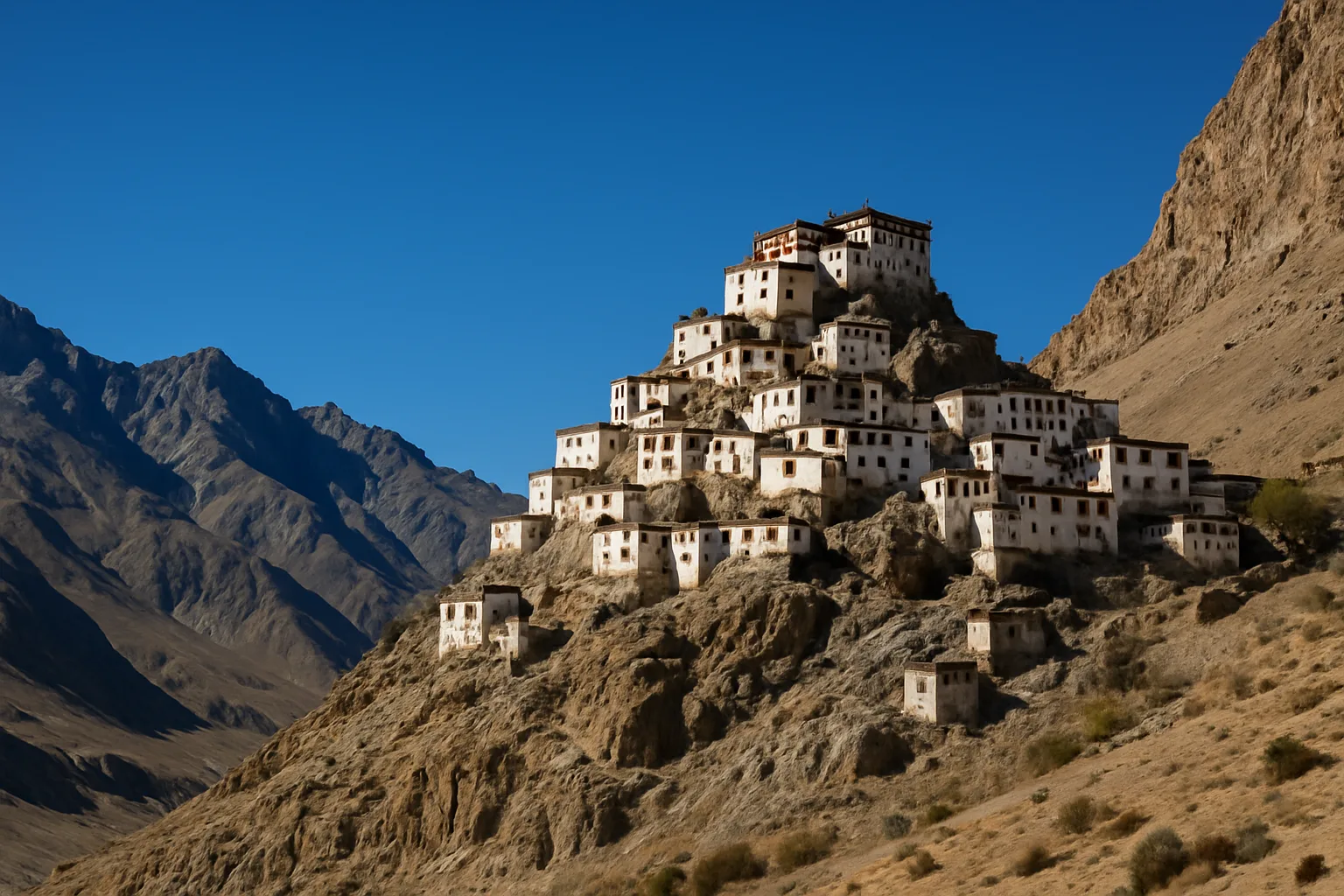
- Key (Ki) Monastery: Rising above the Spiti river on a rocky outcrop, Key is the largest and most influential monastery in Spiti today. Founded at least by the 14th century—though oral tradition places its origins earlier—it was repeatedly sacked during Mongol, Dogra, and Gorkha incursions. Its present structure, a maze of cells and prayer halls, reflects centuries of rebuilding. Key remains the epicenter of the Gelugpa (Yellow Hat) tradition in Spiti, with hundreds of resident monks and a living lineage of teaching.
- Kardang Monastery: Across the mountains in Lahaul, Kardang rose to prominence in the 17th century as the seat of the Drukpa (Red Hat) lineage. Its archives, some written in gold on black paper, document Lahaul’s entanglement with Ladakh, Kullu, and even distant Bhutan. Kardang’s annual Cham dance—part ritual, part social gathering—continues to draw villagers from across the valley.
- Gue and Kungri Monasteries: Lesser-known yet deeply significant, these monasteries preserve unique ritual traditions—including the mummified monk at Gue, a relic said to date back to the 15th century. Kungri, in the Pin valley, is the region’s only Nyingma (Ancient School) monastery, its architecture and festivals echoing older Himalayan forms.
Networks of Pilgrimage and Knowledge
Each monastery, large or small, functioned as more than a religious site. They were repositories of art, medicine, and local law. Pilgrims and wandering monks—documented in the reports of early European explorers like Alexander Cunningham and the writings of local lamas—wove Lahaul and Spiti into the broader fabric of Tibetan Buddhist civilization.
Monasteries in the World of Hill States and Empires
The rise of monasteries coincided with the waxing and waning of regional hill states and distant empires. The influence of the Guge kingdom, the expansionist ambitions of Ladakhi rajas, and the later arrival of Dogra and Sikh armies each left their mark on monastic fortunes. In the 17th and 18th centuries, monastic leaders often played the role of diplomats, mediating tribute and allegiance between local chieftains and external rulers. British colonial administration, reaching Lahaul-Spiti in the 19th century, catalogued these monasteries with both fascination and suspicion—recognizing their power as centers of indigenous authority. Yet, even as outside forces pressed in, the monastic system adapted, drawing on deep reserves of local loyalty and spiritual legitimacy.
Stone, Silence, and Survival: Continuity and Change
Today, the ancient halls of Tabo, Dhankar, Key, and Kardang remain vital centers of worship, learning, and community. Restoration projects have safeguarded priceless murals, while young monks now study both Buddhist philosophy and modern science. Festivals—still observed by entire valleys—bind the present to the past, as the sound of long trumpets and the scent of juniper incense drift through Himalayan air. The monasteries’ survival, through centuries of upheaval, reflects not just architectural ingenuity but the enduring resilience of Lahaul and Spiti’s people.
As our journey through the religious and cultural heart of these valleys continues, we will next turn to the living rituals and festivals that animate their sacred landscapes—unpacking how ancient beliefs are continuously reimagined in the rhythms of everyday life.
Previous: Arrival and Spread of Tibetan Buddhism in Spiti
Next: Monastic Life and Education in Spiti Valley