
Series: History of Solan, Himachal Pradesh, India
Phase 3: Religion & Culture — Part 13 of 30
This article belongs to a historical series examining how expanding empires and regional powers reshaped life in the western Himalayan hills. As external influences pressed into the mountains, local rulers navigated diplomacy, resistance, and accommodation. This phase explores how wider political currents intersected with entrenched hill traditions, altering governance without entirely displacing older structures.
Twilight Over the Hills: A Gathering in Old Solan
The sun dips behind the pine-clad ridges of Solan, and a gentle haze settles over the valley. Villagers, wrapped in woolens against the mountain chill, gather in the courtyard of a weathered temple. An elder strikes the first note on the nagara drum; its sound ripples through the dusk, a call to memory and celebration. Flickering torches reveal faces—old and young, men and women—drawn together by the promise of music and story. Even as modernity encroaches, these folk traditions remain Solan’s beating heart, binding its people to a past both shared and singular.
Origins: Ancient Roots and Migration
Solan’s cultural tapestry is woven from many threads. For centuries, its hills have been crossroads—traversed by pastoralists, traders, and pilgrims. The earliest folkways grew from the rhythms of agrarian and pastoral life. Oral histories recall the Rajput clans who settled these valleys after the fall of the Delhi Sultanate, each bringing their own songs and legends. The Gurkhas, who arrived in the early 19th century, left behind not only fortifications but also elements of their language and ritual. Over time, these influences mingled with the region’s indigenous Pahari traditions, forming the distinctive culture of Solan.
Ancestral Gods and the Ritual Calendar
Solan’s villages have long been shaped by devotion to local deities—gram devtas—whose shrines dot the landscape. Each year, the calendar is marked by festivals in their honor, from Baisakhi in spring to the autumnal Sair. In these rituals, the past comes alive: masked dancers enact tales of gods and demons, while storytellers recite the deeds of legendary kings. The jagran—a night-long vigil of song and prayer—draws communities together, blending spiritual reverence with social festivity. These gatherings have preserved oral epics that might otherwise have vanished, their verses echoing back to the times of the princely Baghat and Kunihar states.
Melodies of the Hills: Music and Dance
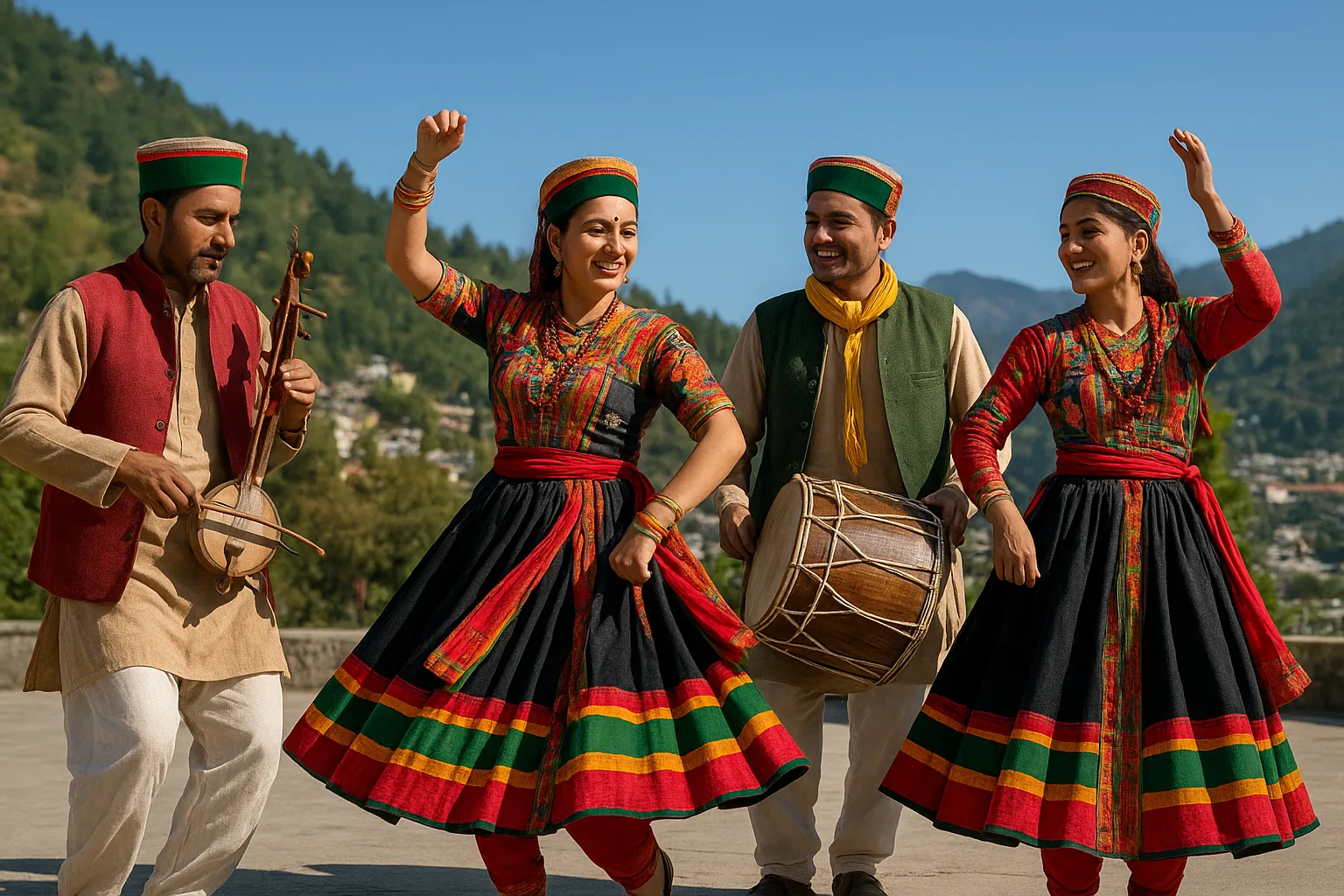
From solitary shepherds’ flutes to the thunder of festival drumming, music is the lifeblood of Solan’s folk culture. The naati—the region’s iconic group dance—has been a fixture at harvests and weddings for generations. Men and women join hands in a slow, circular movement, their steps mirroring the undulating terrain. The accompanying songs, sung in the local dialect, tell of love, exile, and the changing seasons.
Traditional instruments—dholak, chimta, algoza—are still played by hereditary musicians called baajgis. Some tunes recount the exploits of Rajput heroes; others are lullabies passed from mother to daughter. British colonial officers, encountering these gatherings in the late 19th century, described them as “strangely moving, both plaintive and exultant.” The music of Solan, though now mingled with Bollywood rhythms, remains an anchor for community identity.
Women’s Voices: Songs of Work and Devotion
Women’s folk songs, sung while gathering fodder or spinning wool, have long been a medium of quiet strength. The pahari geet—songs of longing, migration, and resilience—reflect the hardships and hopes of mountain life. During the festival of Karwa Chauth, women assemble for all-night singing, weaving tales of sisterhood and endurance. These songs are living archives, preserving memory even as the world outside changes.
Storytelling and Oral Legends
Storytelling is perhaps Solan’s oldest art. Village kathavachaks (bards) have, for centuries, recited legends by firelight—tales of the Pandavas’ wanderings through the Shivaliks, or the exploits of local heroes like Rana Laxman Singh of Baghat. Some stories are rooted in ancient epics; others recall the more recent struggles against colonial rule or natural disaster. Through these tales, history is made personal, its lessons passed down not as dry fact but as living wisdom.
One enduring legend centers on the Shoolini Mata Temple, from which Solan takes its name. Each June, the Shoolini Fair draws crowds from across Himachal Pradesh. The three-day festival, marked by processions and theatrical performances, commemorates the goddess’s protection of the town. Even those who have migrated to distant cities return for these celebrations, their ties to Solan renewed with every retelling.
Festivals: Seasons of Unity
Festivals are the pulse of Solan’s social life. Some, like Lohri and Diwali, are celebrated across northern India, but in Solan they take on a local flavor. The Sair festival, unique to the hills, marks the end of the monsoon and the beginning of the harvest. Families gather to share siddu (steamed bread) and offer thanks for the bounty of the land. During Phagli—Solan’s own spring carnival—villagers don outlandish costumes and parade through the streets, a ritual believed to ward off evil spirits.
The British era brought new festivals and customs to Solan, especially after the town became a cantonment in the mid-19th century. The annual Solan Summer Festival, now a fixture, blends folk performances with modern entertainment, drawing thousands to the town’s central maidan. Through these festivals, Solan’s people renew their sense of community, forging continuity between past and present.
Markets and Fairs: Commerce Meets Culture
Weekly markets—haats—have long been more than places of trade; they are venues for cultural exchange. Farmers bring their produce, artisans display handwoven shawls and carved wooden wares, and traveling minstrels perform for a few coins. In the colonial period, British officers and local rajas alike mingled at these fairs, forging new alliances and rivalries. The marketplace remains a stage for both commerce and storytelling, a living testament to Solan’s openness and adaptability.
Artisans and Handicrafts
Solan’s folk culture is not only sung and danced but also woven, carved, and painted. The region’s artisans are famed for their pattu shawls, each handloomed with geometric motifs that speak of clan and valley. Woodcarvers craft intricate panels for temples and homes—motifs of lotus, peacock, and serpent tracing back to ancient Himachali iconography. Potters shape clay into ritual vessels for the festivals, their designs unchanged for generations.
British gazetteers from the early 20th century note the pride Solan’s craftspeople took in their work, and the role of guilds in preserving standards and passing skills from father to son, mother to daughter. Today, as mass production threatens these traditions, local collectives and NGOs are working to revive them, ensuring that Solan’s heritage is not lost to time.
Religious Pluralism and Social Harmony
Solan’s cultural life has always accommodated diversity. While Hinduism is the dominant faith, the region is home to Sikhs, Christians, and a small Muslim community—each contributing to the town’s social fabric. The Christ Church, established by British settlers in 1857, still rings its bell over the market square. The Gurudwara on the Mall Road welcomes travelers and townsfolk alike, especially during Gurpurab, when hymns and free meals unite all comers.
Interfaith dialogue is not a modern invention here. Oral histories recall how, during times of drought or plague, communities would join in collective prayer, irrespective of creed. The shared rituals of hospitality—welcoming the stranger, sharing bread—remain central to Solan’s ethos.
Modernity and the Changing Tides
In the decades since Independence, Solan has transformed from a sleepy cantonment to a bustling commercial hub. New industries, educational institutions, and tourism have brought fresh influences. Yet, even as satellite dishes spring up on slate roofs, the town’s folk traditions endure. Schoolchildren still learn the steps of naati; radio stations broadcast folk melodies on festival days. The annual Shoolini Fair, once a purely religious event, now includes rock bands and food stalls, but the goddess’s procession remains its centerpiece.
Change, as ever, brings both loss and renewal. Some ancient customs fade, but others adapt and thrive. Through it all, Solan’s people continue to find meaning in the stories, songs, and rituals of their ancestors.
Echoes in the Present
Walk the lanes of Solan today, and the past is never far away. Elderly women hum folk tunes as they tend roadside shrines; children rehearse folk dances for school pageants. The colors and cadences of folk life shape every festival, wedding, and market day. In an age of rapid change, these traditions offer continuity—a sense of belonging, purpose, and pride.
Solan’s folk culture is not a relic, but a living dialogue between memory and invention. It is the thread that links generations, the quiet strength behind the town’s resilience. As we journey further in this series, the story of Solan’s people—and the creative ways they have kept their heritage alive—continues to unfold.
Previous: Temples and Sacred Landscapes of Solan District
Next: Festivals That Shaped Community Life in Solan