
Series: History of Chamba, Himachal Pradesh, India
Phase 3: Culture & Art — Part 13 of 30
This article belongs to a historical series examining how expanding empires and regional powers reshaped life in the western Himalayan hills. As external influences pressed into the mountains, local rulers navigated diplomacy, resistance, and accommodation. This phase explores how wider political currents intersected with entrenched hill traditions, altering governance without entirely displacing older structures.
A Bell at Dawn: Chamba’s Sacred Awakening
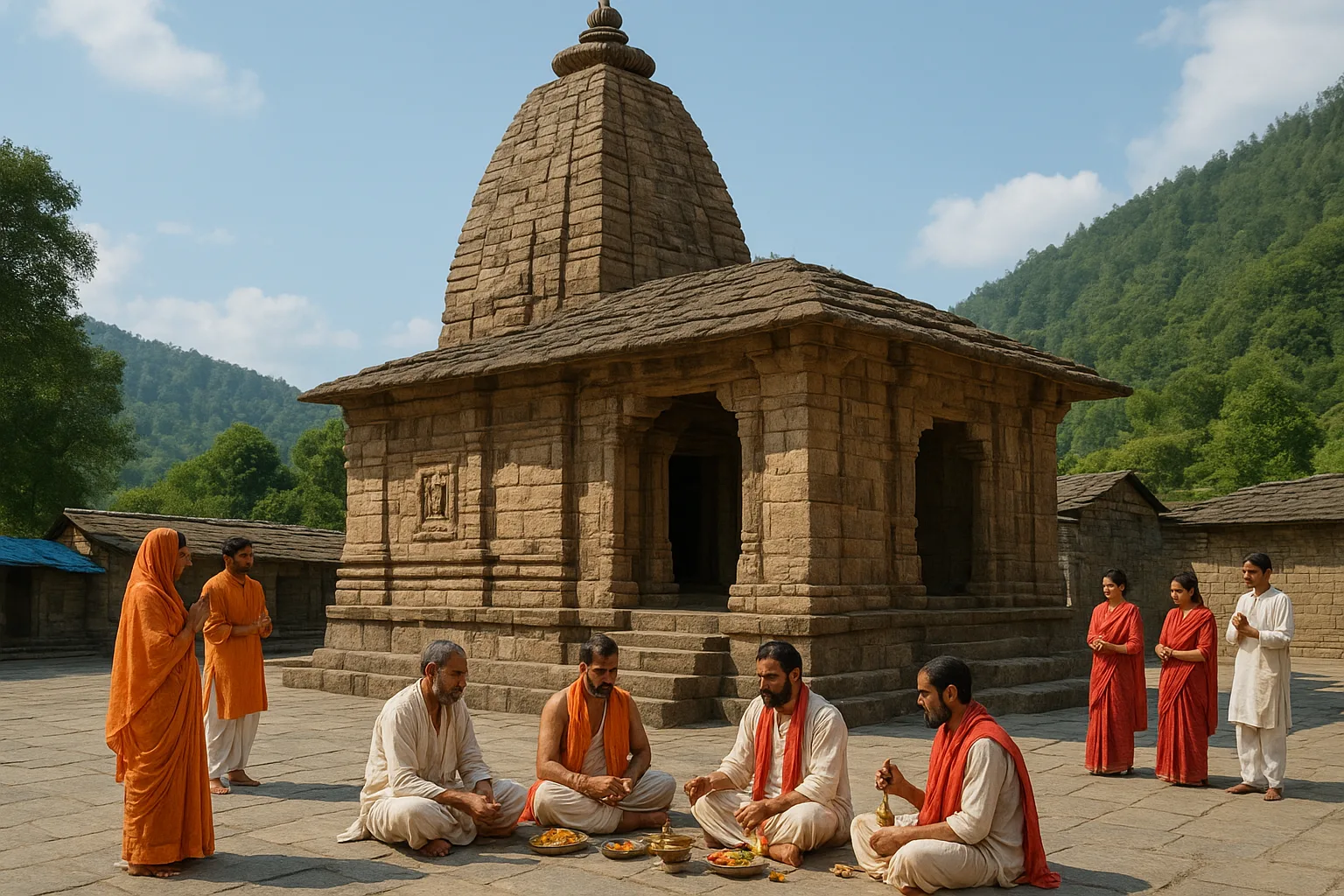
The first rays of sunlight, filtered by cedar and pine, touch the stone spires of Chamba’s temples. The clang of a temple bell, heavy and resonant, rolls across the mist-laden Ravi Valley. In this moment—much as it might have sounded a thousand years ago—we glimpse the heart of medieval Chamba: a landscape where faith, ritual, and daily life were woven seamlessly together.
Chamba’s Emergence: A Valley Shaped by Belief and Geography
By the early 10th century, the region we now know as Chamba was already a mosaic of small settlements. Oral traditions recall the founding of the town by Raja Sahil Varman, a figure whose story blends legend and early statecraft. Chronicles such as the Tarikh-i-Riyasat Chamba and British-era gazetteers describe how Chamba’s rulers, emerging from the shadows of earlier hill principalities, established their seat along the Ravi River. The valley’s position—guarded by Himalayan ranges, yet open to the lower hills—made it both a natural fortress and a crossroads for traders, pilgrims, and migrating communities.
Traces of even earlier habitation linger in archaeological finds: carved stones, copper plates, and the faint outlines of sanctuaries predating the Varman dynasty. Chamba’s earliest communities included pastoralists, small-scale cultivators, and artisans, each bringing their own beliefs and practices. Over centuries, these strands interwove, giving rise to a distinct local identity shaped by the rhythms of Himalayan life and the tides of wider Indian civilization.
From Folk Deities to Royal Patronage: The Evolution of Worship
Long before the great stone temples rose, the people of Chamba worshipped at sacred groves, springs, and boulders. Oral traditions speak of local deities—protectors of forests, rivers, and harvests—whose shrines dotted the hillsides. As the Varman rulers asserted their dominance, they gradually adopted and elevated some of these folk deities, integrating them into a broader Hindu pantheon. The process was reciprocal: royal patronage lent prestige and permanence to local cults, while the gods and goddesses of the hills offered the ruling house divine legitimacy.
Historical inference suggests that, by the 11th century, Shaivism and Vaishnavism—devotional traditions centered around Shiva and Vishnu—had become deeply rooted in Chamba. The construction of grand temples, often commissioned by the rajas, signaled not just piety but also political ambition. These structures anchored royal authority in sacred stone, transforming the landscape into a living tapestry of devotion and governance.
The Heart of the Town: Temples as Centers of Power and Community
The Lakshmi Narayan Temple complex, begun in the 10th century, stands today as a testament to Chamba’s enduring spiritual heritage. Its towering shikharas, intricately carved with stories of gods and mortals, were both houses of worship and symbols of dynastic pride. Early travelers and chroniclers describe the temple as the focal point of town life—its festivals, processions, and daily rituals drawing the community together in shared awe and celebration.
Other notable temples, such as the Chamunda Devi and the Hari Rai, soon followed. Each was associated with distinct rituals, calendars, and patron communities—Brahmins, artisans, traders, and the warrior elite. The temples were not isolated sanctuaries but bustling centers of economic and social activity. Land grants and endowments ensured their upkeep; skilled craftsmen flocked to Chamba to work on their ornamentation, and markets thrived in the temple’s shadow.
Ritual Life: Festivals, Pilgrimage, and the Cycle of Seasons
Life in medieval Chamba was punctuated by ritual—an unbroken cycle of festivals, fasts, and fairs that marked the passage of time. The Minjar Mela, whose origins are traced in both oral tradition and early records, celebrated the ripening of maize and the annual flooding of the Ravi. Dussehra, Shivratri, and other pan-Indian observances found unique local expression, blending Vedic rites with vernacular customs.
Pilgrims arrived from distant valleys, seeking blessings or repaying vows. The temples became nodes in far-reaching networks of faith and commerce, drawing goods, ideas, and people from across the Himalayan world. The social fabric of Chamba was thus constantly renewed by the convergence of the sacred and the secular, the local and the universal.
Caste, Craft, and Community: The Social Order of Chamba’s Temples
Beneath the grandeur of Chamba’s temples lay a complex social reality. The priestly Brahmins presided over rituals; Rajput clans asserted their rights as patrons and warriors; merchant and artisan guilds vied for influence through donations and services. Women played crucial roles as devotees and patrons, though their voices are often faint in official chronicles.
The construction and maintenance of temples provided livelihoods for masons, woodcarvers, metalworkers, and musicians. Inscriptions from the period speak of endowments for temple dancers, water-bearers, and gardeners—each integral to the ritual machinery that kept the temples alive. Over generations, these relationships anchored Chamba’s identity as a center of both spiritual and material abundance.
Myth and Memory: The Enduring Legacy of Chamba’s Sacred Landscape
As centuries passed, the stories and rituals of Chamba’s temples became inseparable from the town’s sense of self. Oral epics recount dramatic interventions by gods in times of drought or invasion; local legends tell of miraculous healings, apparitions, and the mysterious origins of temple icons. While historians distinguish between myth and documented fact, these narratives remain vital to understanding how Chamba’s people have seen themselves across generations.
Today, the ancient bells still sound at dawn, and festivals continue to draw crowds from neighboring valleys. The temples, weathered by time yet lovingly preserved, are more than relics: they are living testaments to a tradition that endures, adapting yet rooted in the Himalayan soil.
In the next part of this series, we will follow the footsteps of Chamba’s artists and artisans—exploring how their craft shaped not only temples, but the very identity of the region.
Previous: Chamba Miniature Paintings Explained
Next: Festivals That Defined Chamba’s Culture