
Series: History of Lahaul & Spiti, Himachal Pradesh, India
Phase 3: Religion & Culture — Part 11 of 30
This article belongs to a historical series examining how expanding empires and regional powers reshaped life in the western Himalayan hills. As external influences pressed into the mountains, local rulers navigated diplomacy, resistance, and accommodation. This phase explores how wider political currents intersected with entrenched hill traditions, altering governance without entirely displacing older structures.
Whispers on the Wind: Spiti Before the Monks
It is dusk in the high, spare valley of Spiti—centuries ago. The shadows stretch long across the bare earth, and the only sounds are the wind’s restless breath and the distant chime of yak bells. Here, in this craggy land between India and Tibet, the very isolation that keeps Spiti hidden also makes it a crossroads. Before Buddhism’s arrival, the valley’s people lived by rhythms as old as the mountains themselves, guided by the pulse of the seasons, the lore of ancestors, and the quiet power of the landscape.
Historical inference, drawn from regional gazetteers and the narratives of early explorers, suggests that pre-Buddhist Spiti was home to indigenous communities with animistic and shamanic beliefs. Oral traditions, still whispered by elders, recall a world alive with spirits—of sky and stone, water and wind. These early inhabitants, likely of proto-Tibetan or Himalayan stock, practiced forms of Bon, a spiritual tradition whose roots run deep in the high Himalayas.
Mapping the Valley: Trade, Contact, and Opportunity
Spiti’s remoteness is legendary, but its valleys were not immune to the great currents of trans-Himalayan trade. For centuries, traders, pilgrims, and exiles traced the rough passes between Ladakh, Guge, Kinnaur, and the plains of India. With them came new ideas, goods—salt, wool, turquoise—and the slow, persistent drip of cultural exchange.
By the 7th and 8th centuries CE, the formation of emerging hill states in Himachal Pradesh—such as those in Lahul, Kullu, and beyond—created new networks of power and alliance. Spiti itself, sparsely populated but strategically poised, was a prize for rulers of both Tibetan and Indian origin. From the north, the mighty Tibetan empire under Songtsen Gampo was expanding, bringing its political shadow over the region. From the south, small Rajput and local chieftains vied for influence, though their reach into Spiti remained limited by geography and climate.
The Dawn of the Dharma: Buddhist Seeds Take Root
Into this volatile mosaic, Buddhism entered not as a thunderclap but as a slow, steady tide. Oral tradition preserves tales of wandering monks—some say Indian masters from Nalanda, others name Tibetan yogis—who journeyed over the high passes, carrying scrolls, statues, and mantras. The earliest wave of Buddhist influence, dating from the 8th to 10th centuries, seems to have arrived along these well-worn trade routes, blending with and gradually supplanting local beliefs.
Documented political history offers a more structured account. During the so-called “Second Diffusion” of Buddhism in Tibet (10th–11th centuries), after the collapse of the Tibetan empire and its revival by figures like Yeshe Ö of Guge, Spiti became a key conduit for Buddhist transmission. The kingdom of Guge, based in western Tibet, exerted direct control over Spiti, sending lamas and craftsmen to establish the first monasteries. The imposing Tabo Monastery, founded in 996 CE by the royal monk Rinchen Zangpo, stands as a testament to this era—a sanctuary of art and learning that still hums with the echoes of its founders.
Between Myth and Memory: The Power of Sacred Geography
Yet, in Spiti, the distinction between history and legend is always porous. Monastic chronicles—such as those kept at Tabo, Dhankar, and Key monasteries—blend the miraculous with the mundane. They speak of demon-ridden valleys tamed by the prayers of saintly visitors, of ancient Bon shrines converted by the gentle persuasion of Buddhist teachers. These stories, whether mythic or factual, reflect an enduring truth: the arrival of Buddhism was not a violent conquest but a subtle, negotiated transformation.
Local belief systems did not disappear overnight. Instead, they were woven into the new Buddhist fabric. Protective deities, once feared as wild spirits, became dharmapalas—guardians of the faith. Festivals and rituals retained echoes of older traditions, even as the Sanskrit mantras of Indian Buddhism mingled with the Tibetan tongue.
Monasteries as Anchors: Centers of Faith and Power
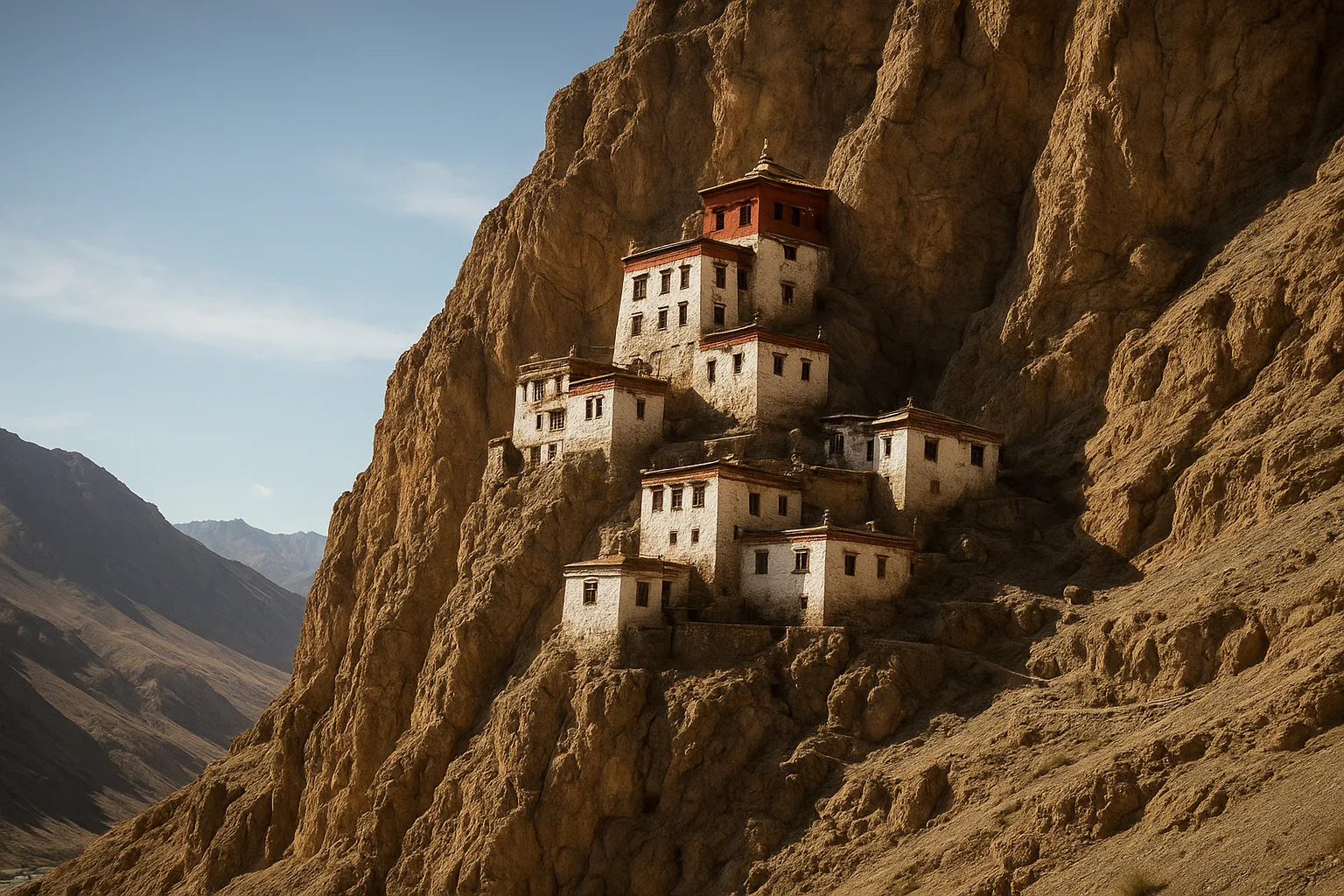
By the 11th and 12th centuries, the landscape of Spiti was studded with monastic citadels. Tabo, with its frescoed halls and scholarly monks, became renowned as the “Ajanta of the Himalayas.” Dhankar, perched precariously above the Spiti River, served as both fortress and spiritual hub. Later, Key Monastery would rise as the valley’s preeminent center of the Gelugpa (Yellow Hat) order, a lineage that would dominate Spiti’s religious culture from the 15th century onward.
These monasteries were more than places of worship. They were schools, courts, granaries, and safe havens in times of war. Their lamas mediated disputes, collected taxes, and maintained lines of communication with both Lhasa and the Indian plains. The political history of Spiti, as chronicled in gazetteers and British survey reports, shows how the lamas’ authority often rivaled or exceeded that of secular rulers.
Continuity and Change: Buddhism in Everyday Life
Over generations, Buddhism seeped into every aspect of Spiti’s culture. Chortens (stupas) dotted the ridges; prayer flags fluttered against the sky. Children learned their first letters from monk-teachers; villagers spun prayer wheels as they tended their fields. The calendar filled with sacred festivals—Chakhar at Tabo, Gustor at Key—each a reminder of the valley’s enduring spiritual heritage.
Yet, as the series has traced, these changes did not erase the past. Elements of Bon, ancient clan customs, and local lore persisted beneath Buddhist forms. The result was not a static devotion, but a living, adaptive faith—one that anchors Spiti’s identity today, even as it continues to evolve.
Echoes Across Centuries
In the crisp mountain dawn, the chant of monks at Tabo rises above the valley, mingling with the wind that has carried so many voices through the ages. The arrival and spread of Tibetan Buddhism in Spiti was neither simple nor sudden. It was a process—layered, complex, and ongoing—shaped by traders and kings, by monks and villagers, by memory and landscape alike.
These ancient roots still nourish Spiti’s people. Their monasteries are not relics, but living centers of faith and learning. The rituals enacted each season are more than tradition; they are a testament to centuries of adaptation and resilience. As we continue our journey through the cultural history of Lahaul and Spiti, the next chapter will turn to the flowering of monastic art and architecture—the visible legacy of this spiritual transformation.
Previous: Agriculture and Pastoralism in Medieval Lahaul–Spiti
Next: Key Monasteries of Lahaul and Spiti Explained