
Series: History of Mandi, Himachal Pradesh, India
Phase 3: Temples, Faith & Culture — Part 11 of 30
This article belongs to a historical series examining how expanding empires and regional powers reshaped life in the western Himalayan hills. As external influences pressed into the mountains, local rulers navigated diplomacy, resistance, and accommodation. This phase explores how wider political currents intersected with entrenched hill traditions, altering governance without entirely displacing older structures.
Stone Steps at Dawn: The Heartbeat of Mandi
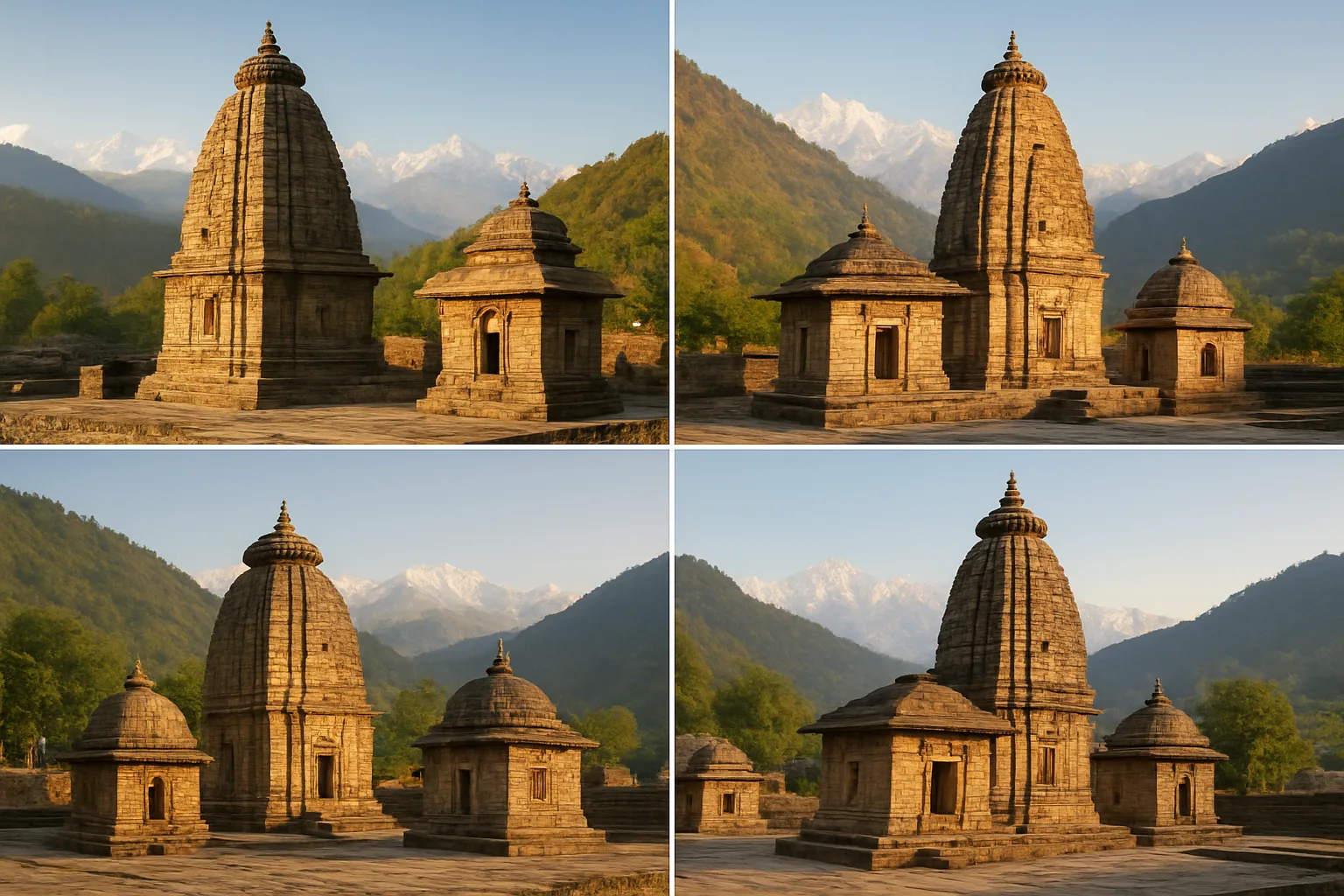
On a misty morning along the banks of the Beas River, the bells of Mandi’s old temples ring out. Pilgrims move between shrines, their footsteps echoing on stone worn smooth by centuries. Here, in the shadow of ancient spires, the lines between myth and memory blur. The town’s nickname—Varanasi of the Hills—is not lightly earned, and nowhere is this more evident than in the famed 81 temples that lend Mandi its sacred rhythm.
Hill Kingdoms and Himalayan Crossroads
Long before temple bells marked this valley, these hills were a patchwork of tribal domains—home to pastoralists, traders, and early agrarian communities. Archaeological traces and early regional chronicles suggest that by the first millennium CE, this section of the mid-Himalaya was both a sanctuary and a thoroughfare. Old trade routes, winding from Ladakh and Tibet down to the Punjab plains, crossed near the present-day site of Mandi, drawing to these crossroads a mosaic of communities and faiths.
The earliest political formations in the area were loosely organized hill states—each ruled by a local chieftain or thakur. By the late medieval period, these had consolidated into principalities such as Suket and Mandi. The chronicles of the region, including the revered Gazetteer of the Kangra District, record that it was during the 16th and 17th centuries that Mandi, under the stewardship of its Rajput rulers, began to acquire its distinctive temple-studded landscape.
Oral Traditions and the Founding of Sacred Sites
Oral lore in Mandi runs deep, weaving together strands of faith and local legend. Many of the town’s oldest temples—such as the Bhootnath and Triloknath shrines—are said to have been founded by the city’s legendary ruler, Raja Ajbar Sen, in the early 16th century. Folk memory tells that Ajbar Sen, after receiving a divine vision, chose this spot by the Beas to lay the foundation of his new capital and its first great temple.
Other temples, like the Panchvaktra Mahadev, are linked to stories older still—tales of sages and hermits who settled on these riverbanks in search of spiritual power. According to local recitation, the number ‘81’ symbolizes completeness, echoing both the ancient Hindu cosmology and the physical reality of the town’s crowded lanes, each sheltering a shrine.
Yet, while oral traditions shape much of Mandi’s devotional geography, historians caution that the actual number and identity of these temples has shifted over time, as floods, fires, and new constructions have altered the town’s contours.
Stone, Faith, and Royal Patronage
It was under the later Rajput rulers—especially during the reigns of Raja Suraj Sen and Raja Siddh Sen (17th–18th centuries)—that Mandi’s temple-building entered its golden age. The rulers, drawing on both political ambition and personal devotion, commissioned a flurry of new shrines. Many temples were constructed in the classic shikhara style, their spires rising above the clustered rooftops.
These rulers saw temple patronage as both an act of piety and a statement of sovereignty. Inscriptions on temple walls record donations of land and grain, while royal chronicles speak of festivals and fairs designed to knit together a diverse population. The architecture itself reflects a blend of North Indian and indigenous Himalayan styles, with granite and sandstone carved into intricate mandapas and sanctums.
Notably, the temples were not just religious centers but also economic and social hubs. Pilgrims arriving for the annual Shivratri fair—a tradition that endures to this day—transformed Mandi into a bustling crossroads of merchants, musicians, and wandering sadhus.
Myth, Memory, and Living Ritual
Each temple in Mandi comes with its own tapestry of stories, some rooted in the epics, others in local memory. The Ardhanarishvara Temple, unique in its depiction of Shiva and Parvati as one, is said to reflect the syncretic faith of the region—where Tantric traditions, Vaishnavism, and Shaivism met and mingled. The Bhootnath Temple, center of the famed Shivratri festival, is reputed in local lore to be the site where Shiva himself wandered in disguise.
Yet, alongside myth, these temples have witnessed the slow churn of history. The Rajput courts of Mandi, like other Himalayan polities, faced Mughal encroachment, shifting alliances, and eventually British suzerainty by the 19th century. Through it all, the temples served as anchors of continuity, their daily rituals offering a sense of order in turbulent times.
Communities and the Fabric of Devotion
Mandi’s temples were never the preserve of royalty alone. Artisans, traders, and local clans each claimed shrines as their own, sponsoring rituals and festivals that reflected their own histories and aspirations. The town’s old bazaar grew up around these sacred sites, its economy and rhythms intertwined with the religious calendar.
Even today, the 81 temples are living spaces. Bells, chants, and the scent of incense mingle with the calls of market vendors. Generations of priests, many from traditional Brahmin lineages, have kept the old rituals alive, adapting them to the shifting tides of history and politics. The temples’ annual cycles—especially during the great Shivratri—remain moments when the entire community gathers, reaffirming a shared identity that transcends caste and clan.
Enduring Temples, Enduring Identity
To walk through Mandi’s temple-studded lanes is to move through centuries of faith, power, and resilience. The stones remember the hands that shaped them, the prayers whispered in times of joy and crisis alike. While the physical count of temples may have waxed and waned, their symbolic presence remains undiminished—a testament to a town that has continually remade itself, yet never forgotten its sacred roots.
In the next part of our journey through Mandi’s history, we’ll step inside these hallowed spaces to explore the art, iconography, and ritual practice that have made them the living heart of the region. The story of Mandi’s temples, like the river that runs through it, is far from over.
Previous: Fortifications and Military Strategy of the Mandi Kingdom
Next: Bhootnath Temple: The Spiritual Heart of Mandi