
Series: History of Kinnaur, Himachal Pradesh, India
Phase 2: Medieval Period — Part 7 of 30
This article forms part of a continuing series that follows the gradual emergence of organised power in the western Himalayas. As small communities gave way to clans, chieftainships, and hill states, patterns of rule, alliance, and conflict began to take shape. This phase examines how authority was negotiated through land, ritual, and warfare, laying the groundwork for regional kingdoms that would dominate the medieval landscape.
Twilight in the Mountains: Kinnaur Before the Kingdoms
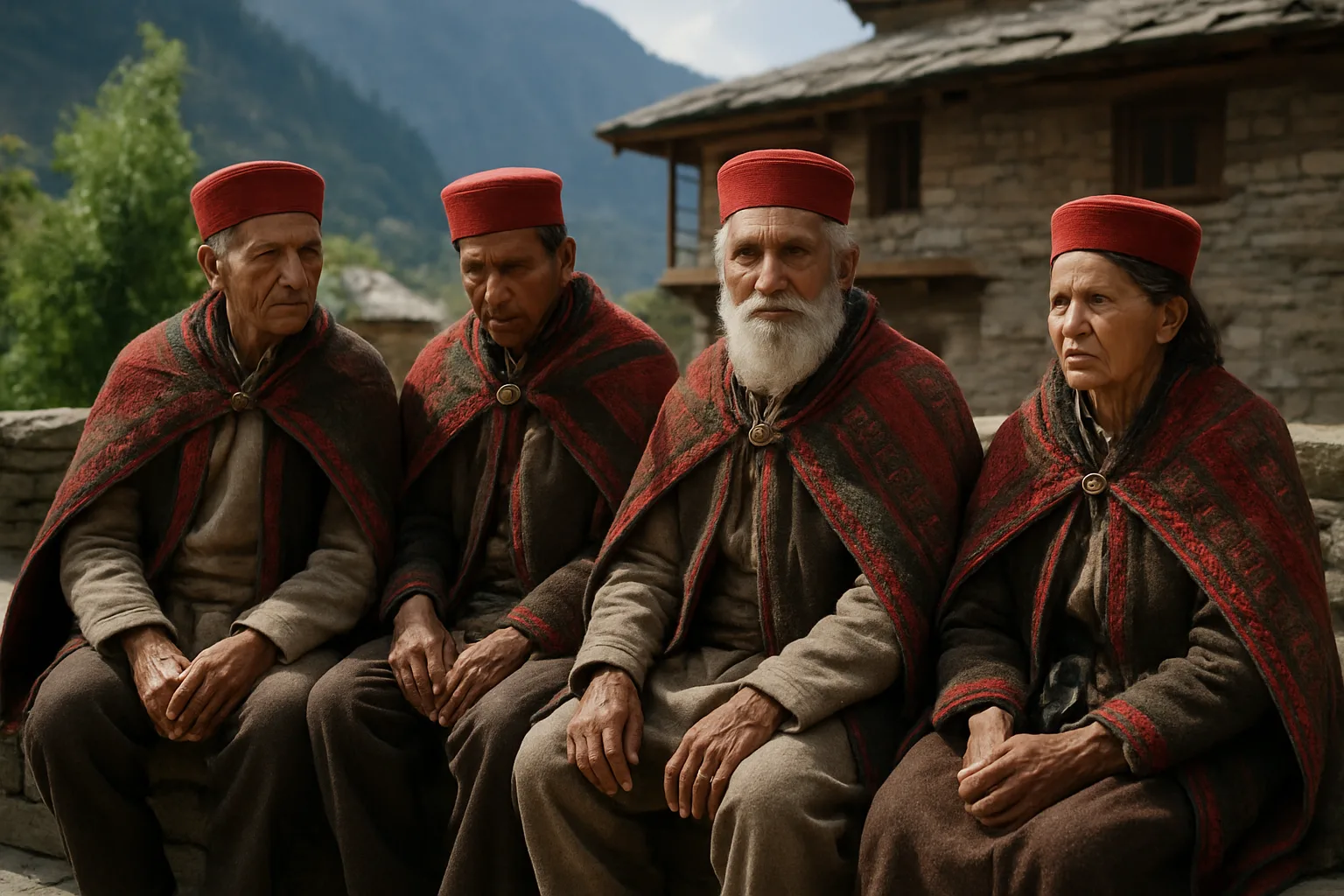
The sun dips behind jagged snow peaks as evening fires flicker to life across a cluster of stone-roofed hamlets. The highland air of Kinnaur, thick with the scent of pine and resin, carries the distant clang of a temple bell and the low murmur of elders in council. This is medieval Kinnaur—an era when the region’s rhythms were set not by distant kings but by the steady hands of local chieftains, whose authority shaped every path and ritual in these remote valleys.
While later chronicles and colonial-era gazetteers would name Kinnaur as a borderland between emerging kingdoms, in the early medieval centuries, it was a world apart. Its villages clung to the mountainsides above the Sutlej, Spiti, and Baspa rivers, watched over by chieftains whose power was as much spiritual as political. Here, the roots of Kinnauri identity took hold—an identity still palpable in the region’s living traditions.
Echoes from the Past: Kinnaur’s Historical Setting
To understand Kinnaur’s medieval governance, it is crucial to anchor the region in time and space. Nestled along the ancient trade arteries that connected the Indian plains with Tibet, Kinnaur’s valleys were both isolated and cosmopolitan. By the 6th century CE, the Gupta empire’s influence had faded from the hills, and new local powers began to assert themselves amid the shifting geopolitics of the western Himalaya.
Unlike the fertile plains, Kinnaur’s rugged terrain discouraged centralization. Power was granular, built from the ground up. Villages organized themselves around family lineages, customary law, and the authority of hereditary chieftains—known in later sources as ‘Wazirs’ or ‘Thakurs’. Oral traditions, still recited in Kinnauri dialects, recall legendary ancestors who tamed the land and established the first clan boundaries, blending myth with memory.
Between Legend and Record: Tracing the Chieftains
Much of early Kinnaur’s political history lies beyond the reach of written chronicles. Yet, the region’s oral literature—epic ballads, ritual chants, and local genealogies—offers a window onto the age of chieftains. These accounts tell of semi-divine ancestors contending with demons and rival clans, echoing the wider Himalayan mythology where kingship was always entwined with the sacred.
Historical inference, drawn from later records like the Kinnaur Gazetteer (1883) and the Gazetteer of the Bashahr State, suggests that by the 10th century, Kinnaur was divided among a patchwork of small principalities and chieftain-led villages. Each chieftain held sway over a few settlements, collecting tribute, settling disputes, and leading rituals to ensure the favor of local deities. Their power was fragile, dependent on kinship, consensus, and their ability to mediate with both the supernatural and the neighboring chiefs.
The Fabric of Village Life: Communities and Belief
Kinnaur’s medieval society was deeply communal. Most villages were self-sufficient, their inhabitants organized into extended families and occupational groups. The chieftain, while first among equals, relied on a council of elders (panchayat) drawn from the leading households. Together, they managed irrigation, divided pasture, and coordinated seasonal festivals.
Belief systems anchored this local governance. Kinnauris venerated an intricate pantheon: mountain gods, clan spirits, and wandering Buddhist monks. The region’s earliest Buddhist influences arrived via trade routes from Tibet, gradually blending with indigenous animist practices. Chieftains often doubled as temple patrons and ritual leaders, reinforcing their legitimacy through mastery of both material and spiritual domains.
Trade, Tribute, and the World Beyond
Despite its remoteness, medieval Kinnaur was never entirely cut off. Its villages lay astride the ‘Hindustan-Tibet Road’—a vital artery for salt, wool, and grain. Caravans from the Sutlej gorge to the Spiti plateau brought both wealth and ideas. Chieftains taxed trade, guarded passes, and sometimes negotiated with neighboring hill states like Bashahr and Spiti for autonomy or alliance.
Relations with the plains and with Tibet were pragmatic and shifting. At times, Kinnauri chieftains paid tribute to powerful neighbors, at others they exploited rivals’ distractions to assert independence. The rise of the Bashahr state in the south, documented in local chronicles, would eventually reshape these delicate balances, but for centuries, Kinnaur’s local chiefs remained the arbiters of daily life.
The Rise of Hill States and Shifting Power
By the late medieval period, the consolidation of regional hill states began to encroach upon Kinnaur’s tradition of local chieftaincy. Bashahr’s rulers, based in Rampur, extended their influence northward, incorporating southern Kinnaur and recognizing some local chieftains as subordinate landlords. Yet, even as external power grew, the realities of geography and tradition ensured that village councils and hereditary chiefs retained substantial autonomy in matters of land, law, and custom.
These centuries witnessed a dynamic interplay between local resilience and external ambition—a pattern familiar across the Himalayan arc. The oral traditions of Kinnaur preserve this era as a time of negotiation and adaptation, where village identity was forged in the tension between self-rule and the slow advance of larger polities.
Legacy in the Present
Today, echoes of Kinnaur’s medieval chieftains linger in the region’s festivals, rituals, and fiercely independent spirit. Village temples still serve as community centers, and councils of elders continue to arbitrate disputes in ways reminiscent of their medieval forebears. The landscape itself, marked by ancient paths and clan boundaries, bears witness to a time when local chieftains held sway over the rhythms of mountain life.
As this series continues, we move forward to the era of Bashahr’s ascendancy, tracing how the tides of state formation and external power would further shape Kinnaur’s unique social and political fabric.
Previous: Kinnaur Under the Influence of the Bushahr Kingdom
Next: Life in Remote Himalayan Villages During Medieval Times